The matrix class, also used for vectors and row-vectors. More...
#include <Matrix.h>
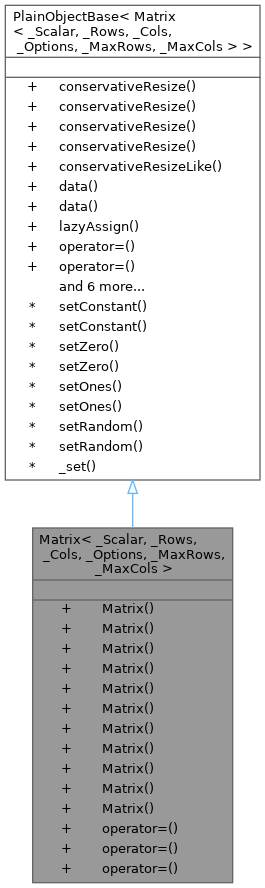
 Inheritance diagram for Matrix< _Scalar, _Rows, _Cols, _Options, _MaxRows, _MaxCols >:
Public Types | |
| typedef PlainObjectBase< Matrix > | Base |
| Base class typedef. | |
Public Member Functions | |
| const AdjointReturnType | adjoint () const |
| void | adjointInPlace () |
| bool | all (void) const |
| bool | any (void) const |
| void | applyHouseholderOnTheLeft (const EssentialPart &essential, const Scalar &tau, Scalar *workspace) |
| void | applyHouseholderOnTheRight (const EssentialPart &essential, const Scalar &tau, Scalar *workspace) |
| void | applyOnTheLeft (const EigenBase< OtherDerived > &other) |
| void | applyOnTheLeft (Index p, Index q, const JacobiRotation< OtherScalar > &j) |
| void | applyOnTheRight (const EigenBase< OtherDerived > &other) |
| void | applyOnTheRight (Index p, Index q, const JacobiRotation< OtherScalar > &j) |
| ArrayWrapper< Matrix< _Scalar, _Rows, _Cols, _Options, _MaxRows, _MaxCols > > | array () |
| const DiagonalWrapper< const Matrix< _Scalar, _Rows, _Cols, _Options, _MaxRows, _MaxCols > > | asDiagonal () const |
| const CwiseBinaryOp< CustomBinaryOp, const Matrix< _Scalar, _Rows, _Cols, _Options, _MaxRows, _MaxCols >, const OtherDerived > | binaryExpr (const Eigen::MatrixBase< OtherDerived > &other, const CustomBinaryOp &func=CustomBinaryOp()) const |
| Block< Matrix< _Scalar, _Rows, _Cols, _Options, _MaxRows, _MaxCols >, BlockRows, BlockCols > | block (Index startRow, Index startCol) |
| const Block< const Matrix< _Scalar, _Rows, _Cols, _Options, _MaxRows, _MaxCols >, BlockRows, BlockCols > | block (Index startRow, Index startCol) const |
| Block< Matrix< _Scalar, _Rows, _Cols, _Options, _MaxRows, _MaxCols > > | block (Index startRow, Index startCol, Index blockRows, Index blockCols) |
| const Block< const Matrix< _Scalar, _Rows, _Cols, _Options, _MaxRows, _MaxCols > > | block (Index startRow, Index startCol, Index blockRows, Index blockCols) const |
| RealScalar | blueNorm () const |
| Block< Matrix< _Scalar, _Rows, _Cols, _Options, _MaxRows, _MaxCols >, CRows, CCols > | bottomLeftCorner () |
| const Block< const Matrix< _Scalar, _Rows, _Cols, _Options, _MaxRows, _MaxCols >, CRows, CCols > | bottomLeftCorner () const |
| Block< Matrix< _Scalar, _Rows, _Cols, _Options, _MaxRows, _MaxCols > > | bottomLeftCorner (Index cRows, Index cCols) |
| const Block< const Matrix< _Scalar, _Rows, _Cols, _Options, _MaxRows, _MaxCols > > | bottomLeftCorner (Index cRows, Index cCols) const |
| Block< Matrix< _Scalar, _Rows, _Cols, _Options, _MaxRows, _MaxCols >, CRows, CCols > | bottomRightCorner () |
| const Block< const Matrix< _Scalar, _Rows, _Cols, _Options, _MaxRows, _MaxCols >, CRows, CCols > | bottomRightCorner () const |
| Block< Matrix< _Scalar, _Rows, _Cols, _Options, _MaxRows, _MaxCols > > | bottomRightCorner (Index cRows, Index cCols) |
| const Block< const Matrix< _Scalar, _Rows, _Cols, _Options, _MaxRows, _MaxCols > > | bottomRightCorner (Index cRows, Index cCols) const |
| NRowsBlockXpr< N >::Type | bottomRows () |
| ConstNRowsBlockXpr< N >::Type | bottomRows () const |
| RowsBlockXpr | bottomRows (Index n) |
| ConstRowsBlockXpr | bottomRows (Index n) const |
| internal::cast_return_type< Matrix< _Scalar, _Rows, _Cols, _Options, _MaxRows, _MaxCols >, constCwiseUnaryOp< internal::scalar_cast_op< typenameinternal::traits< Matrix< _Scalar, _Rows, _Cols, _Options, _MaxRows, _MaxCols > >::Scalar, NewType >, constDerived > >::type | cast () const |
| ColXpr | col (Index i) |
| ConstColXpr | col (Index i) const |
| const ColPivHouseholderQR< PlainObject > | colPivHouseholderQr () const |
| ColwiseReturnType | colwise () |
| ConstColwiseReturnType | colwise () const |
| void | computeInverseAndDetWithCheck (ResultType &inverse, typename ResultType::Scalar &determinant, bool &invertible, const RealScalar &absDeterminantThreshold=NumTraits< Scalar >::dummy_precision()) const |
| void | computeInverseWithCheck (ResultType &inverse, bool &invertible, const RealScalar &absDeterminantThreshold=NumTraits< Scalar >::dummy_precision()) const |
| ConjugateReturnType | conjugate () const |
| void | conservativeResize (Index rows, Index cols) |
| void | conservativeResize (Index rows, NoChange_t) |
| void | conservativeResize (Index size) |
| void | conservativeResize (NoChange_t, Index cols) |
| void | conservativeResizeLike (const DenseBase< OtherDerived > &other) |
| Index | count () const |
| MatrixBase< Matrix< _Scalar, _Rows, _Cols, _Options, _MaxRows, _MaxCols > >::template cross_product_return_type< OtherDerived >::type | cross (const MatrixBase< OtherDerived > &other) const |
| MatrixBase< Matrix< _Scalar, _Rows, _Cols, _Options, _MaxRows, _MaxCols > >::template cross_product_return_type< OtherDerived >::type | cross (const MatrixBase< OtherDerived > &other) const |
| PlainObject | cross3 (const MatrixBase< OtherDerived > &other) const |
| const CwiseUnaryOp< internal::scalar_abs_op< Scalar >, const Matrix< _Scalar, _Rows, _Cols, _Options, _MaxRows, _MaxCols > > | cwiseAbs () const |
| const CwiseUnaryOp< internal::scalar_abs2_op< Scalar >, const Matrix< _Scalar, _Rows, _Cols, _Options, _MaxRows, _MaxCols > > | cwiseAbs2 () const |
| const CwiseUnaryOp< std::binder1st< std::equal_to< Scalar > >, const Matrix< _Scalar, _Rows, _Cols, _Options, _MaxRows, _MaxCols > > | cwiseEqual (const Scalar &s) const |
| const CwiseUnaryOp< internal::scalar_inverse_op< Scalar >, const Matrix< _Scalar, _Rows, _Cols, _Options, _MaxRows, _MaxCols > > | cwiseInverse () const |
| const CwiseUnaryOp< internal::scalar_sqrt_op< Scalar >, const Matrix< _Scalar, _Rows, _Cols, _Options, _MaxRows, _MaxCols > > | cwiseSqrt () const |
| Scalar * | data () |
| const Scalar * | data () const |
| Scalar | determinant () const |
| MatrixBase< Matrix< _Scalar, _Rows, _Cols, _Options, _MaxRows, _MaxCols > >::template DiagonalIndexReturnType< Index >::Type | diagonal () |
| MatrixBase< Matrix< _Scalar, _Rows, _Cols, _Options, _MaxRows, _MaxCols > >::template DiagonalIndexReturnType< Index >::Type | diagonal () |
| DiagonalReturnType | diagonal () |
| MatrixBase< Matrix< _Scalar, _Rows, _Cols, _Options, _MaxRows, _MaxCols > >::template ConstDiagonalIndexReturnType< Index >::Type | diagonal () const |
| MatrixBase< Matrix< _Scalar, _Rows, _Cols, _Options, _MaxRows, _MaxCols > >::template ConstDiagonalIndexReturnType< Index >::Type | diagonal () const |
| const ConstDiagonalReturnType | diagonal () const |
| DiagonalIndexReturnType< Dynamic >::Type | diagonal (Index index) |
| ConstDiagonalIndexReturnType< Dynamic >::Type | diagonal (Index index) const |
| Index | diagonalSize () const |
| internal::scalar_product_traits< typenameinternal::traits< Matrix< _Scalar, _Rows, _Cols, _Options, _MaxRows, _MaxCols > >::Scalar, typenameinternal::traits< OtherDerived >::Scalar >::ReturnType | dot (const MatrixBase< OtherDerived > &other) const |
| EigenvaluesReturnType | eigenvalues () const |
| Computes the eigenvalues of a matrix. | |
| Matrix< Scalar, 3, 1 > | eulerAngles (Index a0, Index a1, Index a2) const |
| EvalReturnType | eval () const |
| void | fill (const Scalar &value) |
| const Flagged< Matrix< _Scalar, _Rows, _Cols, _Options, _MaxRows, _MaxCols >, Added, Removed > | flagged () const |
| ForceAlignedAccess< Matrix< _Scalar, _Rows, _Cols, _Options, _MaxRows, _MaxCols > > | forceAlignedAccess () |
| const ForceAlignedAccess< Matrix< _Scalar, _Rows, _Cols, _Options, _MaxRows, _MaxCols > > | forceAlignedAccess () const |
| internal::conditional< Enable, ForceAlignedAccess< Matrix< _Scalar, _Rows, _Cols, _Options, _MaxRows, _MaxCols > >, Matrix< _Scalar, _Rows, _Cols, _Options, _MaxRows, _MaxCols > & >::type | forceAlignedAccessIf () |
| internal::add_const_on_value_type< typenameinternal::conditional< Enable, ForceAlignedAccess< Matrix< _Scalar, _Rows, _Cols, _Options, _MaxRows, _MaxCols > >, Matrix< _Scalar, _Rows, _Cols, _Options, _MaxRows, _MaxCols > & >::type >::type | forceAlignedAccessIf () const |
| const WithFormat< Matrix< _Scalar, _Rows, _Cols, _Options, _MaxRows, _MaxCols > > | format (const IOFormat &fmt) const |
| const FullPivHouseholderQR< PlainObject > | fullPivHouseholderQr () const |
| const FullPivLU< PlainObject > | fullPivLu () const |
| DenseBase< Matrix< _Scalar, _Rows, _Cols, _Options, _MaxRows, _MaxCols > >::template FixedSegmentReturnType< Size >::Type | head () |
| DenseBase< Matrix< _Scalar, _Rows, _Cols, _Options, _MaxRows, _MaxCols > >::template ConstFixedSegmentReturnType< Size >::Type | head () const |
| SegmentReturnType | head (Index size) |
| DenseBase::ConstSegmentReturnType | head (Index size) const |
| const HNormalizedReturnType | hnormalized () const |
| HomogeneousReturnType | homogeneous () const |
| const HouseholderQR< PlainObject > | householderQr () const |
| RealScalar | hypotNorm () const |
| NonConstImagReturnType | imag () |
| const ImagReturnType | imag () const |
| Index | innerSize () const |
| const internal::inverse_impl< Matrix< _Scalar, _Rows, _Cols, _Options, _MaxRows, _MaxCols > > | inverse () const |
| bool | isApprox (const DenseBase< OtherDerived > &other, RealScalar prec=NumTraits< Scalar >::dummy_precision()) const |
| bool | isApproxToConstant (const Scalar &value, RealScalar prec=NumTraits< Scalar >::dummy_precision()) const |
| bool | isConstant (const Scalar &value, RealScalar prec=NumTraits< Scalar >::dummy_precision()) const |
| bool | isDiagonal (RealScalar prec=NumTraits< Scalar >::dummy_precision()) const |
| bool | isIdentity (RealScalar prec=NumTraits< Scalar >::dummy_precision()) const |
| bool | isLowerTriangular (RealScalar prec=NumTraits< Scalar >::dummy_precision()) const |
| bool | isMuchSmallerThan (const DenseBase< OtherDerived > &other, RealScalar prec=NumTraits< Scalar >::dummy_precision()) const |
| bool | isMuchSmallerThan (const typename NumTraits< Scalar >::Real &other, RealScalar prec) const |
| bool | isOnes (RealScalar prec=NumTraits< Scalar >::dummy_precision()) const |
| bool | isOrthogonal (const MatrixBase< OtherDerived > &other, RealScalar prec=NumTraits< Scalar >::dummy_precision()) const |
| bool | isUnitary (RealScalar prec=NumTraits< Scalar >::dummy_precision()) const |
| bool | isUpperTriangular (RealScalar prec=NumTraits< Scalar >::dummy_precision()) const |
| bool | isZero (RealScalar prec=NumTraits< Scalar >::dummy_precision()) const |
| JacobiSVD< PlainObject > | jacobiSvd (unsigned int computationOptions=0) const |
| Matrix< _Scalar, _Rows, _Cols, _Options, _MaxRows, _MaxCols > & | lazyAssign (const DenseBase< OtherDerived > &other) |
| const LazyProductReturnType< Matrix< _Scalar, _Rows, _Cols, _Options, _MaxRows, _MaxCols >, OtherDerived >::Type | lazyProduct (const MatrixBase< OtherDerived > &other) const |
| const LDLT< PlainObject > | ldlt () const |
| NColsBlockXpr< N >::Type | leftCols () |
| ConstNColsBlockXpr< N >::Type | leftCols () const |
| ColsBlockXpr | leftCols (Index n) |
| ConstColsBlockXpr | leftCols (Index n) const |
| const LLT< PlainObject > | llt () const |
| NumTraits< typenameinternal::traits< Matrix< _Scalar, _Rows, _Cols, _Options, _MaxRows, _MaxCols > >::Scalar >::Real | lpNorm () const |
| NumTraits< typenameinternal::traits< Matrix< _Scalar, _Rows, _Cols, _Options, _MaxRows, _MaxCols > >::Scalar >::Real | lpNorm () const |
| const PartialPivLU< PlainObject > | lu () const |
| void | makeHouseholder (EssentialPart &essential, Scalar &tau, RealScalar &beta) const |
| void | makeHouseholderInPlace (Scalar &tau, RealScalar &beta) |
| Matrix () | |
| Default constructor. | |
| template<typename OtherDerived> | |
| Matrix (const EigenBase< OtherDerived > &other) | |
| Copy constructor for generic expressions. | |
| Matrix (const Matrix &other) | |
| Copy constructor. | |
| template<typename OtherDerived> | |
| Matrix (const MatrixBase< OtherDerived > &other) | |
| Constructor copying the value of the expression other. | |
| template<typename OtherDerived> | |
| Matrix (const ReturnByValue< OtherDerived > &other) | |
| Copy constructor with in-place evaluation. | |
| template<typename OtherDerived> | |
| Matrix (const RotationBase< OtherDerived, ColsAtCompileTime > &r) | |
| Constructs a Dim x Dim rotation matrix from the rotation r. | |
| Matrix (const Scalar &x, const Scalar &y) | |
| Constructs an initialized 2D vector with given coefficients. | |
| Matrix (const Scalar &x, const Scalar &y, const Scalar &z) | |
| Constructs an initialized 3D vector with given coefficients. | |
| Matrix (const Scalar &x, const Scalar &y, const Scalar &z, const Scalar &w) | |
| Constructs an initialized 4D vector with given coefficients. | |
| Matrix (Index dim) | |
| Constructs a vector or row-vector with given dimension. This is only for vectors (either row-vectors or column-vectors), i.e. matrices which are known at compile-time to have either one row or one column. | |
| Matrix (Index rows, Index cols) | |
| Constructs an uninitialized matrix with rows rows and cols columns. | |
| internal::traits< Matrix< _Scalar, _Rows, _Cols, _Options, _MaxRows, _MaxCols > >::Scalar | maxCoeff () const |
| internal::traits< Matrix< _Scalar, _Rows, _Cols, _Options, _MaxRows, _MaxCols > >::Scalar | maxCoeff (IndexType *index) const |
| internal::traits< Matrix< _Scalar, _Rows, _Cols, _Options, _MaxRows, _MaxCols > >::Scalar | maxCoeff (IndexType *row, IndexType *col) const |
| Scalar | mean () const |
| NColsBlockXpr< N >::Type | middleCols (Index startCol) |
| ConstNColsBlockXpr< N >::Type | middleCols (Index startCol) const |
| ColsBlockXpr | middleCols (Index startCol, Index numCols) |
| ConstColsBlockXpr | middleCols (Index startCol, Index numCols) const |
| NRowsBlockXpr< N >::Type | middleRows (Index startRow) |
| ConstNRowsBlockXpr< N >::Type | middleRows (Index startRow) const |
| RowsBlockXpr | middleRows (Index startRow, Index numRows) |
| ConstRowsBlockXpr | middleRows (Index startRow, Index numRows) const |
| internal::traits< Matrix< _Scalar, _Rows, _Cols, _Options, _MaxRows, _MaxCols > >::Scalar | minCoeff () const |
| internal::traits< Matrix< _Scalar, _Rows, _Cols, _Options, _MaxRows, _MaxCols > >::Scalar | minCoeff (IndexType *index) const |
| internal::traits< Matrix< _Scalar, _Rows, _Cols, _Options, _MaxRows, _MaxCols > >::Scalar | minCoeff (IndexType *row, IndexType *col) const |
| const NestByValue< Matrix< _Scalar, _Rows, _Cols, _Options, _MaxRows, _MaxCols > > | nestByValue () const |
| NoAlias< Matrix< _Scalar, _Rows, _Cols, _Options, _MaxRows, _MaxCols >, Eigen::MatrixBase > | noalias () |
| Index | nonZeros () const |
| RealScalar | norm () const |
| void | normalize () |
| const PlainObject | normalized () const |
| bool | operator!= (const MatrixBase< OtherDerived > &other) const |
| const DiagonalProduct< Matrix< _Scalar, _Rows, _Cols, _Options, _MaxRows, _MaxCols >, DiagonalDerived, OnTheRight > | operator* (const DiagonalBase< DiagonalDerived > &diagonal) const |
| const ProductReturnType< Matrix< _Scalar, _Rows, _Cols, _Options, _MaxRows, _MaxCols >, OtherDerived >::Type | operator* (const MatrixBase< OtherDerived > &other) const |
| const ScalarMultipleReturnType | operator* (const Scalar &scalar) const |
| const CwiseUnaryOp< internal::scalar_multiple2_op< Scalar, std::complex< Scalar > >, const Matrix< _Scalar, _Rows, _Cols, _Options, _MaxRows, _MaxCols > > | operator* (const std::complex< Scalar > &scalar) const |
| ScalarMultipleReturnType | operator* (const UniformScaling< Scalar > &s) const |
| Matrix< _Scalar, _Rows, _Cols, _Options, _MaxRows, _MaxCols > & | operator*= (const EigenBase< OtherDerived > &other) |
| Matrix< _Scalar, _Rows, _Cols, _Options, _MaxRows, _MaxCols > & | operator+= (const MatrixBase< OtherDerived > &other) |
| const CwiseUnaryOp< internal::scalar_opposite_op< typename internal::traits< Matrix< _Scalar, _Rows, _Cols, _Options, _MaxRows, _MaxCols > >::Scalar >, const Matrix< _Scalar, _Rows, _Cols, _Options, _MaxRows, _MaxCols > > | operator- () const |
| Matrix< _Scalar, _Rows, _Cols, _Options, _MaxRows, _MaxCols > & | operator-= (const MatrixBase< OtherDerived > &other) |
| const CwiseUnaryOp< internal::scalar_quotient1_op< typename internal::traits< Matrix< _Scalar, _Rows, _Cols, _Options, _MaxRows, _MaxCols > >::Scalar >, const Matrix< _Scalar, _Rows, _Cols, _Options, _MaxRows, _MaxCols > > | operator/ (const Scalar &scalar) const |
| CommaInitializer< Matrix< _Scalar, _Rows, _Cols, _Options, _MaxRows, _MaxCols > > | operator<< (const DenseBase< OtherDerived > &other) |
| CommaInitializer< Matrix< _Scalar, _Rows, _Cols, _Options, _MaxRows, _MaxCols > > | operator<< (const Scalar &s) |
| template<typename OtherDerived> | |
| Matrix & | operator= (const EigenBase< OtherDerived > &other) |
| Copies the generic expression other into *this. | |
| Matrix & | operator= (const Matrix &other) |
| Assigns matrices to each other. | |
| template<typename OtherDerived> | |
| Matrix< _Scalar, _Rows, _Cols, _Storage, _MaxRows, _MaxCols > & | operator= (const RotationBase< OtherDerived, ColsAtCompileTime > &r) |
| Set a Dim x Dim rotation matrix from the rotation r. | |
| bool | operator== (const MatrixBase< OtherDerived > &other) const |
| RealScalar | operatorNorm () const |
| Computes the L2 operator norm. | |
| Index | outerSize () const |
| const PartialPivLU< PlainObject > | partialPivLu () const |
| Scalar | prod () const |
| NonConstRealReturnType | real () |
| RealReturnType | real () const |
| internal::result_of< Func(typenameinternal::traits< Matrix< _Scalar, _Rows, _Cols, _Options, _MaxRows, _MaxCols > >::Scalar)>::type | redux (const Func &func) const |
| const Replicate< Matrix< _Scalar, _Rows, _Cols, _Options, _MaxRows, _MaxCols >, RowFactor, ColFactor > | replicate () const |
| const Replicate< Matrix< _Scalar, _Rows, _Cols, _Options, _MaxRows, _MaxCols >, Dynamic, Dynamic > | replicate (Index rowFacor, Index colFactor) const |
| void | resize (Index rows, Index cols) |
| void | resize (Index rows, NoChange_t) |
| void | resize (Index size) |
| void | resize (NoChange_t, Index cols) |
| void | resizeLike (const EigenBase< OtherDerived > &_other) |
| ReverseReturnType | reverse () |
| ConstReverseReturnType | reverse () const |
| void | reverseInPlace () |
| NColsBlockXpr< N >::Type | rightCols () |
| ConstNColsBlockXpr< N >::Type | rightCols () const |
| ColsBlockXpr | rightCols (Index n) |
| ConstColsBlockXpr | rightCols (Index n) const |
| RowXpr | row (Index i) |
| ConstRowXpr | row (Index i) const |
| RowwiseReturnType | rowwise () |
| ConstRowwiseReturnType | rowwise () const |
| DenseBase< Matrix< _Scalar, _Rows, _Cols, _Options, _MaxRows, _MaxCols > >::template FixedSegmentReturnType< Size >::Type | segment (Index start) |
| DenseBase< Matrix< _Scalar, _Rows, _Cols, _Options, _MaxRows, _MaxCols > >::template ConstFixedSegmentReturnType< Size >::Type | segment (Index start) const |
| SegmentReturnType | segment (Index start, Index size) |
| DenseBase::ConstSegmentReturnType | segment (Index start, Index size) const |
| const Select< Matrix< _Scalar, _Rows, _Cols, _Options, _MaxRows, _MaxCols >, ThenDerived, ElseDerived > | select (const DenseBase< ThenDerived > &thenMatrix, const DenseBase< ElseDerived > &elseMatrix) const |
| const Select< Matrix< _Scalar, _Rows, _Cols, _Options, _MaxRows, _MaxCols >, ThenDerived, typename ThenDerived::ConstantReturnType > | select (const DenseBase< ThenDerived > &thenMatrix, typename ThenDerived::Scalar elseScalar) const |
| const Select< Matrix< _Scalar, _Rows, _Cols, _Options, _MaxRows, _MaxCols >, typename ElseDerived::ConstantReturnType, ElseDerived > | select (typename ElseDerived::Scalar thenScalar, const DenseBase< ElseDerived > &elseMatrix) const |
| Matrix< _Scalar, _Rows, _Cols, _Options, _MaxRows, _MaxCols > & | setConstant (const Scalar &value) |
| Matrix< _Scalar, _Rows, _Cols, _Options, _MaxRows, _MaxCols > & | setIdentity () |
| Matrix< _Scalar, _Rows, _Cols, _Options, _MaxRows, _MaxCols > & | setIdentity (Index rows, Index cols) |
| Resizes to the given size, and writes the identity expression (not necessarily square) into *this. | |
| Matrix< _Scalar, _Rows, _Cols, _Options, _MaxRows, _MaxCols > & | setLinSpaced (const Scalar &low, const Scalar &high) |
| Sets a linearly space vector. | |
| Matrix< _Scalar, _Rows, _Cols, _Options, _MaxRows, _MaxCols > & | setLinSpaced (Index size, const Scalar &low, const Scalar &high) |
| Sets a linearly space vector. | |
| Matrix< _Scalar, _Rows, _Cols, _Options, _MaxRows, _MaxCols > & | setOnes () |
| Matrix< _Scalar, _Rows, _Cols, _Options, _MaxRows, _MaxCols > & | setRandom () |
| Matrix< _Scalar, _Rows, _Cols, _Options, _MaxRows, _MaxCols > & | setZero () |
| RealScalar | squaredNorm () const |
| RealScalar | stableNorm () const |
| Scalar | sum () const |
| void | swap (const DenseBase< OtherDerived > &other, int=OtherDerived::ThisConstantIsPrivateInPlainObjectBase) |
| void | swap (PlainObjectBase< OtherDerived > &other) |
| DenseBase< Matrix< _Scalar, _Rows, _Cols, _Options, _MaxRows, _MaxCols > >::template FixedSegmentReturnType< Size >::Type | tail () |
| DenseBase< Matrix< _Scalar, _Rows, _Cols, _Options, _MaxRows, _MaxCols > >::template ConstFixedSegmentReturnType< Size >::Type | tail () const |
| SegmentReturnType | tail (Index size) |
| DenseBase::ConstSegmentReturnType | tail (Index size) const |
| Block< Matrix< _Scalar, _Rows, _Cols, _Options, _MaxRows, _MaxCols >, CRows, CCols > | topLeftCorner () |
| const Block< const Matrix< _Scalar, _Rows, _Cols, _Options, _MaxRows, _MaxCols >, CRows, CCols > | topLeftCorner () const |
| Block< Matrix< _Scalar, _Rows, _Cols, _Options, _MaxRows, _MaxCols > > | topLeftCorner (Index cRows, Index cCols) |
| const Block< const Matrix< _Scalar, _Rows, _Cols, _Options, _MaxRows, _MaxCols > > | topLeftCorner (Index cRows, Index cCols) const |
| Block< Matrix< _Scalar, _Rows, _Cols, _Options, _MaxRows, _MaxCols >, CRows, CCols > | topRightCorner () |
| const Block< const Matrix< _Scalar, _Rows, _Cols, _Options, _MaxRows, _MaxCols >, CRows, CCols > | topRightCorner () const |
| Block< Matrix< _Scalar, _Rows, _Cols, _Options, _MaxRows, _MaxCols > > | topRightCorner (Index cRows, Index cCols) |
| const Block< const Matrix< _Scalar, _Rows, _Cols, _Options, _MaxRows, _MaxCols > > | topRightCorner (Index cRows, Index cCols) const |
| NRowsBlockXpr< N >::Type | topRows () |
| ConstNRowsBlockXpr< N >::Type | topRows () const |
| RowsBlockXpr | topRows (Index n) |
| ConstRowsBlockXpr | topRows (Index n) const |
| Scalar | trace () const |
| Eigen::Transpose< Matrix< _Scalar, _Rows, _Cols, _Options, _MaxRows, _MaxCols > > | transpose () |
| ConstTransposeReturnType | transpose () const |
| void | transposeInPlace () |
| MatrixBase< Matrix< _Scalar, _Rows, _Cols, _Options, _MaxRows, _MaxCols > >::template TriangularViewReturnType< Mode >::Type | triangularView () |
| MatrixBase< Matrix< _Scalar, _Rows, _Cols, _Options, _MaxRows, _MaxCols > >::template TriangularViewReturnType< Mode >::Type | triangularView () |
| MatrixBase< Matrix< _Scalar, _Rows, _Cols, _Options, _MaxRows, _MaxCols > >::template ConstTriangularViewReturnType< Mode >::Type | triangularView () const |
| MatrixBase< Matrix< _Scalar, _Rows, _Cols, _Options, _MaxRows, _MaxCols > >::template ConstTriangularViewReturnType< Mode >::Type | triangularView () const |
| const CwiseUnaryOp< CustomUnaryOp, const Matrix< _Scalar, _Rows, _Cols, _Options, _MaxRows, _MaxCols > > | unaryExpr (const CustomUnaryOp &func=CustomUnaryOp()) const |
| Apply a unary operator coefficient-wise. | |
| const CwiseUnaryView< CustomViewOp, const Matrix< _Scalar, _Rows, _Cols, _Options, _MaxRows, _MaxCols > > | unaryViewExpr (const CustomViewOp &func=CustomViewOp()) const |
| PlainObject | unitOrthogonal (void) const |
| CoeffReturnType | value () const |
| void | visit (Visitor &func) const |
Static Public Member Functions | |
| static const ConstantReturnType | Constant (const Scalar &value) |
| static const ConstantReturnType | Constant (Index rows, Index cols, const Scalar &value) |
| static const ConstantReturnType | Constant (Index size, const Scalar &value) |
| static const IdentityReturnType | Identity () |
| static const IdentityReturnType | Identity (Index rows, Index cols) |
| static const RandomAccessLinSpacedReturnType | LinSpaced (const Scalar &low, const Scalar &high) |
| static const RandomAccessLinSpacedReturnType | LinSpaced (Index size, const Scalar &low, const Scalar &high) |
| Sets a linearly space vector. | |
| static const SequentialLinSpacedReturnType | LinSpaced (Sequential_t, const Scalar &low, const Scalar &high) |
| static const SequentialLinSpacedReturnType | LinSpaced (Sequential_t, Index size, const Scalar &low, const Scalar &high) |
| Sets a linearly space vector. | |
| static const CwiseNullaryOp< CustomNullaryOp, Matrix< _Scalar, _Rows, _Cols, _Options, _MaxRows, _MaxCols > > | NullaryExpr (const CustomNullaryOp &func) |
| static const CwiseNullaryOp< CustomNullaryOp, Matrix< _Scalar, _Rows, _Cols, _Options, _MaxRows, _MaxCols > > | NullaryExpr (Index rows, Index cols, const CustomNullaryOp &func) |
| static const CwiseNullaryOp< CustomNullaryOp, Matrix< _Scalar, _Rows, _Cols, _Options, _MaxRows, _MaxCols > > | NullaryExpr (Index size, const CustomNullaryOp &func) |
| static const ConstantReturnType | Ones () |
| static const ConstantReturnType | Ones (Index rows, Index cols) |
| static const ConstantReturnType | Ones (Index size) |
| static const CwiseNullaryOp< internal::scalar_random_op< Scalar >, Matrix< _Scalar, _Rows, _Cols, _Options, _MaxRows, _MaxCols > > | Random () |
| static const CwiseNullaryOp< internal::scalar_random_op< Scalar >, Matrix< _Scalar, _Rows, _Cols, _Options, _MaxRows, _MaxCols > > | Random (Index rows, Index cols) |
| static const CwiseNullaryOp< internal::scalar_random_op< Scalar >, Matrix< _Scalar, _Rows, _Cols, _Options, _MaxRows, _MaxCols > > | Random (Index size) |
| static const BasisReturnType | Unit (Index i) |
| static const BasisReturnType | Unit (Index size, Index i) |
| static const BasisReturnType | UnitW () |
| static const BasisReturnType | UnitX () |
| static const BasisReturnType | UnitY () |
| static const BasisReturnType | UnitZ () |
| static const ConstantReturnType | Zero () |
| static const ConstantReturnType | Zero (Index rows, Index cols) |
| static const ConstantReturnType | Zero (Index size) |
Related Symbols | |
(Note that these are not member symbols.) | |
| std::ostream & | operator<< (std::ostream &s, const DenseBase< Matrix< _Scalar, _Rows, _Cols, _Options, _MaxRows, _MaxCols > > &m) |
Map | |
These are convenience functions returning Map objects. The Map() static functions return unaligned Map objects, while the AlignedMap() functions return aligned Map objects and thus should be called only with 16-byte-aligned data pointers.
| |
| Matrix< _Scalar, _Rows, _Cols, _Options, _MaxRows, _MaxCols > & | setConstant (Index size, const Scalar &value) |
| Matrix< _Scalar, _Rows, _Cols, _Options, _MaxRows, _MaxCols > & | setConstant (Index rows, Index cols, const Scalar &value) |
| Matrix< _Scalar, _Rows, _Cols, _Options, _MaxRows, _MaxCols > & | setZero (Index size) |
| Matrix< _Scalar, _Rows, _Cols, _Options, _MaxRows, _MaxCols > & | setZero (Index rows, Index cols) |
| Matrix< _Scalar, _Rows, _Cols, _Options, _MaxRows, _MaxCols > & | setOnes (Index size) |
| Matrix< _Scalar, _Rows, _Cols, _Options, _MaxRows, _MaxCols > & | setOnes (Index rows, Index cols) |
| Matrix< _Scalar, _Rows, _Cols, _Options, _MaxRows, _MaxCols > & | setRandom (Index size) |
| Matrix< _Scalar, _Rows, _Cols, _Options, _MaxRows, _MaxCols > & | setRandom (Index rows, Index cols) |
| Matrix< _Scalar, _Rows, _Cols, _Options, _MaxRows, _MaxCols > & | _set (const DenseBase< OtherDerived > &other) |
Copies the value of the expression other into *this with automatic resizing. | |
The matrix class, also used for vectors and row-vectors.
The Matrix class is the work-horse for all dense (note) matrices and vectors within Eigen. Vectors are matrices with one column, and row-vectors are matrices with one row.
The Matrix class encompasses both fixed-size and dynamic-size objects (note).
The first three template parameters are required:
| _Scalar |
anchor matrix_tparam_scalar Numeric type, e.g. float, double, int or std::complex<float>. User defined sclar types are supported as well (see here).
| _Rows | Number of rows, or Dynamic |
| _Cols | Number of columns, or Dynamic |
The remaining template parameters are optional – in most cases you don't have to worry about them.
| _Options |
anchor matrix_tparam_options A combination of either RowMajor or ColMajor, and of either AutoAlign or DontAlign. The former controls storage order, and defaults to column-major. The latter controls alignment, which is required for vectorization. It defaults to aligning matrices except for fixed sizes that aren't a multiple of the packet size.
| _MaxRows | Maximum number of rows. Defaults to _Rows (note). |
| _MaxCols | Maximum number of columns. Defaults to _Cols (note). |
Eigen provides a number of typedefs covering the usual cases. Here are some examples:
Matrix2d is a 2x2 square matrix of doubles (Matrix<double, 2, 2>) Vector4f is a vector of 4 floats (Matrix<float, 4, 1>) RowVector3i is a row-vector of 3 ints (Matrix<int, 1, 3>)MatrixXf is a dynamic-size matrix of floats (Matrix<float, Dynamic, Dynamic>) VectorXf is a dynamic-size vector of floats (Matrix<float, Dynamic, 1>)Matrix2Xf is a partially fixed-size (dynamic-size) matrix of floats (Matrix<float, 2, Dynamic>) MatrixX3d is a partially dynamic-size (fixed-size) matrix of double (Matrix<double, Dynamic, 3>)See this page for a complete list of predefined Matrix and Vector typedefs.
You can access elements of vectors and matrices using normal subscripting:
This class can be extended with the help of the plugin mechanism described on the page Customizing/Extending Eigen by defining the preprocessor symbol EIGEN_MATRIX_PLUGIN.
Some notes:
This Matrix class handles dense, not sparse matrices and vectors. For sparse matrices and vectors, see the Sparse module.
Dense matrices and vectors are plain usual arrays of coefficients. All the coefficients are stored, in an ordinary contiguous array. This is unlike Sparse matrices and vectors where the coefficients are stored as a list of nonzero coefficients.
Fixed-size means that the numbers of rows and columns are known are compile-time. In this case, Eigen allocates the array of coefficients as a fixed-size array, as a class member. This makes sense for very small matrices, typically up to 4x4, sometimes up to 16x16. Larger matrices should be declared as dynamic-size even if one happens to know their size at compile-time.
Dynamic-size means that the numbers of rows or columns are not necessarily known at compile-time. In this case they are runtime variables, and the array of coefficients is allocated dynamically on the heap.
Note that dense matrices, be they Fixed-size or Dynamic-size, do not expand dynamically in the sense of a std::map. If you want this behavior, see the Sparse module.
| typedef PlainObjectBase<Matrix> Base |
Base class typedef.
|
inlineexplicit |
Default constructor.
For fixed-size matrices, does nothing.
For dynamic-size matrices, creates an empty matrix of size 0. Does not allocate any array. Such a matrix is called a null matrix. This constructor is the unique way to create null matrices: resizing a matrix to 0 is not supported.
Referenced by Matrix().
|
inlineexplicit |
Constructs a vector or row-vector with given dimension. This is only for vectors (either row-vectors or column-vectors), i.e. matrices which are known at compile-time to have either one row or one column.
Note that this is only useful for dynamic-size vectors. For fixed-size vectors, it is redundant to pass the dimension here, so it makes more sense to use the default constructor Matrix() instead.
| Matrix | ( | Index | rows, |
| Index | cols ) |
Constructs an uninitialized matrix with rows rows and cols columns.
This is useful for dynamic-size matrices. For fixed-size matrices, it is redundant to pass these parameters, so one should use the default constructor Matrix() instead.
|
inline |
Copy constructor for generic expressions.
|
explicit |
Constructs a Dim x Dim rotation matrix from the rotation r.
This is defined in the Geometry module.
References Matrix(), and RotationBase< Derived, _Dim >::toRotationMatrix().
|
inlineprotectedinherited |
Copies the value of the expression other into *this with automatic resizing.
*this might be resized to match the dimensions of other. If *this was a null matrix (not already initialized), it will be initialized.
Note that copying a row-vector into a vector (and conversely) is allowed. The resizing, if any, is then done in the appropriate way so that row-vectors remain row-vectors and vectors remain vectors.
|
inlineinherited |
Example:
Output:
Here is the 2x2 complex matrix m:
 (0.68,-0.211) (0.823,-0.605)
 (0.566,0.597)  (-0.33,0.536)
Here is the adjoint of m:
  (0.68,0.211) (0.566,-0.597)
 (0.823,0.605) (-0.33,-0.536)
Referenced by Transform< _Scalar, _Dim, _Mode, _Options >::computeRotationScaling(), and Transform< _Scalar, _Dim, _Mode, _Options >::computeScalingRotation().
|
inlineinherited |
This is the "in place" version of adjoint(): it replaces *this by its own transpose. Thus, doing
has the same effect on m as doing
and is faster and also safer because in the latter line of code, forgetting the eval() results in a bug caused by aliasing.
Notice however that this method is only useful if you want to replace a matrix by its own adjoint. If you just need the adjoint of a matrix, use adjoint().
*this must be a resizable matrix.
|
inlineinherited |
Example:
Output:
Is (  0.68 -0.211  0.566) inside the box: 0
Is (0.597 0.823 0.605) inside the box: 1
|
inlineinherited |
|
inherited |
Apply the elementary reflector H given by 
![$ v^T = [1 essential^T] $](form_124_dark.png)
On input:
| essential | the essential part of the vector v |
| tau | the scaling factor of the Householder transformation |
| workspace | a pointer to working space with at least this->cols() * essential.size() entries |
|
inherited |
Apply the elementary reflector H given by
On input:
| essential | the essential part of the vector v |
| tau | the scaling factor of the Householder transformation |
| workspace | a pointer to working space with at least this->cols() * essential.size() entries |
|
inlineinherited |
replaces *this by *this * other.
|
inlineinherited |
This is defined in the Jacobi module.
Applies the rotation in the plane j to the rows p and q of *this, i.e., it computes B = J * B, with 
|
inlineinherited |
replaces *this by *this * other. It is equivalent to MatrixBase::operator*=()
|
inlineinherited |
Applies the rotation in the plane j to the columns p and q of *this, i.e., it computes B = B * J with 
|
inlineinherited |
|
inlineinherited |
This is only for vectors (either row-vectors or column-vectors), i.e. matrices which are known at compile-time to have either one row or one column.
Example:
Output:
2 0 0
0 5 0
0 0 6
Referenced by Transform< _Scalar, _Dim, _Mode, _Options >::computeRotationScaling(), Transform< _Scalar, _Dim, _Mode, _Options >::computeScalingRotation(), and Eigen::umeyama().
|
inlineinherited |
*this and other *this and other The template parameter CustomBinaryOp is the type of the functor of the custom operator (see class CwiseBinaryOp for an example)
Here is an example illustrating the use of custom functors:
Output:
   (0.68,0.271)  (0.823,-0.967) (-0.444,-0.687)   (-0.27,0.998)
 (-0.211,0.435) (-0.605,-0.514)  (0.108,-0.198) (0.0268,-0.563)
 (0.566,-0.717)  (-0.33,-0.726) (-0.0452,-0.74)  (0.904,0.0259)
  (0.597,0.214)   (0.536,0.608)  (0.258,-0.782)   (0.832,0.678)
|
inlineinherited |
The template parameters BlockRows and BlockCols are the number of rows and columns in the block.
| startRow | the first row in the block |
| startCol | the first column in the block |
Example:
Output:
Here is the matrix m:
 7  9 -5 -3
-2 -6  1  0
 6 -3  0  9
 6  6  3  9
Here is m.block<2,2>(1,1):
-6 1
-3 0
Now the matrix m is:
 7  9 -5 -3
-2  0  0  0
 6  0  0  9
 6  6  3  9
|
inlineinherited |
This is the const version of block<>(Index, Index).
|
inlineinherited |
| startRow | the first row in the block |
| startCol | the first column in the block |
| blockRows | the number of rows in the block |
| blockCols | the number of columns in the block |
Example:
Output:
Here is the matrix m:
 7  9 -5 -3
-2 -6  1  0
 6 -3  0  9
 6  6  3  9
Here is m.block(1, 1, 2, 2):
-6 1
-3 0
Now the matrix m is:
 7  9 -5 -3
-2  0  0  0
 6  0  0  9
 6  6  3  9
|
inlineinherited |
This is the const version of block(Index,Index,Index,Index).
|
inlineinherited |
*this using the Blue's algorithm. A Portable Fortran Program to Find the Euclidean Norm of a Vector, ACM TOMS, Vol 4, Issue 1, 1978.For architecture/scalar types without vectorization, this version is much faster than stableNorm(). Otherwise the stableNorm() is faster.
|
inlineinherited |
The template parameters CRows and CCols are the number of rows and columns in the corner.
Example:
Output:
Here is the matrix m:
 7  9 -5 -3
-2 -6  1  0
 6 -3  0  9
 6  6  3  9
Here is m.bottomLeftCorner<2,2>():
 6 -3
 6  6
Now the matrix m is:
 7  9 -5 -3
-2 -6  1  0
 0  0  0  9
 0  0  3  9
|
inlineinherited |
This is the const version of bottomLeftCorner<int, int>().
|
inlineinherited |
| cRows | the number of rows in the corner |
| cCols | the number of columns in the corner |
Example:
Output:
Here is the matrix m:
 7  9 -5 -3
-2 -6  1  0
 6 -3  0  9
 6  6  3  9
Here is m.bottomLeftCorner(2, 2):
 6 -3
 6  6
Now the matrix m is:
 7  9 -5 -3
-2 -6  1  0
 0  0  0  9
 0  0  3  9
|
inlineinherited |
This is the const version of bottomLeftCorner(Index, Index).
|
inlineinherited |
The template parameters CRows and CCols are the number of rows and columns in the corner.
Example:
Output:
Here is the matrix m:
 7  9 -5 -3
-2 -6  1  0
 6 -3  0  9
 6  6  3  9
Here is m.bottomRightCorner<2,2>():
0 9
3 9
Now the matrix m is:
 7  9 -5 -3
-2 -6  1  0
 6 -3  0  0
 6  6  0  0
|
inlineinherited |
This is the const version of bottomRightCorner<int, int>().
|
inlineinherited |
| cRows | the number of rows in the corner |
| cCols | the number of columns in the corner |
Example:
Output:
Here is the matrix m:
 7  9 -5 -3
-2 -6  1  0
 6 -3  0  9
 6  6  3  9
Here is m.bottomRightCorner(2, 2):
0 9
3 9
Now the matrix m is:
 7  9 -5 -3
-2 -6  1  0
 6 -3  0  0
 6  6  0  0
|
inlineinherited |
This is the const version of bottomRightCorner(Index, Index).
|
inlineinherited |
| N | the number of rows in the block |
Example:
Output:
Here is the array a:
 7  9 -5 -3
-2 -6  1  0
 6 -3  0  9
 6  6  3  9
Here is a.bottomRows<2>():
 6 -3  0  9
 6  6  3  9
Now the array a is:
 7  9 -5 -3
-2 -6  1  0
 0  0  0  0
 0  0  0  0
|
inlineinherited |
This is the const version of bottomRows<int>().
|
inlineinherited |
| n | the number of rows in the block |
Example:
Output:
Here is the array a:
 7  9 -5 -3
-2 -6  1  0
 6 -3  0  9
 6  6  3  9
Here is a.bottomRows(2):
 6 -3  0  9
 6  6  3  9
Now the array a is:
 7  9 -5 -3
-2 -6  1  0
 0  0  0  0
 0  0  0  0
|
inlineinherited |
This is the const version of bottomRows(Index).
|
inlineinherited |
The template parameter NewScalar is the type we are casting the scalars to.
|
inlineinherited |
Example:
Output:
1 4 0
0 5 0
0 6 1
Referenced by Transform< _Scalar, _Dim, _Mode, _Options >::computeRotationScaling(), Transform< _Scalar, _Dim, _Mode, _Options >::computeScalingRotation(), EigenSolver< _MatrixType >::eigenvectors(), and QuaternionBase< Derived >::setFromTwoVectors().
|
inherited |
*this.
|
inlineinherited |
|
inlineinherited |
Example:
Output:
Here is the matrix m:
  0.68  0.597  -0.33
-0.211  0.823  0.536
 0.566 -0.605 -0.444
Here is the sum of each column:
  1.04  0.815 -0.238
Here is the maximum absolute value of each column:
 0.68 0.823 0.536
|
inlineinherited |
This is defined in the LU module.
Computation of matrix inverse and determinant, with invertibility check.
This is only for fixed-size square matrices of size up to 4x4.
| inverse | Reference to the matrix in which to store the inverse. |
| determinant | Reference to the variable in which to store the inverse. |
| invertible | Reference to the bool variable in which to store whether the matrix is invertible. |
| absDeterminantThreshold | Optional parameter controlling the invertibility check. The matrix will be declared invertible if the absolute value of its determinant is greater than this threshold. |
Example:
Output:
Here is the matrix m:
  0.68  0.597  -0.33
-0.211  0.823  0.536
 0.566 -0.605 -0.444
Its determinant is 0.209
It is invertible, and its inverse is:
-0.199   2.23   2.84
  1.01 -0.555  -1.42
 -1.62   3.59   3.29
|
inlineinherited |
This is defined in the LU module.
Computation of matrix inverse, with invertibility check.
This is only for fixed-size square matrices of size up to 4x4.
| inverse | Reference to the matrix in which to store the inverse. |
| invertible | Reference to the bool variable in which to store whether the matrix is invertible. |
| absDeterminantThreshold | Optional parameter controlling the invertibility check. The matrix will be declared invertible if the absolute value of its determinant is greater than this threshold. |
Example:
Output:
Here is the matrix m:
  0.68  0.597  -0.33
-0.211  0.823  0.536
 0.566 -0.605 -0.444
It is invertible, and its inverse is:
-0.199   2.23   2.84
  1.01 -0.555  -1.42
 -1.62   3.59   3.29
|
inlineinherited |
*this.
|
inlineinherited |
Resizes the matrix to rows x cols while leaving old values untouched.
The method is intended for matrices of dynamic size. If you only want to change the number of rows and/or of columns, you can use conservativeResize(NoChange_t, Index) or conservativeResize(Index, NoChange_t).
Matrices are resized relative to the top-left element. In case values need to be appended to the matrix they will be uninitialized.
|
inlineinherited |
Resizes the matrix to rows x cols while leaving old values untouched.
As opposed to conservativeResize(Index rows, Index cols), this version leaves the number of columns unchanged.
In case the matrix is growing, new rows will be uninitialized.
|
inlineinherited |
Resizes the vector to size while retaining old values.
This is only for vectors (either row-vectors or column-vectors), i.e. matrices which are known at compile-time to have either one row or one column.. This method does not work for partially dynamic matrices when the static dimension is anything other than 1. For example it will not work with Matrix<double, 2, Dynamic>.
When values are appended, they will be uninitialized.
|
inlineinherited |
Resizes the matrix to rows x cols while leaving old values untouched.
As opposed to conservativeResize(Index rows, Index cols), this version leaves the number of rows unchanged.
In case the matrix is growing, new columns will be uninitialized.
|
inlineinherited |
Resizes the matrix to rows x cols of other, while leaving old values untouched.
The method is intended for matrices of dynamic size. If you only want to change the number of rows and/or of columns, you can use conservativeResize(NoChange_t, Index) or conservativeResize(Index, NoChange_t).
Matrices are resized relative to the top-left element. In case values need to be appended to the matrix they will copied from other.
|
inlinestaticinherited |
This variant is only for fixed-size DenseBase types. For dynamic-size types, you need to use the variants taking size arguments.
The template parameter CustomNullaryOp is the type of the functor.
|
inlinestaticinherited |
The parameters rows and cols are the number of rows and of columns of the returned matrix. Must be compatible with this DenseBase type.
This variant is meant to be used for dynamic-size matrix types. For fixed-size types, it is redundant to pass rows and cols as arguments, so Zero() should be used instead.
The template parameter CustomNullaryOp is the type of the functor.
|
inlinestaticinherited |
The parameter size is the size of the returned vector. Must be compatible with this DenseBase type.
This is only for vectors (either row-vectors or column-vectors), i.e. matrices which are known at compile-time to have either one row or one column.
This variant is meant to be used for dynamic-size vector types. For fixed-size types, it is redundant to pass size as argument, so Zero() should be used instead.
The template parameter CustomNullaryOp is the type of the functor.
|
inlineinherited |
This is defined in the Geometry module.
*this and other Here is a very good explanation of cross-product: http://xkcd.com/199/
Referenced by QuaternionBase< Derived >::setFromTwoVectors().
|
inlineinherited |
This is defined in the Geometry module.
*this and other Here is a very good explanation of cross-product: http://xkcd.com/199/
|
inlineinherited |
This is defined in the Geometry module.
*this and other using only the x, y, and z coefficientsThe size of *this and other must be four. This function is especially useful when using 4D vectors instead of 3D ones to get advantage of SSE/AltiVec vectorization.
|
inlineinherited |
*this Example:
Output:
2 4 6
5 1 0
|
inlineinherited |
*this Example:
Output:
 4 16 36
25  1  0
|
inlineinherited |
*this and a scalar s
|
inlineinherited |
Example:
Output:
0.5 2 1
0.333 4 1
|
inlineinherited |
Example:
Output:
1
1.41
2
|
inlineinherited |
|
inlineinherited |
|
inlineinherited |
This is defined in the LU module.
Referenced by Eigen::umeyama().
|
inlineinherited |
*this *this is not required to be square.
The template parameter DiagIndex represent a super diagonal if DiagIndex > 0 and a sub diagonal otherwise. DiagIndex == 0 is equivalent to the main diagonal.
Example:
Output:
Here is the matrix m:
 7  9 -5 -3
-2 -6  1  0
 6 -3  0  9
 6  6  3  9
Here are the coefficients on the 1st super-diagonal and 2nd sub-diagonal of m:
9 1 9
6 6
Referenced by AngleAxis< _Scalar >::toRotationMatrix().
|
inlineinherited |
*this *this is not required to be square.
The template parameter DiagIndex represent a super diagonal if DiagIndex > 0 and a sub diagonal otherwise. DiagIndex == 0 is equivalent to the main diagonal.
Example:
Output:
Here is the matrix m:
 7  9 -5 -3
-2 -6  1  0
 6 -3  0  9
 6  6  3  9
Here are the coefficients on the 1st super-diagonal and 2nd sub-diagonal of m:
9 1 9
6 6
|
inlineinherited |
*this *this is not required to be square.
Example:
Output:
Here is the matrix m:
 7  6 -3
-2  9  6
 6 -6 -5
Here are the coefficients on the main diagonal of m:
7
9
-5
|
inlineinherited |
This is the const version of diagonal<int>().
|
inlineinherited |
This is the const version of diagonal<int>().
|
inlineinherited |
This is the const version of diagonal().
|
inlineinherited |
*this *this is not required to be square.
The template parameter DiagIndex represent a super diagonal if DiagIndex > 0 and a sub diagonal otherwise. DiagIndex == 0 is equivalent to the main diagonal.
Example:
Output:
Here is the matrix m:
 7  9 -5 -3
-2 -6  1  0
 6 -3  0  9
 6  6  3  9
Here are the coefficients on the 1st super-diagonal and 2nd sub-diagonal of m:
9 1 9
6 6
|
inlineinherited |
This is the const version of diagonal(Index).
|
inlineinherited |
|
inherited |
This is only for vectors (either row-vectors or column-vectors), i.e. matrices which are known at compile-time to have either one row or one column.
Referenced by Hyperplane< _Scalar, _AmbientDim, _Options >::Hyperplane(), Hyperplane< _Scalar, _AmbientDim, _Options >::Hyperplane(), ParametrizedLine< _Scalar, _AmbientDim, _Options >::projection(), QuaternionBase< Derived >::setFromTwoVectors(), Hyperplane< _Scalar, _AmbientDim, _Options >::Through(), and Hyperplane< _Scalar, _AmbientDim, _Options >::Through().
|
inlineinherited |
Computes the eigenvalues of a matrix.
This is defined in the Eigenvalues module.
This function computes the eigenvalues with the help of the EigenSolver class (for real matrices) or the ComplexEigenSolver class (for complex matrices).
The eigenvalues are repeated according to their algebraic multiplicity, so there are as many eigenvalues as rows in the matrix.
The SelfAdjointView class provides a better algorithm for selfadjoint matrices.
Example:
Output:
The eigenvalues of the 3x3 matrix of ones are:
(-5.31e-17,0)
(3,0)
(0,0)
|
inlineinherited |
This is defined in the Geometry module.
*this using the convention defined by the triplet (a0,a1,a2)Each of the three parameters a0,a1,a2 represents the respective rotation axis as an integer in {0,1,2}. For instance, in:
"2" represents the z axis and "0" the x axis, etc. The returned angles are such that we have the following equality:
This corresponds to the right-multiply conventions (with right hand side frames).
|
inlineinherited |
Notice that in the case of a plain matrix or vector (not an expression) this function just returns a const reference, in order to avoid a useless copy.
|
inlineinherited |
Alias for setConstant(): sets all coefficients in this expression to value.
|
inlineinherited |
This is mostly for internal use.
|
inlineinherited |
|
inlineinherited |
|
inlineinherited |
|
inlineinherited |
|
inlineinherited |
See class IOFormat for some examples.
|
inherited |
*this.
|
inlineinherited |
This is defined in the LU module.
*this.
|
inlineinherited |
This is only for vectors (either row-vectors or column-vectors), i.e. matrices which are known at compile-time to have either one row or one column.
The template parameter Size is the number of coefficients in the block
Example:
Output:
Here is the vector v:
 7 -2  6  6
Here is v.head(2):
 7 -2
Now the vector v is:
0 0 6 6
|
inlineinherited |
This is the const version of head<int>().
|
inlineinherited |
This is only for vectors (either row-vectors or column-vectors), i.e. matrices which are known at compile-time to have either one row or one column.
| size | the number of coefficients in the block |
Example:
Output:
Here is the vector v:
 7 -2  6  6
Here is v.head(2):
 7 -2
Now the vector v is:
0 0 6 6
|
inlineinherited |
This is the const version of head(Index).
|
inlineinherited |
This is defined in the Geometry module.
*this Example:
Output:
|
inlineinherited |
This is defined in the Geometry module.
This is only for vectors (either row-vectors or column-vectors), i.e. matrices which are known at compile-time to have either one row or one column.
Example:
Output:
|
inherited |
*this.
|
inlineinherited |
*this avoiding undeflow and overflow. This version use a concatenation of hypot() calls, and it is very slow.
|
inlinestaticinherited |
This variant is only for fixed-size MatrixBase types. For dynamic-size types, you need to use the variant taking size arguments.
Example:
Output:
1 0 0 0
0 1 0 0
0 0 1 0
Referenced by Transform< Scalar, Dim, Mode, Options >::Identity().
|
inlinestaticinherited |
The parameters rows and cols are the number of rows and of columns of the returned matrix. Must be compatible with this MatrixBase type.
This variant is meant to be used for dynamic-size matrix types. For fixed-size types, it is redundant to pass rows and cols as arguments, so Identity() should be used instead.
Example:
Output:
1 0 0
0 1 0
0 0 1
0 0 0
|
inlineinherited |
*this.
|
inlineinherited |
*this.
|
inlineinherited |
|
inlineinherited |
This is defined in the LU module.
For small fixed sizes up to 4x4, this method uses cofactors. In the general case, this method uses class PartialPivLU.
Here is the matrix m:
  0.68  0.597  -0.33
-0.211  0.823  0.536
 0.566 -0.605 -0.444
Its inverse is:
-0.199   2.23   2.84
  1.01 -0.555  -1.42
 -1.62   3.59   3.29
|
inherited |
true if *this is approximately equal to other, within the precision determined by prec.


![\[ \Vert v - w \Vert \leqslant p\,\min(\Vert v\Vert, \Vert w\Vert). \]](form_15_dark.png)
*this is approximately equal to the zero matrix or vector. Indeed, isApprox(zero) returns false unless *this itself is exactly the zero matrix or vector. If you want to test whether *this is zero, use internal::isMuchSmallerThan(const
RealScalar&, RealScalar) instead.
|
inherited |
|
inherited |
This is just an alias for isApproxToConstant().
|
inherited |
Example:
Output:
Here's the matrix m:
1e+04     0     1
    0 1e+04     0
    0     0 1e+04
m.isDiagonal() returns: 0
m.isDiagonal(1e-3) returns: 1
|
inherited |
Example:
Output:
Here's the matrix m:
     1      0 0.0001
     0      1      0
     0      0      1
m.isIdentity() returns: 0
m.isIdentity(1e-3) returns: 1
|
inherited |
|
inherited |
true if the norm of *this is much smaller than the norm of other, within the precision determined by prec.
![\[ \Vert v \Vert \leqslant p\,\Vert w\Vert. \]](form_18_dark.png)
|
inherited |
true if the norm of *this is much smaller than other, within the precision determined by prec.
![\[ \Vert v \Vert \leqslant p\,\vert x\vert. \]](form_17_dark.png)
For matrices, the comparison is done using the Hilbert-Schmidt norm. For this reason, the value of the reference scalar other should come from the Hilbert-Schmidt norm of a reference matrix of same dimensions.
|
inherited |
Example:
Output:
Here's the matrix m:
1 1 1
1 1 1
1 1 1
m.isOnes() returns: 0
m.isOnes(1e-3) returns: 1
|
inherited |
Example:
Output:
Here's the vector v:
1
0
0
Here's the vector w:
0.0001
0
1
v.isOrthogonal(w) returns: 0
v.isOrthogonal(w,1e-3) returns: 1
|
inherited |
m.isUnitary() returns true if and only if the columns (equivalently, the rows) of m form an orthonormal basis.Example:
Output:
Here's the matrix m:
     1      0 0.0001
     0      1      0
     0      0      1
m.isUnitary() returns: 0
m.isUnitary(1e-3) returns: 1
|
inherited |
|
inherited |
Example:
Output:
Here's the matrix m:
     0      0 0.0001
     0      0      0
     0      0      0
m.isZero() returns: 0
m.isZero(1e-3) returns: 1
|
inherited |
This is defined in the SVD module.
*this computed by two-sided Jacobi transformations.
|
inlineinherited |
|
inherited |
*this and other without implicit evaluation.The returned product will behave like any other expressions: the coefficients of the product will be computed once at a time as requested. This might be useful in some extremely rare cases when only a small and no coherent fraction of the result's coefficients have to be computed.
|
inlineinherited |
This is defined in the Cholesky module.
*this
|
inlineinherited |
| N | the number of columns in the block |
Example:
Output:
Here is the array a:
 7  9 -5 -3
-2 -6  1  0
 6 -3  0  9
 6  6  3  9
Here is a.leftCols<2>():
 7  9
-2 -6
 6 -3
 6  6
Now the array a is:
 0  0 -5 -3
 0  0  1  0
 0  0  0  9
 0  0  3  9
|
inlineinherited |
This is the const version of leftCols<int>().
|
inlineinherited |
| n | the number of columns in the block |
Example:
Output:
Here is the array a:
 7  9 -5 -3
-2 -6  1  0
 6 -3  0  9
 6  6  3  9
Here is a.leftCols(2):
 7  9
-2 -6
 6 -3
 6  6
Now the array a is:
 0  0 -5 -3
 0  0  1  0
 0  0  0  9
 0  0  3  9
|
inlineinherited |
This is the const version of leftCols(Index).
|
inlinestaticinherited |
Special version for fixed size types which does not require the size parameter.
|
inlinestaticinherited |
Sets a linearly space vector.
The function generates 'size' equally spaced values in the closed interval [low,high]. When size is set to 1, a vector of length 1 containing 'high' is returned.
This is only for vectors (either row-vectors or column-vectors), i.e. matrices which are known at compile-time to have either one row or one column.
Example:
Output:
 7  8  9 10
   0 0.25  0.5 0.75    1
|
inlinestaticinherited |
Special version for fixed size types which does not require the size parameter.
|
inlinestaticinherited |
Sets a linearly space vector.
The function generates 'size' equally spaced values in the closed interval [low,high]. This particular version of LinSpaced() uses sequential access, i.e. vector access is assumed to be a(0), a(1), ..., a(size). This assumption allows for better vectorization and yields faster code than the random access version.
When size is set to 1, a vector of length 1 containing 'high' is returned.
This is only for vectors (either row-vectors or column-vectors), i.e. matrices which are known at compile-time to have either one row or one column.
Example:
Output:
 7  8  9 10
   0 0.25  0.5 0.75    1
|
inlineinherited |
This is defined in the Cholesky module.
*this
|
inlineinherited |


|
inlineinherited |
|
inlineinherited |
This is defined in the LU module.
Synonym of partialPivLu().
*this.
|
inherited |
Computes the elementary reflector H such that: ![$ H *this = [ beta 0 ... 0]^T $](form_122_dark.png)
On output:
| essential | the essential part of the vector v |
| tau | the scaling factor of the Householder transformation |
| beta | the result of H * *this |
|
inherited |
Computes the elementary reflector H such that:
The essential part of the vector v is stored in *this.
On output:
| tau | the scaling factor of the Householder transformation |
| beta | the result of H * *this |
|
inlineinherited |
|
inherited |
|
inherited |
|
inlineinherited |
|
inlineinherited |
| N | the number of columns in the block |
| startCol | the index of the first column in the block |
Example:
Output:
A =
  7  -6   0   9 -10
 -2  -3   3   3  -5
  6   6  -3   5  -8
  6  -5   0  -8   6
  9   1   9   2  -7

A(:,1..3) =
-6  0  9
-3  3  3
 6 -3  5
-5  0 -8
 1  9  2
|
inlineinherited |
This is the const version of middleCols<int>().
| startCol | the index of the first column in the block |
| numCols | the number of columns in the block |
Example:
Output:
A =
  7  -6   0   9 -10
 -2  -3   3   3  -5
  6   6  -3   5  -8
  6  -5   0  -8   6
  9   1   9   2  -7

A(1..3,:) =
-6  0  9
-3  3  3
 6 -3  5
-5  0 -8
 1  9  2
This is the const version of middleCols(Index,Index).
|
inlineinherited |
| N | the number of rows in the block |
| startRow | the index of the first row in the block |
Example:
Output:
A =
  7  -6   0   9 -10
 -2  -3   3   3  -5
  6   6  -3   5  -8
  6  -5   0  -8   6
  9   1   9   2  -7

A(1..3,:) =
-2 -3  3  3 -5
 6  6 -3  5 -8
 6 -5  0 -8  6
|
inlineinherited |
This is the const version of middleRows<int>().
| startRow | the index of the first row in the block |
| numRows | the number of rows in the block |
Example:
Output:
A =
  7  -6   0   9 -10
 -2  -3   3   3  -5
  6   6  -3   5  -8
  6  -5   0  -8   6
  9   1   9   2  -7

A(2..3,:) =
 6  6 -3  5 -8
 6 -5  0 -8  6
This is the const version of middleRows(Index,Index).
|
inlineinherited |
|
inherited |
|
inherited |
|
inlineinherited |
|
inherited |
*this with an operator= assuming no aliasing between *this and the source expression.More precisely, noalias() allows to bypass the EvalBeforeAssignBit flag. Currently, even though several expressions may alias, only product expressions have this flag. Therefore, noalias() is only usefull when the source expression contains a matrix product.
Here are some examples where noalias is usefull:
On the other hand the following example will lead to a wrong result:
because the result matrix A is also an operand of the matrix product. Therefore, there is no alternative than evaluating A * B in a temporary, that is the default behavior when you write:
|
inlineinherited |
|
inlineinherited |
*this, and for matrices the Frobenius norm. In both cases, it consists in the square root of the sum of the square of all the matrix entries. For vectors, this is also equals to the square root of the dot product of *this with itself.
|
inlineinherited |
Normalizes the vector, i.e. divides it by its own norm.
This is only for vectors (either row-vectors or column-vectors), i.e. matrices which are known at compile-time to have either one row or one column.
|
inlineinherited |
This is only for vectors (either row-vectors or column-vectors), i.e. matrices which are known at compile-time to have either one row or one column.
|
inlinestaticinherited |
This variant is only for fixed-size DenseBase types. For dynamic-size types, you need to use the variants taking size arguments.
The template parameter CustomNullaryOp is the type of the functor.
|
inlinestaticinherited |
The parameters rows and cols are the number of rows and of columns of the returned matrix. Must be compatible with this MatrixBase type.
This variant is meant to be used for dynamic-size matrix types. For fixed-size types, it is redundant to pass rows and cols as arguments, so Zero() should be used instead.
The template parameter CustomNullaryOp is the type of the functor.
|
inlinestaticinherited |
The parameter size is the size of the returned vector. Must be compatible with this MatrixBase type.
This is only for vectors (either row-vectors or column-vectors), i.e. matrices which are known at compile-time to have either one row or one column.
This variant is meant to be used for dynamic-size vector types. For fixed-size types, it is redundant to pass size as argument, so Zero() should be used instead.
The template parameter CustomNullaryOp is the type of the functor.
|
inlinestaticinherited |
This variant is only for fixed-size MatrixBase types. For dynamic-size types, you need to use the variants taking size arguments.
Example:
Output:
1 1
1 1
6 6 6 6
|
inlinestaticinherited |
The parameters rows and cols are the number of rows and of columns of the returned matrix. Must be compatible with this MatrixBase type.
This variant is meant to be used for dynamic-size matrix types. For fixed-size types, it is redundant to pass rows and cols as arguments, so Ones() should be used instead.
Example:
Output:
1 1 1
1 1 1
|
inlinestaticinherited |
The parameter size is the size of the returned vector. Must be compatible with this MatrixBase type.
This is only for vectors (either row-vectors or column-vectors), i.e. matrices which are known at compile-time to have either one row or one column.
This variant is meant to be used for dynamic-size vector types. For fixed-size types, it is redundant to pass size as argument, so Ones() should be used instead.
Example:
Output:
6 6 6 6
1
1
|
inlineinherited |
*this and other are not exactly equal to each other.
|
inlineinherited |
*this by the diagonal matrix diagonal.
|
inlineinherited |
*this and other.
|
inlineinherited |
*this scaled by the scalar factor scalar
|
inlineinherited |
Overloaded for efficient real matrix times complex scalar value
|
inherited |
Concatenates a linear transformation matrix and a uniform scaling
|
inlineinherited |
replaces *this by *this * other.
*this
|
inlineinherited |
replaces *this by *this + other.
*this
|
inlineinherited |
*this
|
inlineinherited |
replaces *this by *this - other.
*this
|
inlineinherited |
*this divided by the scalar value scalar
|
inlineinherited |
|
inlineinherited |
Convenient operator to set the coefficients of a matrix.
The coefficients must be provided in a row major order and exactly match the size of the matrix. Otherwise an assertion is raised.
Example:
Output:
1 2 3
4 5 6
7 8 9

10 11  0
12 13  0
 0  0  1

14 15 16
14  5  6
15  8  9
|
inline |
Copies the generic expression other into *this.
The expression must provide a (templated) evalTo(Derived& dst) const function which does the actual job. In practice, this allows any user to write its own special matrix without having to modify MatrixBase
|
inline |
Assigns matrices to each other.
| Matrix< _Scalar, _Rows, _Cols, _Storage, _MaxRows, _MaxCols > & operator= | ( | const RotationBase< OtherDerived, ColsAtCompileTime > & | r | ) |
Set a Dim x Dim rotation matrix from the rotation r.
This is defined in the Geometry module.
|
inlineinherited |
*this and other are all exactly equal.
|
inlineinherited |
Computes the L2 operator norm.
This is defined in the Eigenvalues module.
This function computes the L2 operator norm of a matrix, which is also known as the spectral norm. The norm of a matrix 
![\[ \|A\|_2 = \max_x \frac{\|Ax\|_2}{\|x\|_2} \]](form_82_dark.png)
where the maximum is over all vectors and the norm on the right is the Euclidean vector norm. The norm equals the largest singular value, which is the square root of the largest eigenvalue of the positive semi-definite matrix 
The current implementation uses the eigenvalues of
Example:
Output:
The operator norm of the 3x3 matrix of ones is 3
|
inlineinherited |
|
inlineinherited |
This is defined in the LU module.
*this.
|
inlineinherited |
Example:
Output:
Here is the matrix m:
  0.68  0.597  -0.33
-0.211  0.823  0.536
 0.566 -0.605 -0.444
Here is the product of all the coefficients:
0.0019
|
inlinestaticinherited |
This variant is only for fixed-size MatrixBase types. For dynamic-size types, you need to use the variants taking size arguments.
Example:
Output:
700 600
-200 600
This expression has the "evaluate before nesting" flag so that it will be evaluated into a temporary matrix whenever it is nested in a larger expression. This prevents unexpected behavior with expressions involving random matrices.
|
inlinestaticinherited |
The parameters rows and cols are the number of rows and of columns of the returned matrix. Must be compatible with this MatrixBase type.
This variant is meant to be used for dynamic-size matrix types. For fixed-size types, it is redundant to pass rows and cols as arguments, so Random() should be used instead.
Example:
Output:
 7  6  9
-2  6 -6
This expression has the "evaluate before nesting" flag so that it will be evaluated into a temporary matrix whenever it is nested in a larger expression. This prevents unexpected behavior with expressions involving random matrices.
|
inlinestaticinherited |
The parameter size is the size of the returned vector. Must be compatible with this MatrixBase type.
This is only for vectors (either row-vectors or column-vectors), i.e. matrices which are known at compile-time to have either one row or one column.
This variant is meant to be used for dynamic-size vector types. For fixed-size types, it is redundant to pass size as argument, so Random() should be used instead.
Example:
Output:
7
-2
This expression has the "evaluate before nesting" flag so that it will be evaluated into a temporary vector whenever it is nested in a larger expression. This prevents unexpected behavior with expressions involving random matrices.
|
inlineinherited |
*this.
|
inlineinherited |
*this.
|
inlineinherited |
The template parameter BinaryOp is the type of the functor func which must be an associative operator. Both current STL and TR1 functor styles are handled.
|
inlineinherited |
*this Example:
Output:
Here is the matrix m:
 7  6  9
-2  6 -6
m.replicate<3,2>() = ...
 7  6  9  7  6  9
-2  6 -6 -2  6 -6
 7  6  9  7  6  9
-2  6 -6 -2  6 -6
 7  6  9  7  6  9
-2  6 -6 -2  6 -6
|
inlineinherited |
*this Example:
Output:
Here is the vector v:
7
-2
6
v.replicate(2,5) = ...
 7  7  7  7  7
-2 -2 -2 -2 -2
 6  6  6  6  6
 7  7  7  7  7
-2 -2 -2 -2 -2
 6  6  6  6  6
|
inlineinherited |
Resizes *this to a rows x cols matrix.
This method is intended for dynamic-size matrices, although it is legal to call it on any matrix as long as fixed dimensions are left unchanged. If you only want to change the number of rows and/or of columns, you can use resize(NoChange_t, Index), resize(Index, NoChange_t).
If the current number of coefficients of *this exactly matches the product rows * cols, then no memory allocation is performed and the current values are left unchanged. In all other cases, including shrinking, the data is reallocated and all previous values are lost.
Example:
Output:
here's the 2x3 matrix m:
1 2 3
4 5 6
let's resize m to 3x2. This is a conservative resizing because 2*3==3*2.
here's the 3x2 matrix m:
1 5
4 3
2 6
now let's resize m to size 2x2. This is NOT a conservative resizing, so it becomes uninitialized:
0 0
0 0
|
inlineinherited |
Resizes the matrix, changing only the number of rows. For the parameter of type NoChange_t, just pass the special value NoChange as in the example below.
Example:
Output:
m: 5 rows, 4 cols
|
inlineinherited |
Resizes *this to a vector of length size
This is only for vectors (either row-vectors or column-vectors), i.e. matrices which are known at compile-time to have either one row or one column.. This method does not work for partially dynamic matrices when the static dimension is anything other than 1. For example it will not work with Matrix<double, 2, Dynamic>.
Example:
Output:
v: 3 rows, 1 cols
w: 1 rows, 3 cols
|
inlineinherited |
Resizes the matrix, changing only the number of columns. For the parameter of type NoChange_t, just pass the special value NoChange as in the example below.
Example:
Output:
m: 3 rows, 5 cols
|
inlineinherited |
Resizes *this to have the same dimensions as other. Takes care of doing all the checking that's needed.
Note that copying a row-vector into a vector (and conversely) is allowed. The resizing, if any, is then done in the appropriate way so that row-vectors remain row-vectors and vectors remain vectors.
|
inlineinherited |
Example:
Output:
Here is the matrix m:
 7  6 -3  1
-2  9  6  0
 6 -6 -5  3
Here is the reverse of m:
 3 -5 -6  6
 0  6  9 -2
 1 -3  6  7
Here is the coefficient (1,0) in the reverse of m:
0
Let us overwrite this coefficient with the value 4.
Now the matrix m is:
 7  6 -3  1
-2  9  6  4
 6 -6 -5  3
|
inlineinherited |
This is the const version of reverse().
|
inlineinherited |
This is the "in place" version of reverse: it reverses *this.
In most cases it is probably better to simply use the reversed expression of a matrix. However, when reversing the matrix data itself is really needed, then this "in-place" version is probably the right choice because it provides the following additional features:
|
inlineinherited |
| N | the number of columns in the block |
Example:
Output:
Here is the array a:
 7  9 -5 -3
-2 -6  1  0
 6 -3  0  9
 6  6  3  9
Here is a.rightCols<2>():
-5 -3
 1  0
 0  9
 3  9
Now the array a is:
 7  9  0  0
-2 -6  0  0
 6 -3  0  0
 6  6  0  0
|
inlineinherited |
This is the const version of rightCols<int>().
|
inlineinherited |
| n | the number of columns in the block |
Example:
Output:
Here is the array a:
 7  9 -5 -3
-2 -6  1  0
 6 -3  0  9
 6  6  3  9
Here is a.rightCols(2):
-5 -3
 1  0
 0  9
 3  9
Now the array a is:
 7  9  0  0
-2 -6  0  0
 6 -3  0  0
 6  6  0  0
|
inlineinherited |
This is the const version of rightCols(Index).
|
inlineinherited |
Example:
Output:
1 0 0
4 5 6
0 0 1
|
inlineinherited |
|
inlineinherited |
Example:
Output:
Here is the matrix m:
  0.68  0.597  -0.33
-0.211  0.823  0.536
 0.566 -0.605 -0.444
Here is the sum of each row:
0.948
1.15
-0.483
Here is the maximum absolute value of each row:
0.68
0.823
0.605
|
inlineinherited |
*this This is only for vectors (either row-vectors or column-vectors), i.e. matrices which are known at compile-time to have either one row or one column.
The template parameter Size is the number of coefficients in the block
| start | the index of the first element of the sub-vector |
Example:
Output:
Here is the vector v:
 7 -2  6  6
Here is v.segment<2>(1):
-2 6
Now the vector v is:
 7 -2  0  0
|
inlineinherited |
This is the const version of segment<int>(Index).
|
inlineinherited |
This is only for vectors (either row-vectors or column-vectors), i.e. matrices which are known at compile-time to have either one row or one column.
| start | the first coefficient in the segment |
| size | the number of coefficients in the segment |
Example:
Output:
Here is the vector v:
 7 -2  6  6
Here is v.segment(1, 2):
-2 6
Now the vector v is:
7 0 0 6
|
inlineinherited |
This is the const version of segment(Index,Index).
|
inlineinherited |
*this(i,j), and elseMatrix(i,j) otherwise.Example:
Output:
 1  2  3
 4 -5 -6
-7 -8 -9
|
inlineinherited |
Version of DenseBase::select(const DenseBase&, const DenseBase&) with the else expression being a scalar value.
|
inlineinherited |
Version of DenseBase::select(const DenseBase&, const DenseBase&) with the then expression being a scalar value.
|
inlineinherited |
Sets all coefficients in this expression to value.
|
inlineinherited |
Resizes to the given size, and sets all coefficients in this expression to the given value.
| rows | the new number of rows |
| cols | the new number of columns |
| value | the value to which all coefficients are set |
Example:
Output:
5 5 5
5 5 5
5 5 5
|
inlineinherited |
Resizes to the given size, and sets all coefficients in this expression to the given value.
This is only for vectors (either row-vectors or column-vectors), i.e. matrices which are known at compile-time to have either one row or one column.
Example:
Output:
5
5
5
|
inlineinherited |
Writes the identity expression (not necessarily square) into *this.
Example:
Output:
0 0 0 0
1 0 0 0
0 1 0 0
0 0 1 0
|
inlineinherited |
Resizes to the given size, and writes the identity expression (not necessarily square) into *this.
| rows | the new number of rows |
| cols | the new number of columns |
Example:
Output:
1 0 0
0 1 0
0 0 1
|
inlineinherited |
Sets a linearly space vector.
The function fill *this with equally spaced values in the closed interval [low,high]. When size is set to 1, a vector of length 1 containing 'high' is returned.
This is only for vectors (either row-vectors or column-vectors), i.e. matrices which are known at compile-time to have either one row or one column.
|
inlineinherited |
Sets a linearly space vector.
The function generates 'size' equally spaced values in the closed interval [low,high]. When size is set to 1, a vector of length 1 containing 'high' is returned.
This is only for vectors (either row-vectors or column-vectors), i.e. matrices which are known at compile-time to have either one row or one column.
Example:
Output:
0.5
0.75
1
1.25
1.5
|
inlineinherited |
Sets all coefficients in this expression to one.
Example:
Output:
 7  9 -5 -3
 1  1  1  1
 6 -3  0  9
 6  6  3  9
|
inlineinherited |
Resizes to the given size, and sets all coefficients in this expression to one.
| rows | the new number of rows |
| cols | the new number of columns |
Example:
Output:
1 1 1
1 1 1
1 1 1
|
inlineinherited |
Resizes to the given size, and sets all coefficients in this expression to one.
This is only for vectors (either row-vectors or column-vectors), i.e. matrices which are known at compile-time to have either one row or one column.
Example:
Output:
1
1
1
|
inlineinherited |
Sets all coefficients in this expression to random values.
Example:
Output:
 0  7  0  0
 0 -2  0  0
 0  6  0  0
 0  6  0  0
|
inlineinherited |
Resizes to the given size, and sets all coefficients in this expression to random values.
| rows | the new number of rows |
| cols | the new number of columns |
Example:
Output:
  0.68  0.597  -0.33
-0.211  0.823  0.536
 0.566 -0.605 -0.444
|
inlineinherited |
Resizes to the given size, and sets all coefficients in this expression to random values.
This is only for vectors (either row-vectors or column-vectors), i.e. matrices which are known at compile-time to have either one row or one column.
Example:
Output:
0.68
-0.211
0.566
|
inlineinherited |
Sets all coefficients in this expression to zero.
Example:
Output:
 7  9 -5 -3
 0  0  0  0
 6 -3  0  9
 6  6  3  9
|
inlineinherited |
Resizes to the given size, and sets all coefficients in this expression to zero.
| rows | the new number of rows |
| cols | the new number of columns |
Example:
Output:
0 0 0
0 0 0
0 0 0
|
inlineinherited |
Resizes to the given size, and sets all coefficients in this expression to zero.
This is only for vectors (either row-vectors or column-vectors), i.e. matrices which are known at compile-time to have either one row or one column.
Example:
Output:
0
0
0
|
inlineinherited |
*this avoiding underflow and overflow. This version use a blockwise two passes algorithm: 1 - find the absolute largest coefficient s 2 - compute 
For architecture/scalar types supporting vectorization, this version is faster than blueNorm(). Otherwise the blueNorm() is much faster.
|
inlineinherited |
|
inlineinherited |
swaps *this with the expression other.
|
inlineinherited |
swaps *this with the matrix or array other.
|
inlineinherited |
This is only for vectors (either row-vectors or column-vectors), i.e. matrices which are known at compile-time to have either one row or one column.
The template parameter Size is the number of coefficients in the block
Example:
Output:
Here is the vector v:
 7 -2  6  6
Here is v.tail(2):
6 6
Now the vector v is:
 7 -2  0  0
|
inlineinherited |
This is the const version of tail<int>.
|
inlineinherited |
This is only for vectors (either row-vectors or column-vectors), i.e. matrices which are known at compile-time to have either one row or one column.
| size | the number of coefficients in the block |
Example:
Output:
Here is the vector v:
 7 -2  6  6
Here is v.tail(2):
6 6
Now the vector v is:
 7 -2  0  0
|
inlineinherited |
This is the const version of tail(Index).
|
inlineinherited |
The template parameters CRows and CCols are the number of rows and columns in the corner.
Example:
Output:
Here is the matrix m:
 7  9 -5 -3
-2 -6  1  0
 6 -3  0  9
 6  6  3  9
Here is m.topLeftCorner<2,2>():
 7  9
-2 -6
Now the matrix m is:
 0  0 -5 -3
 0  0  1  0
 6 -3  0  9
 6  6  3  9
|
inlineinherited |
This is the const version of topLeftCorner<int, int>().
|
inlineinherited |
| cRows | the number of rows in the corner |
| cCols | the number of columns in the corner |
Example:
Output:
Here is the matrix m:
 7  9 -5 -3
-2 -6  1  0
 6 -3  0  9
 6  6  3  9
Here is m.topLeftCorner(2, 2):
 7  9
-2 -6
Now the matrix m is:
 0  0 -5 -3
 0  0  1  0
 6 -3  0  9
 6  6  3  9
|
inlineinherited |
This is the const version of topLeftCorner(Index, Index).
|
inlineinherited |
The template parameters CRows and CCols are the number of rows and columns in the corner.
Example:
Output:
Here is the matrix m:
 7  9 -5 -3
-2 -6  1  0
 6 -3  0  9
 6  6  3  9
Here is m.topRightCorner<2,2>():
-5 -3
 1  0
Now the matrix m is:
 7  9  0  0
-2 -6  0  0
 6 -3  0  9
 6  6  3  9
|
inlineinherited |
This is the const version of topRightCorner<int, int>().
|
inlineinherited |
| cRows | the number of rows in the corner |
| cCols | the number of columns in the corner |
Example:
Output:
Here is the matrix m:
 7  9 -5 -3
-2 -6  1  0
 6 -3  0  9
 6  6  3  9
Here is m.topRightCorner(2, 2):
-5 -3
 1  0
Now the matrix m is:
 7  9  0  0
-2 -6  0  0
 6 -3  0  9
 6  6  3  9
|
inlineinherited |
This is the const version of topRightCorner(Index, Index).
|
inlineinherited |
| N | the number of rows in the block |
Example:
Output:
Here is the array a:
 7  9 -5 -3
-2 -6  1  0
 6 -3  0  9
 6  6  3  9
Here is a.topRows<2>():
 7  9 -5 -3
-2 -6  1  0
Now the array a is:
 0  0  0  0
 0  0  0  0
 6 -3  0  9
 6  6  3  9
|
inlineinherited |
This is the const version of topRows<int>().
|
inlineinherited |
| n | the number of rows in the block |
Example:
Output:
Here is the array a:
 7  9 -5 -3
-2 -6  1  0
 6 -3  0  9
 6  6  3  9
Here is a.topRows(2):
 7  9 -5 -3
-2 -6  1  0
Now the array a is:
 0  0  0  0
 0  0  0  0
 6 -3  0  9
 6  6  3  9
|
inlineinherited |
This is the const version of topRows(Index).
|
inlineinherited |
*this, i.e. the sum of the coefficients on the main diagonal.*this can be any matrix, not necessarily square.
|
inlineinherited |
Example:
Output:
Here is the matrix m:
7 6
-2 6
Here is the transpose of m:
 7 -2
 6  6
Here is the coefficient (1,0) in the transpose of m:
6
Let us overwrite this coefficient with the value 0.
Now the matrix m is:
7 0
-2 6
Referenced by QuaternionBase< Derived >::setFromTwoVectors(), and Eigen::umeyama().
|
inlineinherited |
This is the const version of transpose().
Make sure you read the warning for transpose() !
|
inlineinherited |
This is the "in place" version of transpose(): it replaces *this by its own transpose. Thus, doing
has the same effect on m as doing
and is faster and also safer because in the latter line of code, forgetting the eval() results in a bug caused by aliasing.
Notice however that this method is only useful if you want to replace a matrix by its own transpose. If you just need the transpose of a matrix, use transpose().
*this must be a resizable matrix.
|
inherited |
The parameter Mode can have the following values: Upper, StrictlyUpper, UnitUpper, Lower, StrictlyLower, UnitLower.
Example:
Output:
|
inherited |
The parameter Mode can have the following values: Upper, StrictlyUpper, UnitUpper, Lower, StrictlyLower, UnitLower.
Example:
Output:
|
inherited |
This is the const version of MatrixBase::triangularView()
|
inherited |
This is the const version of MatrixBase::triangularView()
|
inlineinherited |
Apply a unary operator coefficient-wise.
| [in] | func | Functor implementing the unary operator |
| CustomUnaryOp | Type of func |
The function ptr_fun() from the C++ standard library can be used to make functors out of normal functions.
Example:
Output:
   0.68   0.823  -0.444   -0.27
 -0.211  -0.605   0.108  0.0268
  0.566   -0.33 -0.0452   0.904
  0.597   0.536   0.258   0.832
becomes:
  0.68  0.823      0      0
     0      0  0.108 0.0268
 0.566      0      0  0.904
 0.597  0.536  0.258  0.832
Genuine functors allow for more possibilities, for instance it may contain a state.
Example:
Output:
   0.68   0.823  -0.444   -0.27
 -0.211  -0.605   0.108  0.0268
  0.566   -0.33 -0.0452   0.904
  0.597   0.536   0.258   0.832
becomes:
    0.5     0.5  -0.444   -0.27
 -0.211    -0.5   0.108  0.0268
    0.5   -0.33 -0.0452     0.5
    0.5     0.5   0.258     0.5
|
inlineinherited |
The template parameter CustomUnaryOp is the type of the functor of the custom unary operator.
Example:
Output:
   0.68   0.823  -0.444   -0.27
 -0.211  -0.605   0.108  0.0268
  0.566   -0.33 -0.0452   0.904
  0.597   0.536   0.258   0.832
becomes:
    0.5     0.5  -0.444   -0.27
 -0.211    -0.5   0.108  0.0268
    0.5   -0.33 -0.0452     0.5
    0.5     0.5   0.258     0.5
|
inlinestaticinherited |
This is only for vectors (either row-vectors or column-vectors), i.e. matrices which are known at compile-time to have either one row or one column.
This variant is for fixed-size vector only.
|
inlinestaticinherited |
This is only for vectors (either row-vectors or column-vectors), i.e. matrices which are known at compile-time to have either one row or one column.
|
inherited |
*this The size of *this must be at least 2. If the size is exactly 2, then the returned vector is a counter clock wise rotation of *this, i.e., (-y,x).normalized().
Referenced by Hyperplane< _Scalar, _AmbientDim, _Options >::Hyperplane().
|
inlinestaticinherited |
This is only for vectors (either row-vectors or column-vectors), i.e. matrices which are known at compile-time to have either one row or one column.
|
inlinestaticinherited |
This is only for vectors (either row-vectors or column-vectors), i.e. matrices which are known at compile-time to have either one row or one column.
|
inlinestaticinherited |
This is only for vectors (either row-vectors or column-vectors), i.e. matrices which are known at compile-time to have either one row or one column.
|
inlinestaticinherited |
This is only for vectors (either row-vectors or column-vectors), i.e. matrices which are known at compile-time to have either one row or one column.
|
inlineinherited |
|
inherited |
Applies the visitor visitor to the whole coefficients of the matrix or vector.
The template parameter Visitor is the type of the visitor and provides the following interface:
|
inlinestaticinherited |
This variant is only for fixed-size MatrixBase types. For dynamic-size types, you need to use the variants taking size arguments.
Example:
Output:
0 0
0 0
0 0 0 0
|
inlinestaticinherited |
The parameters rows and cols are the number of rows and of columns of the returned matrix. Must be compatible with this MatrixBase type.
This variant is meant to be used for dynamic-size matrix types. For fixed-size types, it is redundant to pass rows and cols as arguments, so Zero() should be used instead.
Example:
Output:
0 0 0
0 0 0
|
inlinestaticinherited |
The parameter size is the size of the returned vector. Must be compatible with this MatrixBase type.
This is only for vectors (either row-vectors or column-vectors), i.e. matrices which are known at compile-time to have either one row or one column.
This variant is meant to be used for dynamic-size vector types. For fixed-size types, it is redundant to pass size as argument, so Zero() should be used instead.
Example:
Output:
0 0 0 0
0
0
|
Outputs the matrix, to the given stream.
If you wish to print the matrix with a format different than the default, use DenseBase::format().
It is also possible to change the default format by defining EIGEN_DEFAULT_IO_FORMAT before including Eigen headers. If not defined, this will automatically be defined to Eigen::IOFormat(), that is the Eigen::IOFormat with default parameters.