|
Eigen
5.0.1
|

|
|
Eigen
5.0.1
|
|
#include <Eigen/src/Cholesky/LLT.h>
Standard Cholesky decomposition (LL^T) of a matrix and associated features.
| MatrixType_ | the type of the matrix of which we are computing the LL^T Cholesky decomposition |
| UpLo_ | the triangular part that will be used for the decomposition: Lower (default) or Upper. The other triangular part won't be read. |
This class performs a LL^T Cholesky decomposition of a symmetric, positive definite matrix A such that A = LL^* = U^*U, where L is lower triangular.
While the Cholesky decomposition is particularly useful to solve selfadjoint problems like D^*D x = b, for that purpose, we recommend the Cholesky decomposition without square root which is more stable and even faster. Nevertheless, this standard Cholesky decomposition remains useful in many other situations like generalised eigen problems with hermitian matrices.
Remember that Cholesky decompositions are not rank-revealing. This LLT decomposition is only stable on positive definite matrices, use LDLT instead for the semidefinite case. Also, do not use a Cholesky decomposition to determine whether a system of equations has a solution.
Example:
Output:
The matrix A is
 4 -1  2
-1  6  0
 2  0  5
The Cholesky factor L is
    2     0     0
 -0.5   2.4     0
    1 0.209  1.99
To check this, let us compute L * L.transpose()
 4 -1  2
-1  6  0
 2  0  5
This should equal the matrix A
Performance: for best performance, it is recommended to use a column-major storage format with the Lower triangular part (the default), or, equivalently, a row-major storage format with the Upper triangular part. Otherwise, you might get a 20% slowdown for the full factorization step, and rank-updates can be up to 3 times slower.
This class supports the inplace decomposition mechanism.
Note that during the decomposition, only the lower (or upper, as defined by UpLo_) triangular part of A is considered. Therefore, the strict upper part (or the strict lower part when UpLo_ is Upper) does not have to store correct values.
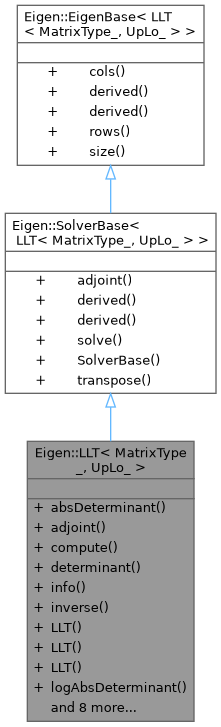
 Inheritance diagram for Eigen::LLT< MatrixType_, UpLo_ >:
Public Member Functions | |
| RealScalar | absDeterminant () const |
| const LLT & | adjoint () const noexcept |
| template<typename InputType> | |
| LLT< MatrixType, UpLo_ > & | compute (const EigenBase< InputType > &a) |
| Scalar | determinant () const |
| ComputationInfo | info () const |
| Reports whether previous computation was successful. | |
| Inverse< LLT > | inverse () const |
| LLT () | |
| Default Constructor. | |
| template<typename InputType> | |
| LLT (EigenBase< InputType > &matrix) | |
| Constructs a LLT factorization from a given matrix. | |
| LLT (Index size) | |
| Default Constructor with memory preallocation. | |
| RealScalar | logAbsDeterminant () const |
| Traits::MatrixL | matrixL () const |
| const MatrixType & | matrixLLT () const |
| Traits::MatrixU | matrixU () const |
| template<typename VectorType> | |
| LLT< MatrixType_, UpLo_ > & | rankUpdate (const VectorType &v, const RealScalar &sigma) |
| RealScalar | rcond () const |
| MatrixType | reconstructedMatrix () const |
| Scalar | signDeterminant () const |
| template<typename Rhs> | |
| Solve< LLT, Rhs > | solve (const MatrixBase< Rhs > &b) const |
| Public Member Functions inherited from Eigen::SolverBase< LLT< MatrixType_, UpLo_ > > | |
| const AdjointReturnType | adjoint () const |
| constexpr LLT< MatrixType_, UpLo_ > & | derived () |
| constexpr const LLT< MatrixType_, UpLo_ > & | derived () const |
| Solve< LLT< MatrixType_, UpLo_ >, Rhs > | solve (const MatrixBase< Rhs > &b) const |
| SolverBase ()=default | |
| const ConstTransposeReturnType | transpose () const |
| Public Member Functions inherited from Eigen::EigenBase< LLT< MatrixType_, UpLo_ > > | |
| constexpr Index | cols () const noexcept |
| constexpr LLT< MatrixType_, UpLo_ > & | derived () |
| constexpr const LLT< MatrixType_, UpLo_ > & | derived () const |
| constexpr Index | rows () const noexcept |
| constexpr Index | size () const noexcept |
Additional Inherited Members | |
| Public Types inherited from Eigen::EigenBase< LLT< MatrixType_, UpLo_ > > | |
| using | Index |
| The interface type of indices. | |
|
inline |
Default Constructor.
The default constructor is useful in cases in which the user intends to perform decompositions via LLT::compute(const MatrixType&).
|
inlineexplicit |
Default Constructor with memory preallocation.
Like the default constructor but with preallocation of the internal data according to the specified problem size.
|
inlineexplicit |
Constructs a LLT factorization from a given matrix.
This overloaded constructor is provided for inplace decomposition when MatrixType is a Eigen::Ref.
| LLT< MatrixType_, UpLo_ >::RealScalar Eigen::LLT< MatrixType_, UpLo_ >::absDeterminant | ( | ) | const |
It has only linear complexity (that is, O(n) where n is the dimension of the square matrix) as the Cholesky decomposition has already been computed.
Success. A failed factorization does not represent the input matrix.
|
inlinenoexcept |
*this, that is, a const reference to the decomposition itself as the underlying matrix is self-adjoint.This method is provided for compatibility with other matrix decompositions, thus enabling generic code such as:
| LLT< MatrixType, UpLo_ > & Eigen::LLT< MatrixType_, UpLo_ >::compute | ( | const EigenBase< InputType > & | a | ) |
Computes / recomputes the Cholesky decomposition A = LL^* = U^*U of matrix
Example:
Output:
Here is the matrix A:
 2 -1
-1  3
Here is the right hand side b:
1 2
3 1
Computing LLT decomposition...
The solution is:
1.2 1.4
1.4 0.8
The matrix A is now:
 2 -1
-1  4
Computing LLT decomposition...
The solution is now:
    1  1.29
    1 0.571
| LLT< MatrixType_, UpLo_ >::Scalar Eigen::LLT< MatrixType_, UpLo_ >::determinant | ( | ) | const |
It has only linear complexity (that is, O(n) where n is the dimension of the square matrix) as the Cholesky decomposition has already been computed.
Success. A failed factorization does not represent the input matrix.
|
inline |
Reports whether previous computation was successful.
Success if computation was successful, NumericalIssue if the matrix appears not to be positive definite.
|
inline |
*this is the Cholesky decomposition.The result is computed as \( A^{-1} = L^{-*} L^{-1} \) by inverting the stored factor in place and squaring it, the LAPACK *POTRI sequence, for 2n^3/3 flops against the 2n^3 of solving with an explicit identity right hand side. Beyond the destination, only a block-sized scratch panel of at most 128x128 coefficients is used, whatever the matrix size.
Fewer flops is not fewer seconds at every size: for a real scalar below EIGEN_LLT_INVERSE_POTRI_THRESHOLD (32, or 256 where AVX-512 is enabled) the POTRI sequence runs in its unblocked kernels while the solve against an identity runs its 3x at the blocked TRSM rate, so that is what this method does there. Complex scalars always take the POTRI path. The result is exactly self-adjoint either way: one triangle is computed and mirrored onto the other.
An in-place decomposition (see the class documentation) may overwrite its own factor with the result, as in storage = llt.inverse(); like any other write to the referenced matrix, that leaves the decomposition unusable afterwards.
The matrix must be positive definite, that is, info() must be Success.
| LLT< MatrixType_, UpLo_ >::RealScalar Eigen::LLT< MatrixType_, UpLo_ >::logAbsDeterminant | ( | ) | const |
It has only linear complexity (that is, O(n) where n is the dimension of the square matrix) as the Cholesky decomposition has already been computed.
Success. A failed factorization does not represent the input matrix.
|
inline |
|
inline |
TODO: document the storage layout
|
inline |
| LLT< MatrixType_, UpLo_ > & Eigen::LLT< MatrixType_, UpLo_ >::rankUpdate | ( | const VectorType & | v, |
| const RealScalar & | sigma ) |
Performs a rank one update (or downdate) of the current decomposition. If A = LL^* before the rank one update, then after it we have LL^* = A + sigma * v v^* where v must be a vector of same dimension.
|
inline |
*this is the Cholesky decomposition. | MatrixType Eigen::LLT< MatrixType, UpLo_ >::reconstructedMatrix | ( | ) | const |
| LLT< MatrixType_, UpLo_ >::Scalar Eigen::LLT< MatrixType_, UpLo_ >::signDeterminant | ( | ) | const |
1 since that matrix is positive definite.This method is provided for compatibility with the other decompositions, thus enabling generic code.
Success. A failed factorization does not represent the input matrix.
|
inline |
Since this LLT class assumes anyway that the matrix A is invertible, the solution theoretically exists and is unique regardless of b.
Example:
Output:
2.02
2.97
 1.13.2