template<typename MatrixType_, int UpLo_>
class Eigen::LDLT< MatrixType_, UpLo_ >
Robust Cholesky decomposition of a matrix with pivoting.
- Template Parameters
-
| MatrixType_ | the type of the matrix of which to compute the LDL^T Cholesky decomposition |
| UpLo_ | the triangular part that will be used for the decomposition: Lower (default) or Upper. The other triangular part won't be read. |
Perform a robust Cholesky decomposition of a positive semidefinite or negative semidefinite matrix \( A \) such that \( A = P^TLDL^*P \), where P is a permutation matrix, L is lower triangular with a unit diagonal and D is a diagonal matrix.
The decomposition uses pivoting to ensure stability, so that D will have zeros in the bottom right rank(A) - n submatrix. Avoiding the square root on D also stabilizes the computation.
Remember that Cholesky decompositions are not rank-revealing. Also, do not use a Cholesky decomposition to determine whether a system of equations has a solution.
This class supports the inplace decomposition mechanism.
D is purely diagonal, so this class cannot factor an indefinite matrix. For a self-adjoint matrix that is indefinite, use BunchKaufman, which produces a block-diagonal D.
- See also
- MatrixBase::ldlt(), SelfAdjointView::ldlt(), class LLT, class BunchKaufman
|
| RealScalar | absDeterminant () const |
| |
| const LDLT & | adjoint () const |
| |
| template<typename InputType> |
| LDLT< MatrixType, UpLo_ > & | compute (const EigenBase< InputType > &a) |
| |
| Scalar | determinant () const |
| |
| ComputationInfo | info () const |
| | Reports whether previous computation was successful.
|
| |
| bool | isNegative (void) const |
| |
| bool | isPositive () const |
| |
| | LDLT () |
| | Default Constructor.
|
| |
| template<typename InputType> |
| | LDLT (const EigenBase< InputType > &matrix) |
| | Constructor with decomposition.
|
| |
| template<typename InputType> |
| | LDLT (EigenBase< InputType > &matrix) |
| | Constructs a LDLT factorization from a given matrix.
|
| |
| | LDLT (Index size) |
| | Default Constructor with memory preallocation.
|
| |
| RealScalar | logAbsDeterminant () const |
| |
| Traits::MatrixL | matrixL () const |
| |
| const MatrixType & | matrixLDLT () const |
| |
| Traits::MatrixU | matrixU () const |
| |
| template<typename Derived> |
| LDLT< MatrixType, UpLo_ > & | rankUpdate (const MatrixBase< Derived > &w, const typename LDLT< MatrixType, UpLo_ >::RealScalar &sigma) |
| |
| RealScalar | rcond () const |
| |
| MatrixType | reconstructedMatrix () const |
| |
| void | setZero () |
| |
| Scalar | signDeterminant () const |
| |
| template<typename Rhs> |
| Solve< LDLT, Rhs > | solve (const MatrixBase< Rhs > &b) const |
| |
| const TranspositionType & | transpositionsP () const |
| |
| Diagonal< const MatrixType > | vectorD () const |
| |
| const AdjointReturnType | adjoint () const |
| |
| constexpr LDLT< MatrixType_, UpLo_ > & | derived () |
| |
| constexpr const LDLT< MatrixType_, UpLo_ > & | derived () const |
| |
| Solve< LDLT< MatrixType_, UpLo_ >, Rhs > | solve (const MatrixBase< Rhs > &b) const |
| |
| | SolverBase ()=default |
| |
| const ConstTransposeReturnType | transpose () const |
| |
| constexpr Index | cols () const noexcept |
| |
| constexpr LDLT< MatrixType_, UpLo_ > & | derived () |
| |
| constexpr const LDLT< MatrixType_, UpLo_ > & | derived () const |
| |
| constexpr Index | rows () const noexcept |
| |
| constexpr Index | size () const noexcept |
| |
template<typename MatrixType_, int UpLo_>
template<typename Derived>
| LDLT< MatrixType, UpLo_ > & Eigen::LDLT< MatrixType_, UpLo_ >::rankUpdate |
( |
const MatrixBase< Derived > & | w, |
|
|
const typename LDLT< MatrixType, UpLo_ >::RealScalar & | sigma ) |
Update the LDLT decomposition: given a decomposition of \( A = P^TLDL^*P \), efficiently compute the decomposition of \( A + \sigma w w^* \).
If *this holds no factorization yet, A is taken to be zero and the decomposition is built from scratch; info() then reports Success. An update applied to an existing factorization leaves info() unchanged, so a NumericalIssue already reported for that factorization stands until compute() replaces it or setZero() discards it. LLT::rankUpdate() differs on both counts: it requires an existing factorization and re-reports the status on every call.
- Note
- rcond(), isPositive() and isNegative() are not maintained across rank updates. rcond() keeps using the L1 norm recorded by the last compute(), which is zero when there was none, and the definiteness flags are assigned only where this function builds a factorization from scratch, from the sign of sigma alone.
- Parameters
-
| w | a vector to be incorporated into the decomposition. |
| sigma | a scalar, +1 for updates and -1 for "downdates," which correspond to removing previously-added column vectors. Optional; default value is +1. |
- See also
- setZero()
template<typename MatrixType_, int UpLo_>
template<typename Rhs>
- Returns
- a solution x of \( A x = b \) using the current decomposition of A.
This function also supports in-place solves using the syntax x = decompositionObject.solve(x) .
This method just tries to find as good a solution as possible. If you want to check whether a solution exists or if it is accurate, just call this function to get a result and then compute the error of this result, or use MatrixBase::isApprox() directly, for instance like this:
bool a_solution_exists = (A*result).isApprox(b, precision);
This method avoids dividing by zero, so that the non-existence of a solution doesn't by itself mean that you'll get inf or nan values.
More precisely, this method solves \( A x = b \) using the decomposition \( A = P^T L D L^* P \) by solving the systems \( P^T y_1 = b \), \( L y_2 = y_1 \), \( D y_3 = y_2 \), \( L^* y_4 = y_3 \) and \( P x = y_4 \) in succession. If the matrix \( A \) is singular, then \( D \) will also be singular (all the other matrices are invertible). In that case, the least-square solution of \( D y_3 = y_2 \) is computed. This does not mean that this function computes the least-square solution of \( A x = b \) if \( A \) is singular.
- See also
- MatrixBase::ldlt(), SelfAdjointView::ldlt()


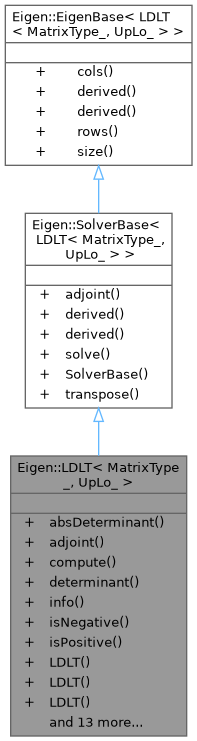
 Inheritance diagram for Eigen::LDLT< MatrixType_, UpLo_ >:
 1.13.2