SparseVector< _Scalar, _Options, _Index > Class Template Reference

a sparse vector class More...

#include <SparseVector.h>

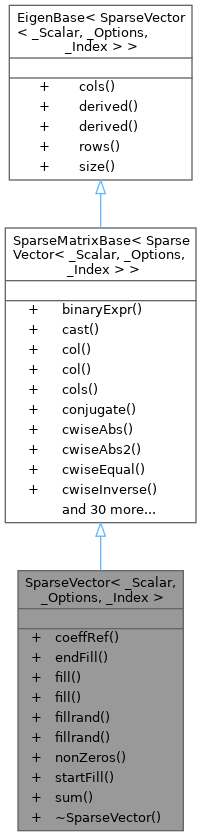
+ Inheritance diagram for SparseVector< _Scalar, _Options, _Index >:

Public Member Functions

const CwiseBinaryOp< CustomBinaryOp, const SparseVector< _Scalar, _Options, _Index >, const OtherDerived > binaryExpr (const Eigen::SparseMatrixBase< OtherDerived > &other, const CustomBinaryOp &func=CustomBinaryOp()) const
 
internal::cast_return_type< SparseVector< _Scalar, _Options, _Index >, constCwiseUnaryOp< internal::scalar_cast_op< typenameinternal::traits< SparseVector< _Scalar, _Options, _Index > >::Scalar, NewType >, constDerived > >::type cast () const
 
Scalar & coeffRef (Index i)
 
SparseInnerVectorSet< SparseVector< _Scalar, _Options, _Index >, 1 > col (Index j)
 
const SparseInnerVectorSet< SparseVector< _Scalar, _Options, _Index >, 1 > col (Index j) const
 
ConjugateReturnType conjugate () const
 
const CwiseUnaryOp< internal::scalar_abs_op< Scalar >, const SparseVector< _Scalar, _Options, _Index > > cwiseAbs () const
 
const CwiseUnaryOp< internal::scalar_abs2_op< Scalar >, const SparseVector< _Scalar, _Options, _Index > > cwiseAbs2 () const
 
const CwiseUnaryOp< std::binder1st< std::equal_to< Scalar > >, const SparseVector< _Scalar, _Options, _Index > > cwiseEqual (const Scalar &s) const
 
const CwiseUnaryOp< internal::scalar_inverse_op< Scalar >, const SparseVector< _Scalar, _Options, _Index > > cwiseInverse () const
 
const CwiseUnaryOp< internal::scalar_sqrt_op< Scalar >, const SparseVector< _Scalar, _Options, _Index > > cwiseSqrt () const
 
SparseVector< _Scalar, _Options, _Index > & derived ()
 
const SparseVector< _Scalar, _Options, _Index > & derived () const
 
const EIGEN_CWISE_PRODUCT_RETURN_TYPE (SparseVector< _Scalar, _Options, _Index >, OtherDerived) cwiseProduct(const Eigen
 
EIGEN_DEPRECATED void endFill ()
 
const internal::eval< SparseVector< _Scalar, _Options, _Index > >::type eval () const
 
EIGEN_DEPRECATED Scalar & fill (Index i)
 
EIGEN_DEPRECATED Scalar & fill (Index r, Index c)
 
EIGEN_DEPRECATED Scalar & fillrand (Index i)
 
EIGEN_DEPRECATED Scalar & fillrand (Index r, Index c)
 
NonConstImagReturnType imag ()
 
const ImagReturnType imag () const
 
SparseInnerVectorSet< SparseVector< _Scalar, _Options, _Index >, 1 > innerVector (Index outer)
 
const SparseInnerVectorSet< SparseVector< _Scalar, _Options, _Index >, 1 > innerVector (Index outer) const
 
SparseInnerVectorSet< SparseVector< _Scalar, _Options, _Index >, Dynamic > innerVectors (Index outerStart, Index outerSize)
 
const SparseInnerVectorSet< SparseVector< _Scalar, _Options, _Index >, Dynamic > innerVectors (Index outerStart, Index outerSize) const
 
SparseInnerVectorSet< SparseVector< _Scalar, _Options, _Index >, Dynamic > middleCols (Index start, Index size)
 
const SparseInnerVectorSet< SparseVector< _Scalar, _Options, _Index >, Dynamic > middleCols (Index start, Index size) const
 
SparseInnerVectorSet< SparseVector< _Scalar, _Options, _Index >, Dynamic > middleRows (Index start, Index size)
 
const SparseInnerVectorSet< SparseVector< _Scalar, _Options, _Index >, Dynamic > middleRows (Index start, Index size) const
 
Index nonZeros () const
 
const SparseDenseProductReturnType< SparseVector< _Scalar, _Options, _Index >, OtherDerived >::Type operator* (const MatrixBase< OtherDerived > &other) const
 
const ScalarMultipleReturnType operator* (const Scalar &scalar) const
 
const SparseSparseProductReturnType< SparseVector< _Scalar, _Options, _Index >, OtherDerived >::Type operator* (const SparseMatrixBase< OtherDerived > &other) const
 
const CwiseUnaryOp< internal::scalar_multiple2_op< Scalar, std::complex< Scalar > >, const SparseVector< _Scalar, _Options, _Index > > operator* (const std::complex< Scalar > &scalar) const
 
const CwiseUnaryOp< internal::scalar_opposite_op< typename internal::traits< SparseVector< _Scalar, _Options, _Index > >::Scalar >, const SparseVector< _Scalar, _Options, _Index > > operator- () const
 
const CwiseUnaryOp< internal::scalar_quotient1_op< typename internal::traits< SparseVector< _Scalar, _Options, _Index > >::Scalar >, const SparseVector< _Scalar, _Options, _Index > > operator/ (const Scalar &scalar) const
 
NonConstRealReturnType real ()
 
RealReturnType real () const
 
SparseInnerVectorSet< SparseVector< _Scalar, _Options, _Index >, 1 > row (Index i)
 
const SparseInnerVectorSet< SparseVector< _Scalar, _Options, _Index >, 1 > row (Index i) const
 
Index size () const
 
EIGEN_DEPRECATED void startFill (Index reserve)
 
Scalar sum () const
 
SparseSymmetricPermutationProduct< SparseVector< _Scalar, _Options, _Index >, Upper|LowertwistedBy (const PermutationMatrix< Dynamic, Dynamic, Index > &perm) const
 
const CwiseUnaryOp< CustomUnaryOp, const SparseVector< _Scalar, _Options, _Index > > unaryExpr (const CustomUnaryOp &func=CustomUnaryOp()) const
 Apply a unary operator coefficient-wise.
 
const CwiseUnaryView< CustomViewOp, const SparseVector< _Scalar, _Options, _Index > > unaryViewExpr (const CustomViewOp &func=CustomViewOp()) const
 
 ~SparseVector ()
 

Detailed Description

template<typename _Scalar, int _Options, typename _Index>
class Eigen::SparseVector< _Scalar, _Options, _Index >

a sparse vector class

Template Parameters
_Scalarthe scalar type, i.e. the type of the coefficients

See http://www.netlib.org/linalg/html_templates/node91.html for details on the storage scheme.

This class can be extended with the help of the plugin mechanism described on the page Customizing/Extending Eigen by defining the preprocessor symbol EIGEN_SPARSEVECTOR_PLUGIN.

Constructor & Destructor Documentation

◆ ~SparseVector()

template<typename _Scalar, int _Options, typename _Index>
~SparseVector ( )
inline

Destructor

Member Function Documentation

◆ binaryExpr()

const CwiseBinaryOp< CustomBinaryOp, const SparseVector< _Scalar, _Options, _Index >, const OtherDerived > binaryExpr ( const Eigen::SparseMatrixBase< OtherDerived > & other,
const CustomBinaryOp & func = CustomBinaryOp() ) const
inlineinherited
Returns
an expression of the difference of *this and other
Note
If you want to substract a given scalar from all coefficients, see Cwise::operator-().
See also
class CwiseBinaryOp, operator-=()
Returns
an expression of the sum of *this and other
Note
If you want to add a given scalar to all coefficients, see Cwise::operator+().
See also
class CwiseBinaryOp, operator+=()
Returns
an expression of a custom coefficient-wise operator func of *this and other

The template parameter CustomBinaryOp is the type of the functor of the custom operator (see class CwiseBinaryOp for an example)

Here is an example illustrating the use of custom functors:

#include <Eigen/Core>
#include <iostream>
using namespace Eigen;
using namespace std;
// define a custom template binary functor
template<typename Scalar> struct MakeComplexOp {
EIGEN_EMPTY_STRUCT_CTOR(MakeComplexOp)
typedef complex<Scalar> result_type;
complex<Scalar> operator()(const Scalar& a, const Scalar& b) const { return complex<Scalar>(a,b); }
};
int main(int, char**)
{
Matrix4d m1 = Matrix4d::Random(), m2 = Matrix4d::Random();
cout << m1.binaryExpr(m2, MakeComplexOp<double>()) << endl;
return 0;
}
static const CwiseNullaryOp< internal::scalar_random_op< Scalar >, Matrix< double, _Rows, _Cols, _Options, _MaxRows, _MaxCols > > Random(Index rows, Index cols)
Definition Random.h:49
const CwiseBinaryOp< CustomBinaryOp, const Matrix< _Scalar, _Rows, _Cols, _Options, _MaxRows, _MaxCols >, const OtherDerived > binaryExpr(const Eigen::MatrixBase< OtherDerived > &other, const CustomBinaryOp &func=CustomBinaryOp()) const
Definition MatrixBase.h:43

Output:

   (0.68,0.271)  (0.823,-0.967) (-0.444,-0.687)   (-0.27,0.998)
 (-0.211,0.435) (-0.605,-0.514)  (0.108,-0.198) (0.0268,-0.563)
 (0.566,-0.717)  (-0.33,-0.726) (-0.0452,-0.74)  (0.904,0.0259)
  (0.597,0.214)   (0.536,0.608)  (0.258,-0.782)   (0.832,0.678)
See also
class CwiseBinaryOp, operator+(), operator-(), cwiseProduct()

◆ cast()

internal::cast_return_type< SparseVector< _Scalar, _Options, _Index >, constCwiseUnaryOp< internal::scalar_cast_op< typenameinternal::traits< SparseVector< _Scalar, _Options, _Index > >::Scalar, NewType >, constDerived > >::type cast ( ) const
inlineinherited
Returns
an expression of *this with the Scalar type casted to NewScalar.

The template parameter NewScalar is the type we are casting the scalars to.

See also
class CwiseUnaryOp

◆ coeffRef()

template<typename _Scalar, int _Options, typename _Index>
Scalar & coeffRef ( Index i)
inline
Returns
a reference to the coefficient value at given index i This operation involes a log(rho*size) binary search. If the coefficient does not exist yet, then a sorted insertion into a sequential buffer is performed.

This insertion might be very costly if the number of nonzeros above i is large.

◆ col() [1/2]

SparseInnerVectorSet< SparseVector< _Scalar, _Options, _Index >, 1 > col ( Index i)
inherited
Returns
the i-th column of the matrix *this. For column-major matrix only.

◆ col() [2/2]

const SparseInnerVectorSet< SparseVector< _Scalar, _Options, _Index >, 1 > col ( Index i) const
inherited
Returns
the i-th column of the matrix *this. For column-major matrix only. (read-only version)

◆ conjugate()

ConjugateReturnType conjugate ( ) const
inlineinherited
Returns
an expression of the complex conjugate of *this.
See also
adjoint()

◆ cwiseAbs()

const CwiseUnaryOp< internal::scalar_abs_op< Scalar >, const SparseVector< _Scalar, _Options, _Index > > cwiseAbs ( ) const
inlineinherited
Returns
an expression of the coefficient-wise absolute value of *this

Example:

MatrixXd m(2,3);
m << 2, -4, 6,
-5, 1, 0;
cout << m.cwiseAbs() << endl;

Output:

2 4 6
5 1 0
See also
cwiseAbs2()

◆ cwiseAbs2()

const CwiseUnaryOp< internal::scalar_abs2_op< Scalar >, const SparseVector< _Scalar, _Options, _Index > > cwiseAbs2 ( ) const
inlineinherited
Returns
an expression of the coefficient-wise squared absolute value of *this

Example:

MatrixXd m(2,3);
m << 2, -4, 6,
-5, 1, 0;
cout << m.cwiseAbs2() << endl;

Output:

 4 16 36
25  1  0
See also
cwiseAbs()

◆ cwiseEqual()

const CwiseUnaryOp< std::binder1st< std::equal_to< Scalar > >, const SparseVector< _Scalar, _Options, _Index > > cwiseEqual ( const Scalar & s) const
inlineinherited
Returns
an expression of the coefficient-wise == operator of *this and a scalar s
Warning
this performs an exact comparison, which is generally a bad idea with floating-point types. In order to check for equality between two vectors or matrices with floating-point coefficients, it is generally a far better idea to use a fuzzy comparison as provided by isApprox() and isMuchSmallerThan().
See also
cwiseEqual(const MatrixBase<OtherDerived> &) const

◆ cwiseInverse()

const CwiseUnaryOp< internal::scalar_inverse_op< Scalar >, const SparseVector< _Scalar, _Options, _Index > > cwiseInverse ( ) const
inlineinherited
Returns
an expression of the coefficient-wise inverse of *this.

Example:

MatrixXd m(2,3);
m << 2, 0.5, 1,
3, 0.25, 1;
cout << m.cwiseInverse() << endl;

Output:

0.5 2 1
0.333 4 1
See also
cwiseProduct()

◆ cwiseSqrt()

const CwiseUnaryOp< internal::scalar_sqrt_op< Scalar >, const SparseVector< _Scalar, _Options, _Index > > cwiseSqrt ( ) const
inlineinherited
Returns
an expression of the coefficient-wise square root of *this.

Example:

Vector3d v(1,2,4);
cout << v.cwiseSqrt() << endl;

Output:

1
1.41
2
See also
cwisePow(), cwiseSquare()

◆ derived() [1/2]

SparseVector< _Scalar, _Options, _Index > & derived ( )
inlineinherited
Returns
a reference to the derived object

◆ derived() [2/2]

const SparseVector< _Scalar, _Options, _Index > & derived ( ) const
inlineinherited
Returns
a const reference to the derived object

◆ EIGEN_CWISE_PRODUCT_RETURN_TYPE()

const EIGEN_CWISE_PRODUCT_RETURN_TYPE ( SparseVector< _Scalar, _Options, _Index > ,
OtherDerived  ) const
inlineinherited
Returns
an expression of the Schur product (coefficient wise product) of *this and other

Example:

Matrix3i a = Matrix3i::Random(), b = Matrix3i::Random();
Matrix3i c = a.cwiseProduct(b);
cout << "a:\n" << a << "\nb:\n" << b << "\nc:\n" << c << endl;

Output:

a:
 7  6 -3
-2  9  6
 6 -6 -5
b:
 1 -3  9
 0  0  3
 3  9  5
c:
  7 -18 -27
  0   0  18
 18 -54 -25
See also
class CwiseBinaryOp, cwiseAbs2
Returns
an expression of the coefficient-wise == operator of *this and other
Warning
this performs an exact comparison, which is generally a bad idea with floating-point types. In order to check for equality between two vectors or matrices with floating-point coefficients, it is generally a far better idea to use a fuzzy comparison as provided by isApprox() and isMuchSmallerThan().

Example:

MatrixXi m(2,2);
m << 1, 0,
1, 1;
cout << "Comparing m with identity matrix:" << endl;
cout << m.cwiseEqual(MatrixXi::Identity(2,2)) << endl;
int count = m.cwiseEqual(MatrixXi::Identity(2,2)).count();
cout << "Number of coefficients that are equal: " << count << endl;
static const IdentityReturnType Identity()
Definition CwiseNullaryOp.h:700

Output:

Comparing m with identity matrix:
1 1
0 1
Number of coefficients that are equal: 3
See also
cwiseNotEqual(), isApprox(), isMuchSmallerThan()
Returns
an expression of the coefficient-wise != operator of *this and other
Warning
this performs an exact comparison, which is generally a bad idea with floating-point types. In order to check for equality between two vectors or matrices with floating-point coefficients, it is generally a far better idea to use a fuzzy comparison as provided by isApprox() and isMuchSmallerThan().

Example:

MatrixXi m(2,2);
m << 1, 0,
1, 1;
cout << "Comparing m with identity matrix:" << endl;
cout << m.cwiseNotEqual(MatrixXi::Identity(2,2)) << endl;
int count = m.cwiseNotEqual(MatrixXi::Identity(2,2)).count();
cout << "Number of coefficients that are not equal: " << count << endl;

Output:

Comparing m with identity matrix:
0 0
1 0
Number of coefficients that are not equal: 1
See also
cwiseEqual(), isApprox(), isMuchSmallerThan()
Returns
an expression of the coefficient-wise min of *this and other

Example:

Vector3d v(2,3,4), w(4,2,3);
cout << v.cwiseMin(w) << endl;

Output:

2
2
3
See also
class CwiseBinaryOp, max()
Returns
an expression of the coefficient-wise min of *this and scalar other
See also
class CwiseBinaryOp, min()
Returns
an expression of the coefficient-wise max of *this and other

Example:

Vector3d v(2,3,4), w(4,2,3);
cout << v.cwiseMax(w) << endl;

Output:

4
3
4
See also
class CwiseBinaryOp, min()
Returns
an expression of the coefficient-wise max of *this and scalar other
See also
class CwiseBinaryOp, min()
Returns
an expression of the coefficient-wise quotient of *this and other

Example:

Vector3d v(2,3,4), w(4,2,3);
cout << v.cwiseQuotient(w) << endl;

Output:

0.5
1.5
1.33
See also
class CwiseBinaryOp, cwiseProduct(), cwiseInverse()
Returns
the number of rows.
See also
cols()
Returns
the number of columns.
See also
rows()
Returns
the number of coefficients, which is rows()*cols().
See also
rows(), cols().
Returns
the number of nonzero coefficients which is in practice the number of stored coefficients.
true if either the number of rows or the number of columns is equal to 1. In other words, this function returns
rows()==1 || cols()==1
See also
rows(), cols(), IsVectorAtCompileTime.
Returns
the size of the storage major dimension, i.e., the number of columns for a columns major matrix, and the number of rows otherwise
the size of the inner dimension according to the storage order, i.e., the number of rows for a columns major matrix, and the number of cols otherwise

◆ endFill()

template<typename _Scalar, int _Options, typename _Index>
EIGEN_DEPRECATED void endFill ( )
inline

◆ eval()

const internal::eval< SparseVector< _Scalar, _Options, _Index > >::type eval ( ) const
inlineinherited
Returns
the matrix or vector obtained by evaluating this expression.

Notice that in the case of a plain matrix or vector (not an expression) this function just returns a const reference, in order to avoid a useless copy.

◆ fill() [1/2]

template<typename _Scalar, int _Options, typename _Index>
EIGEN_DEPRECATED Scalar & fill ( Index i)
inline

◆ fill() [2/2]

template<typename _Scalar, int _Options, typename _Index>
EIGEN_DEPRECATED Scalar & fill ( Index r,
Index c )
inline

◆ fillrand() [1/2]

template<typename _Scalar, int _Options, typename _Index>
EIGEN_DEPRECATED Scalar & fillrand ( Index i)
inline

◆ fillrand() [2/2]

template<typename _Scalar, int _Options, typename _Index>
EIGEN_DEPRECATED Scalar & fillrand ( Index r,
Index c )
inline

◆ imag() [1/2]

NonConstImagReturnType imag ( )
inlineinherited
Returns
a non const expression of the imaginary part of *this.
See also
real()

◆ imag() [2/2]

const ImagReturnType imag ( ) const
inlineinherited
Returns
an read-only expression of the imaginary part of *this.
See also
real()

◆ innerVector() [1/2]

SparseInnerVectorSet< SparseVector< _Scalar, _Options, _Index >, 1 > innerVector ( Index outer)
inherited
Returns
the outer -th column (resp. row) of the matrix *this if *this is col-major (resp. row-major).

◆ innerVector() [2/2]

const SparseInnerVectorSet< SparseVector< _Scalar, _Options, _Index >, 1 > innerVector ( Index outer) const
inherited
Returns
the outer -th column (resp. row) of the matrix *this if *this is col-major (resp. row-major). Read-only.

◆ innerVectors() [1/2]

SparseInnerVectorSet< SparseVector< _Scalar, _Options, _Index >, Dynamic > innerVectors ( Index outerStart,
Index outerSize )
inherited
Returns
the outer -th column (resp. row) of the matrix *this if *this is col-major (resp. row-major).

◆ innerVectors() [2/2]

const SparseInnerVectorSet< SparseVector< _Scalar, _Options, _Index >, Dynamic > innerVectors ( Index outerStart,
Index outerSize ) const
inherited
Returns
the outer -th column (resp. row) of the matrix *this if *this is col-major (resp. row-major). Read-only.

◆ middleCols() [1/2]

SparseInnerVectorSet< SparseVector< _Scalar, _Options, _Index >, Dynamic > middleCols ( Index start,
Index size )
inherited
Returns
the i-th column of the matrix *this. For column-major matrix only.

◆ middleCols() [2/2]

const SparseInnerVectorSet< SparseVector< _Scalar, _Options, _Index >, Dynamic > middleCols ( Index start,
Index size ) const
inherited
Returns
the i-th column of the matrix *this. For column-major matrix only. (read-only version)

◆ middleRows() [1/2]

SparseInnerVectorSet< SparseVector< _Scalar, _Options, _Index >, Dynamic > middleRows ( Index start,
Index size )
inherited
Returns
the i-th row of the matrix *this. For row-major matrix only.

◆ middleRows() [2/2]

const SparseInnerVectorSet< SparseVector< _Scalar, _Options, _Index >, Dynamic > middleRows ( Index start,
Index size ) const
inherited
Returns
the i-th row of the matrix *this. For row-major matrix only. (read-only version)

◆ nonZeros()

template<typename _Scalar, int _Options, typename _Index>
Index nonZeros ( ) const
inline
Returns
the number of non zero coefficients

◆ operator*() [1/4]

const SparseDenseProductReturnType< SparseVector< _Scalar, _Options, _Index >, OtherDerived >::Type operator* ( const MatrixBase< OtherDerived > & other) const
inlineinherited

sparse * dense (returns a dense object unless it is an outer product)

◆ operator*() [2/4]

const ScalarMultipleReturnType operator* ( const Scalar & scalar) const
inlineinherited
Returns
an expression of *this scaled by the scalar factor scalar

◆ operator*() [3/4]

const SparseSparseProductReturnType< SparseVector< _Scalar, _Options, _Index >, OtherDerived >::Type operator* ( const SparseMatrixBase< OtherDerived > & other) const
inlineinherited
Returns
an expression of the product of two sparse matrices. By default a conservative product preserving the symbolic non zeros is performed. The automatic pruning of the small values can be achieved by calling the pruned() function in which case a totally different product algorithm is employed:
C = (A*B).pruned(); // supress numerical zeros (exact)
C = (A*B).pruned(ref);
C = (A*B).pruned(ref,epsilon);
where ref is a meaningful non zero reference value.

◆ operator*() [4/4]

const CwiseUnaryOp< internal::scalar_multiple2_op< Scalar, std::complex< Scalar > >, const SparseVector< _Scalar, _Options, _Index > > operator* ( const std::complex< Scalar > & scalar) const
inlineinherited

Overloaded for efficient real matrix times complex scalar value

◆ operator-()

const CwiseUnaryOp< internal::scalar_opposite_op< typename internal::traits< SparseVector< _Scalar, _Options, _Index > >::Scalar >, const SparseVector< _Scalar, _Options, _Index > > operator- ( ) const
inlineinherited
Returns
an expression of the opposite of *this

◆ operator/()

const CwiseUnaryOp< internal::scalar_quotient1_op< typename internal::traits< SparseVector< _Scalar, _Options, _Index > >::Scalar >, const SparseVector< _Scalar, _Options, _Index > > operator/ ( const Scalar & scalar) const
inlineinherited
Returns
an expression of *this divided by the scalar value scalar

◆ real() [1/2]

NonConstRealReturnType real ( )
inlineinherited
Returns
a non const expression of the real part of *this.
See also
imag()

◆ real() [2/2]

RealReturnType real ( ) const
inlineinherited
Returns
a read-only expression of the real part of *this.
See also
imag()

◆ row() [1/2]

SparseInnerVectorSet< SparseVector< _Scalar, _Options, _Index >, 1 > row ( Index i)
inherited
Returns
the i-th row of the matrix *this. For row-major matrix only.

◆ row() [2/2]

const SparseInnerVectorSet< SparseVector< _Scalar, _Options, _Index >, 1 > row ( Index i) const
inherited
Returns
the i-th row of the matrix *this. For row-major matrix only. (read-only version)

◆ size()

Index size ( ) const
inlineinherited
Returns
the number of coefficients, which is rows()*cols().
See also
rows(), cols(), SizeAtCompileTime.

◆ startFill()

template<typename _Scalar, int _Options, typename _Index>
EIGEN_DEPRECATED void startFill ( Index reserve)
inline

◆ sum()

template<typename _Scalar, int _Options, typename _Index>
internal::traits< SparseVector< _Scalar, _Options, _Index > >::Scalar sum ( ) const

Overloaded for performance

◆ twistedBy()

SparseSymmetricPermutationProduct< SparseVector< _Scalar, _Options, _Index >, Upper|Lower > twistedBy ( const PermutationMatrix< Dynamic, Dynamic, Index > & perm) const
inlineinherited
Returns
an expression of P H P^-1 where H is the matrix represented by *this

◆ unaryExpr()

const CwiseUnaryOp< CustomUnaryOp, const SparseVector< _Scalar, _Options, _Index > > unaryExpr ( const CustomUnaryOp & func = CustomUnaryOp()) const
inlineinherited

Apply a unary operator coefficient-wise.

Parameters
[in]funcFunctor implementing the unary operator
Template Parameters
CustomUnaryOpType of func
Returns
An expression of a custom coefficient-wise unary operator func of *this

The function ptr_fun() from the C++ standard library can be used to make functors out of normal functions.

Example:

#include <Eigen/Core>
#include <iostream>
using namespace Eigen;
using namespace std;
// define function to be applied coefficient-wise
double ramp(double x)
{
if (x > 0)
return x;
else
return 0;
}
int main(int, char**)
{
Matrix4d m1 = Matrix4d::Random();
cout << m1 << endl << "becomes: " << endl << m1.unaryExpr(ptr_fun(ramp)) << endl;
return 0;
}
const CwiseUnaryOp< CustomUnaryOp, const Matrix< _Scalar, _Rows, _Cols, _Options, _MaxRows, _MaxCols > > unaryExpr(const CustomUnaryOp &func=CustomUnaryOp()) const
Definition MatrixBase.h:140

Output:

   0.68   0.823  -0.444   -0.27
 -0.211  -0.605   0.108  0.0268
  0.566   -0.33 -0.0452   0.904
  0.597   0.536   0.258   0.832
becomes: 
  0.68  0.823      0      0
     0      0  0.108 0.0268
 0.566      0      0  0.904
 0.597  0.536  0.258  0.832

Genuine functors allow for more possibilities, for instance it may contain a state.

Example:

#include <Eigen/Core>
#include <iostream>
using namespace Eigen;
using namespace std;
// define a custom template unary functor
template<typename Scalar>
struct CwiseClampOp {
CwiseClampOp(const Scalar& inf, const Scalar& sup) : m_inf(inf), m_sup(sup) {}
const Scalar operator()(const Scalar& x) const { return x<m_inf ? m_inf : (x>m_sup ? m_sup : x); }
Scalar m_inf, m_sup;
};
int main(int, char**)
{
Matrix4d m1 = Matrix4d::Random();
cout << m1 << endl << "becomes: " << endl << m1.unaryExpr(CwiseClampOp<double>(-0.5,0.5)) << endl;
return 0;
}

Output:

   0.68   0.823  -0.444   -0.27
 -0.211  -0.605   0.108  0.0268
  0.566   -0.33 -0.0452   0.904
  0.597   0.536   0.258   0.832
becomes: 
    0.5     0.5  -0.444   -0.27
 -0.211    -0.5   0.108  0.0268
    0.5   -0.33 -0.0452     0.5
    0.5     0.5   0.258     0.5
See also
class CwiseUnaryOp, class CwiseBinaryOp

◆ unaryViewExpr()

const CwiseUnaryView< CustomViewOp, const SparseVector< _Scalar, _Options, _Index > > unaryViewExpr ( const CustomViewOp & func = CustomViewOp()) const
inlineinherited
Returns
an expression of a custom coefficient-wise unary operator func of *this

The template parameter CustomUnaryOp is the type of the functor of the custom unary operator.

Example:

#include <Eigen/Core>
#include <iostream>
using namespace Eigen;
using namespace std;
// define a custom template unary functor
template<typename Scalar>
struct CwiseClampOp {
CwiseClampOp(const Scalar& inf, const Scalar& sup) : m_inf(inf), m_sup(sup) {}
const Scalar operator()(const Scalar& x) const { return x<m_inf ? m_inf : (x>m_sup ? m_sup : x); }
Scalar m_inf, m_sup;
};
int main(int, char**)
{
Matrix4d m1 = Matrix4d::Random();
cout << m1 << endl << "becomes: " << endl << m1.unaryExpr(CwiseClampOp<double>(-0.5,0.5)) << endl;
return 0;
}

Output:

   0.68   0.823  -0.444   -0.27
 -0.211  -0.605   0.108  0.0268
  0.566   -0.33 -0.0452   0.904
  0.597   0.536   0.258   0.832
becomes: 
    0.5     0.5  -0.444   -0.27
 -0.211    -0.5   0.108  0.0268
    0.5   -0.33 -0.0452     0.5
    0.5     0.5   0.258     0.5
See also
class CwiseUnaryOp, class CwiseBinaryOp

The documentation for this class was generated from the following files: