SparseMatrix< _Scalar, _Options, _Index > Class Template Reference

A versatible sparse matrix representation. More...

#include <SparseMatrix.h>

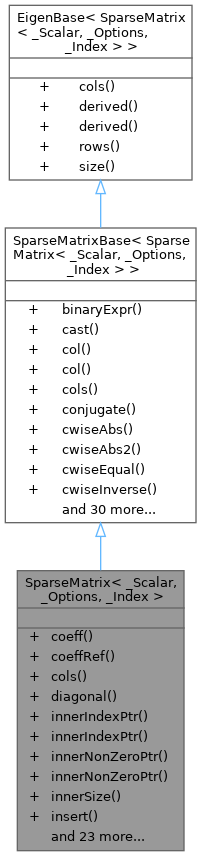
+ Inheritance diagram for SparseMatrix< _Scalar, _Options, _Index >:

Public Member Functions

const CwiseBinaryOp< CustomBinaryOp, const SparseMatrix< _Scalar, _Options, _Index >, const OtherDerived > binaryExpr (const Eigen::SparseMatrixBase< OtherDerived > &other, const CustomBinaryOp &func=CustomBinaryOp()) const
 
internal::cast_return_type< SparseMatrix< _Scalar, _Options, _Index >, constCwiseUnaryOp< internal::scalar_cast_op< typenameinternal::traits< SparseMatrix< _Scalar, _Options, _Index > >::Scalar, NewType >, constDerived > >::type cast () const
 
Scalar coeff (Index row, Index col) const
 
Scalar & coeffRef (Index row, Index col)
 
SparseInnerVectorSet< SparseMatrix< _Scalar, _Options, _Index >, 1 > col (Index j)
 
const SparseInnerVectorSet< SparseMatrix< _Scalar, _Options, _Index >, 1 > col (Index j) const
 
Index cols () const
 
ConjugateReturnType conjugate () const
 
const CwiseUnaryOp< internal::scalar_abs_op< Scalar >, const SparseMatrix< _Scalar, _Options, _Index > > cwiseAbs () const
 
const CwiseUnaryOp< internal::scalar_abs2_op< Scalar >, const SparseMatrix< _Scalar, _Options, _Index > > cwiseAbs2 () const
 
const CwiseUnaryOp< std::binder1st< std::equal_to< Scalar > >, const SparseMatrix< _Scalar, _Options, _Index > > cwiseEqual (const Scalar &s) const
 
const CwiseUnaryOp< internal::scalar_inverse_op< Scalar >, const SparseMatrix< _Scalar, _Options, _Index > > cwiseInverse () const
 
const CwiseUnaryOp< internal::scalar_sqrt_op< Scalar >, const SparseMatrix< _Scalar, _Options, _Index > > cwiseSqrt () const
 
SparseMatrix< _Scalar, _Options, _Index > & derived ()
 
const SparseMatrix< _Scalar, _Options, _Index > & derived () const
 
const Diagonal< const SparseMatrixdiagonal () const
 
const EIGEN_CWISE_PRODUCT_RETURN_TYPE (SparseMatrix< _Scalar, _Options, _Index >, OtherDerived) cwiseProduct(const Eigen
 
const internal::eval< SparseMatrix< _Scalar, _Options, _Index > >::type eval () const
 
NonConstImagReturnType imag ()
 
const ImagReturnType imag () const
 
Index * innerIndexPtr ()
 
const Index * innerIndexPtr () const
 
Index * innerNonZeroPtr ()
 
const Index * innerNonZeroPtr () const
 
Index innerSize () const
 
SparseInnerVectorSet< SparseMatrix< _Scalar, _Options, _Index >, 1 > innerVector (Index outer)
 
const SparseInnerVectorSet< SparseMatrix< _Scalar, _Options, _Index >, 1 > innerVector (Index outer) const
 
SparseInnerVectorSet< SparseMatrix< _Scalar, _Options, _Index >, Dynamic > innerVectors (Index outerStart, Index outerSize)
 
const SparseInnerVectorSet< SparseMatrix< _Scalar, _Options, _Index >, Dynamic > innerVectors (Index outerStart, Index outerSize) const
 
EIGEN_DONT_INLINE Scalar & insert (Index row, Index col)
 
bool isCompressed () const
 
void makeCompressed ()
 
SparseInnerVectorSet< SparseMatrix< _Scalar, _Options, _Index >, Dynamic > middleCols (Index start, Index size)
 
const SparseInnerVectorSet< SparseMatrix< _Scalar, _Options, _Index >, Dynamic > middleCols (Index start, Index size) const
 
SparseInnerVectorSet< SparseMatrix< _Scalar, _Options, _Index >, Dynamic > middleRows (Index start, Index size)
 
const SparseInnerVectorSet< SparseMatrix< _Scalar, _Options, _Index >, Dynamic > middleRows (Index start, Index size) const
 
Index nonZeros () const
 
const SparseDenseProductReturnType< SparseMatrix< _Scalar, _Options, _Index >, OtherDerived >::Type operator* (const MatrixBase< OtherDerived > &other) const
 
const ScalarMultipleReturnType operator* (const Scalar &scalar) const
 
const SparseSparseProductReturnType< SparseMatrix< _Scalar, _Options, _Index >, OtherDerived >::Type operator* (const SparseMatrixBase< OtherDerived > &other) const
 
const CwiseUnaryOp< internal::scalar_multiple2_op< Scalar, std::complex< Scalar > >, const SparseMatrix< _Scalar, _Options, _Index > > operator* (const std::complex< Scalar > &scalar) const
 
const CwiseUnaryOp< internal::scalar_opposite_op< typename internal::traits< SparseMatrix< _Scalar, _Options, _Index > >::Scalar >, const SparseMatrix< _Scalar, _Options, _Index > > operator- () const
 
const CwiseUnaryOp< internal::scalar_quotient1_op< typename internal::traits< SparseMatrix< _Scalar, _Options, _Index > >::Scalar >, const SparseMatrix< _Scalar, _Options, _Index > > operator/ (const Scalar &scalar) const
 
Index * outerIndexPtr ()
 
const Index * outerIndexPtr () const
 
Index outerSize () const
 
template<typename KeepFunc>
void prune (const KeepFunc &keep=KeepFunc())
 
void prune (Scalar reference, RealScalar epsilon=NumTraits< RealScalar >::dummy_precision())
 
NonConstRealReturnType real ()
 
RealReturnType real () const
 
template<class SizesType>
void reserve (const SizesType &reserveSizes)
 
void reserve (Index reserveSize)
 
void resize (Index rows, Index cols)
 
SparseInnerVectorSet< SparseMatrix< _Scalar, _Options, _Index >, 1 > row (Index i)
 
const SparseInnerVectorSet< SparseMatrix< _Scalar, _Options, _Index >, 1 > row (Index i) const
 
Index rows () const
 
template<typename InputIterators>
void setFromTriplets (const InputIterators &begin, const InputIterators &end)
 
void setZero ()
 
Index size () const
 
 SparseMatrix ()
 
template<typename OtherDerived>
 SparseMatrix (const ReturnByValue< OtherDerived > &other)
 Copy constructor with in-place evaluation.
 
 SparseMatrix (const SparseMatrix &other)
 
template<typename OtherDerived>
 SparseMatrix (const SparseMatrixBase< OtherDerived > &other)
 
 SparseMatrix (Index rows, Index cols)
 
void swap (SparseMatrix &other)
 
SparseSymmetricPermutationProduct< SparseMatrix< _Scalar, _Options, _Index >, Upper|LowertwistedBy (const PermutationMatrix< Dynamic, Dynamic, Index > &perm) const
 
const CwiseUnaryOp< CustomUnaryOp, const SparseMatrix< _Scalar, _Options, _Index > > unaryExpr (const CustomUnaryOp &func=CustomUnaryOp()) const
 Apply a unary operator coefficient-wise.
 
const CwiseUnaryView< CustomViewOp, const SparseMatrix< _Scalar, _Options, _Index > > unaryViewExpr (const CustomViewOp &func=CustomViewOp()) const
 
Scalar * valuePtr ()
 
const Scalar * valuePtr () const
 
 ~SparseMatrix ()
 

Detailed Description

template<typename _Scalar, int _Options, typename _Index>
class Eigen::SparseMatrix< _Scalar, _Options, _Index >

A versatible sparse matrix representation.

This class implements a more versatile variants of the common compressed row/column storage format. Each colmun's (resp. row) non zeros are stored as a pair of value with associated row (resp. colmiun) index. All the non zeros are stored in a single large buffer. Unlike the compressed format, there might be extra space inbetween the nonzeros of two successive colmuns (resp. rows) such that insertion of new non-zero can be done with limited memory reallocation and copies.

A call to the function makeCompressed() turns the matrix into the standard compressed format compatible with many library.

More details on this storage sceheme are given in the manual pages.

Template Parameters
_Scalarthe scalar type, i.e. the type of the coefficients
_OptionsUnion of bit flags controlling the storage scheme. Currently the only possibility is RowMajor. The default is 0 which means column-major.
_Indexthe type of the indices. It has to be a signed type (e.g., short, int, std::ptrdiff_t). Default is int.

This class can be extended with the help of the plugin mechanism described on the page Customizing/Extending Eigen by defining the preprocessor symbol EIGEN_SPARSEMATRIX_PLUGIN.

Constructor & Destructor Documentation

◆ SparseMatrix() [1/4]

template<typename _Scalar, int _Options, typename _Index>
SparseMatrix ( )
inline

Default constructor yielding an empty 0 x 0 matrix

◆ SparseMatrix() [2/4]

template<typename _Scalar, int _Options, typename _Index>
SparseMatrix ( Index rows,
Index cols )
inline

Constructs a rows x cols empty matrix

◆ SparseMatrix() [3/4]

template<typename _Scalar, int _Options, typename _Index>
template<typename OtherDerived>
SparseMatrix ( const SparseMatrixBase< OtherDerived > & other)
inline

Constructs a sparse matrix from the sparse expression other

◆ SparseMatrix() [4/4]

template<typename _Scalar, int _Options, typename _Index>
SparseMatrix ( const SparseMatrix< _Scalar, _Options, _Index > & other)
inline

Copy constructor (it performs a deep copy)

◆ ~SparseMatrix()

template<typename _Scalar, int _Options, typename _Index>
~SparseMatrix ( )
inline

Destructor

Member Function Documentation

◆ binaryExpr()

const CwiseBinaryOp< CustomBinaryOp, const SparseMatrix< _Scalar, _Options, _Index >, const OtherDerived > binaryExpr ( const Eigen::SparseMatrixBase< OtherDerived > & other,
const CustomBinaryOp & func = CustomBinaryOp() ) const
inlineinherited
Returns
an expression of the difference of *this and other
Note
If you want to substract a given scalar from all coefficients, see Cwise::operator-().
See also
class CwiseBinaryOp, operator-=()
Returns
an expression of the sum of *this and other
Note
If you want to add a given scalar to all coefficients, see Cwise::operator+().
See also
class CwiseBinaryOp, operator+=()
Returns
an expression of a custom coefficient-wise operator func of *this and other

The template parameter CustomBinaryOp is the type of the functor of the custom operator (see class CwiseBinaryOp for an example)

Here is an example illustrating the use of custom functors:

#include <Eigen/Core>
#include <iostream>
using namespace Eigen;
using namespace std;
// define a custom template binary functor
template<typename Scalar> struct MakeComplexOp {
EIGEN_EMPTY_STRUCT_CTOR(MakeComplexOp)
typedef complex<Scalar> result_type;
complex<Scalar> operator()(const Scalar& a, const Scalar& b) const { return complex<Scalar>(a,b); }
};
int main(int, char**)
{
Matrix4d m1 = Matrix4d::Random(), m2 = Matrix4d::Random();
cout << m1.binaryExpr(m2, MakeComplexOp<double>()) << endl;
return 0;
}
static const CwiseNullaryOp< internal::scalar_random_op< Scalar >, Matrix< double, _Rows, _Cols, _Options, _MaxRows, _MaxCols > > Random(Index rows, Index cols)
Definition Random.h:49
const CwiseBinaryOp< CustomBinaryOp, const Matrix< _Scalar, _Rows, _Cols, _Options, _MaxRows, _MaxCols >, const OtherDerived > binaryExpr(const Eigen::MatrixBase< OtherDerived > &other, const CustomBinaryOp &func=CustomBinaryOp()) const
Definition MatrixBase.h:43

Output:

   (0.68,0.271)  (0.823,-0.967) (-0.444,-0.687)   (-0.27,0.998)
 (-0.211,0.435) (-0.605,-0.514)  (0.108,-0.198) (0.0268,-0.563)
 (0.566,-0.717)  (-0.33,-0.726) (-0.0452,-0.74)  (0.904,0.0259)
  (0.597,0.214)   (0.536,0.608)  (0.258,-0.782)   (0.832,0.678)
See also
class CwiseBinaryOp, operator+(), operator-(), cwiseProduct()

◆ cast()

internal::cast_return_type< SparseMatrix< _Scalar, _Options, _Index >, constCwiseUnaryOp< internal::scalar_cast_op< typenameinternal::traits< SparseMatrix< _Scalar, _Options, _Index > >::Scalar, NewType >, constDerived > >::type cast ( ) const
inlineinherited
Returns
an expression of *this with the Scalar type casted to NewScalar.

The template parameter NewScalar is the type we are casting the scalars to.

See also
class CwiseUnaryOp

◆ coeff()

template<typename _Scalar, int _Options, typename _Index>
Scalar coeff ( Index row,
Index col ) const
inline
Returns
the value of the matrix at position i, j This function returns Scalar(0) if the element is an explicit zero

◆ coeffRef()

template<typename _Scalar, int _Options, typename _Index>
Scalar & coeffRef ( Index row,
Index col )
inline
Returns
a non-const reference to the value of the matrix at position i, j

If the element does not exist then it is inserted via the insert(Index,Index) function which itself turns the matrix into a non compressed form if that was not the case.

This is a O(log(nnz_j)) operation (binary search) plus the cost of insert(Index,Index) function if the element does not already exist.

◆ col() [1/2]

SparseInnerVectorSet< SparseMatrix< _Scalar, _Options, _Index >, 1 > col ( Index i)
inherited
Returns
the i-th column of the matrix *this. For column-major matrix only.

◆ col() [2/2]

const SparseInnerVectorSet< SparseMatrix< _Scalar, _Options, _Index >, 1 > col ( Index i) const
inherited
Returns
the i-th column of the matrix *this. For column-major matrix only. (read-only version)

◆ cols()

template<typename _Scalar, int _Options, typename _Index>
Index cols ( ) const
inline
Returns
the number of columns of the matrix

◆ conjugate()

ConjugateReturnType conjugate ( ) const
inlineinherited
Returns
an expression of the complex conjugate of *this.
See also
adjoint()

◆ cwiseAbs()

const CwiseUnaryOp< internal::scalar_abs_op< Scalar >, const SparseMatrix< _Scalar, _Options, _Index > > cwiseAbs ( ) const
inlineinherited
Returns
an expression of the coefficient-wise absolute value of *this

Example:

MatrixXd m(2,3);
m << 2, -4, 6,
-5, 1, 0;
cout << m.cwiseAbs() << endl;

Output:

2 4 6
5 1 0
See also
cwiseAbs2()

◆ cwiseAbs2()

const CwiseUnaryOp< internal::scalar_abs2_op< Scalar >, const SparseMatrix< _Scalar, _Options, _Index > > cwiseAbs2 ( ) const
inlineinherited
Returns
an expression of the coefficient-wise squared absolute value of *this

Example:

MatrixXd m(2,3);
m << 2, -4, 6,
-5, 1, 0;
cout << m.cwiseAbs2() << endl;

Output:

 4 16 36
25  1  0
See also
cwiseAbs()

◆ cwiseEqual()

const CwiseUnaryOp< std::binder1st< std::equal_to< Scalar > >, const SparseMatrix< _Scalar, _Options, _Index > > cwiseEqual ( const Scalar & s) const
inlineinherited
Returns
an expression of the coefficient-wise == operator of *this and a scalar s
Warning
this performs an exact comparison, which is generally a bad idea with floating-point types. In order to check for equality between two vectors or matrices with floating-point coefficients, it is generally a far better idea to use a fuzzy comparison as provided by isApprox() and isMuchSmallerThan().
See also
cwiseEqual(const MatrixBase<OtherDerived> &) const

◆ cwiseInverse()

const CwiseUnaryOp< internal::scalar_inverse_op< Scalar >, const SparseMatrix< _Scalar, _Options, _Index > > cwiseInverse ( ) const
inlineinherited
Returns
an expression of the coefficient-wise inverse of *this.

Example:

MatrixXd m(2,3);
m << 2, 0.5, 1,
3, 0.25, 1;
cout << m.cwiseInverse() << endl;

Output:

0.5 2 1
0.333 4 1
See also
cwiseProduct()

◆ cwiseSqrt()

const CwiseUnaryOp< internal::scalar_sqrt_op< Scalar >, const SparseMatrix< _Scalar, _Options, _Index > > cwiseSqrt ( ) const
inlineinherited
Returns
an expression of the coefficient-wise square root of *this.

Example:

Vector3d v(1,2,4);
cout << v.cwiseSqrt() << endl;

Output:

1
1.41
2
See also
cwisePow(), cwiseSquare()

◆ derived() [1/2]

SparseMatrix< _Scalar, _Options, _Index > & derived ( )
inlineinherited
Returns
a reference to the derived object

◆ derived() [2/2]

const SparseMatrix< _Scalar, _Options, _Index > & derived ( ) const
inlineinherited
Returns
a const reference to the derived object

◆ diagonal()

template<typename _Scalar, int _Options, typename _Index>
const Diagonal< const SparseMatrix > diagonal ( ) const
inline
Returns
a const expression of the diagonal coefficients

◆ EIGEN_CWISE_PRODUCT_RETURN_TYPE()

const EIGEN_CWISE_PRODUCT_RETURN_TYPE ( SparseMatrix< _Scalar, _Options, _Index > ,
OtherDerived  ) const
inlineinherited
Returns
an expression of the Schur product (coefficient wise product) of *this and other

Example:

Matrix3i a = Matrix3i::Random(), b = Matrix3i::Random();
Matrix3i c = a.cwiseProduct(b);
cout << "a:\n" << a << "\nb:\n" << b << "\nc:\n" << c << endl;

Output:

a:
 7  6 -3
-2  9  6
 6 -6 -5
b:
 1 -3  9
 0  0  3
 3  9  5
c:
  7 -18 -27
  0   0  18
 18 -54 -25
See also
class CwiseBinaryOp, cwiseAbs2
Returns
an expression of the coefficient-wise == operator of *this and other
Warning
this performs an exact comparison, which is generally a bad idea with floating-point types. In order to check for equality between two vectors or matrices with floating-point coefficients, it is generally a far better idea to use a fuzzy comparison as provided by isApprox() and isMuchSmallerThan().

Example:

MatrixXi m(2,2);
m << 1, 0,
1, 1;
cout << "Comparing m with identity matrix:" << endl;
cout << m.cwiseEqual(MatrixXi::Identity(2,2)) << endl;
int count = m.cwiseEqual(MatrixXi::Identity(2,2)).count();
cout << "Number of coefficients that are equal: " << count << endl;
static const IdentityReturnType Identity()
Definition CwiseNullaryOp.h:700

Output:

Comparing m with identity matrix:
1 1
0 1
Number of coefficients that are equal: 3
See also
cwiseNotEqual(), isApprox(), isMuchSmallerThan()
Returns
an expression of the coefficient-wise != operator of *this and other
Warning
this performs an exact comparison, which is generally a bad idea with floating-point types. In order to check for equality between two vectors or matrices with floating-point coefficients, it is generally a far better idea to use a fuzzy comparison as provided by isApprox() and isMuchSmallerThan().

Example:

MatrixXi m(2,2);
m << 1, 0,
1, 1;
cout << "Comparing m with identity matrix:" << endl;
cout << m.cwiseNotEqual(MatrixXi::Identity(2,2)) << endl;
int count = m.cwiseNotEqual(MatrixXi::Identity(2,2)).count();
cout << "Number of coefficients that are not equal: " << count << endl;

Output:

Comparing m with identity matrix:
0 0
1 0
Number of coefficients that are not equal: 1
See also
cwiseEqual(), isApprox(), isMuchSmallerThan()
Returns
an expression of the coefficient-wise min of *this and other

Example:

Vector3d v(2,3,4), w(4,2,3);
cout << v.cwiseMin(w) << endl;

Output:

2
2
3
See also
class CwiseBinaryOp, max()
Returns
an expression of the coefficient-wise min of *this and scalar other
See also
class CwiseBinaryOp, min()
Returns
an expression of the coefficient-wise max of *this and other

Example:

Vector3d v(2,3,4), w(4,2,3);
cout << v.cwiseMax(w) << endl;

Output:

4
3
4
See also
class CwiseBinaryOp, min()
Returns
an expression of the coefficient-wise max of *this and scalar other
See also
class CwiseBinaryOp, min()
Returns
an expression of the coefficient-wise quotient of *this and other

Example:

Vector3d v(2,3,4), w(4,2,3);
cout << v.cwiseQuotient(w) << endl;

Output:

0.5
1.5
1.33
See also
class CwiseBinaryOp, cwiseProduct(), cwiseInverse()
Returns
the number of rows.
See also
cols()
Returns
the number of columns.
See also
rows()
Returns
the number of coefficients, which is rows()*cols().
See also
rows(), cols().
Returns
the number of nonzero coefficients which is in practice the number of stored coefficients.
true if either the number of rows or the number of columns is equal to 1. In other words, this function returns
rows()==1 || cols()==1
Index cols() const
Definition SparseMatrix.h:121
Index rows() const
Definition SparseMatrix.h:119
See also
rows(), cols(), IsVectorAtCompileTime.
Returns
the size of the storage major dimension, i.e., the number of columns for a columns major matrix, and the number of rows otherwise
the size of the inner dimension according to the storage order, i.e., the number of rows for a columns major matrix, and the number of cols otherwise

◆ eval()

const internal::eval< SparseMatrix< _Scalar, _Options, _Index > >::type eval ( ) const
inlineinherited
Returns
the matrix or vector obtained by evaluating this expression.

Notice that in the case of a plain matrix or vector (not an expression) this function just returns a const reference, in order to avoid a useless copy.

◆ imag() [1/2]

NonConstImagReturnType imag ( )
inlineinherited
Returns
a non const expression of the imaginary part of *this.
See also
real()

◆ imag() [2/2]

const ImagReturnType imag ( ) const
inlineinherited
Returns
an read-only expression of the imaginary part of *this.
See also
real()

◆ innerIndexPtr() [1/2]

template<typename _Scalar, int _Options, typename _Index>
Index * innerIndexPtr ( )
inline
Returns
a non-const pointer to the array of inner indices. This function is aimed at interoperability with other libraries.
See also
valuePtr(), outerIndexPtr()

◆ innerIndexPtr() [2/2]

template<typename _Scalar, int _Options, typename _Index>
const Index * innerIndexPtr ( ) const
inline
Returns
a const pointer to the array of inner indices. This function is aimed at interoperability with other libraries.
See also
valuePtr(), outerIndexPtr()

◆ innerNonZeroPtr() [1/2]

template<typename _Scalar, int _Options, typename _Index>
Index * innerNonZeroPtr ( )
inline
Returns
a non-const pointer to the array of the number of non zeros of the inner vectors. This function is aimed at interoperability with other libraries.
Warning
it returns the null pointer 0 in compressed mode

◆ innerNonZeroPtr() [2/2]

template<typename _Scalar, int _Options, typename _Index>
const Index * innerNonZeroPtr ( ) const
inline
Returns
a const pointer to the array of the number of non zeros of the inner vectors. This function is aimed at interoperability with other libraries.
Warning
it returns the null pointer 0 in compressed mode

◆ innerSize()

template<typename _Scalar, int _Options, typename _Index>
Index innerSize ( ) const
inline
Returns
the number of rows (resp. columns) of the matrix if the storage order column major (resp. row major)

◆ innerVector() [1/2]

SparseInnerVectorSet< SparseMatrix< _Scalar, _Options, _Index >, 1 > innerVector ( Index outer)
inherited
Returns
the outer -th column (resp. row) of the matrix *this if *this is col-major (resp. row-major).

◆ innerVector() [2/2]

const SparseInnerVectorSet< SparseMatrix< _Scalar, _Options, _Index >, 1 > innerVector ( Index outer) const
inherited
Returns
the outer -th column (resp. row) of the matrix *this if *this is col-major (resp. row-major). Read-only.

◆ innerVectors() [1/2]

SparseInnerVectorSet< SparseMatrix< _Scalar, _Options, _Index >, Dynamic > innerVectors ( Index outerStart,
Index outerSize )
inherited
Returns
the outer -th column (resp. row) of the matrix *this if *this is col-major (resp. row-major).

◆ innerVectors() [2/2]

const SparseInnerVectorSet< SparseMatrix< _Scalar, _Options, _Index >, Dynamic > innerVectors ( Index outerStart,
Index outerSize ) const
inherited
Returns
the outer -th column (resp. row) of the matrix *this if *this is col-major (resp. row-major). Read-only.

◆ insert()

template<typename _Scalar, int _Options, typename _Index>
EIGEN_DONT_INLINE Scalar & insert ( Index row,
Index col )
inline
Returns
a reference to a novel non zero coefficient with coordinates row x col. The non zero coefficient must not already exist.

If the matrix *this is in compressed mode, then *this is turned into uncompressed mode while reserving room for 2 non zeros per inner vector. It is strongly recommended to first call reserve(const SizesType &) to reserve a more appropriate number of elements per inner vector that better match your scenario.

This function performs a sorted insertion in O(1) if the elements of each inner vector are inserted in increasing inner index order, and in O(nnz_j) for a random insertion.

Referenced by SparseMatrix< Scalar, RowMajor >::coeffRef().

◆ isCompressed()

template<typename _Scalar, int _Options, typename _Index>
bool isCompressed ( ) const
inline

◆ makeCompressed()

template<typename _Scalar, int _Options, typename _Index>
void makeCompressed ( )
inline

Turns the matrix into the compressed format.

Referenced by SparseMatrix< Scalar, RowMajor >::prune().

◆ middleCols() [1/2]

SparseInnerVectorSet< SparseMatrix< _Scalar, _Options, _Index >, Dynamic > middleCols ( Index start,
Index size )
inherited
Returns
the i-th column of the matrix *this. For column-major matrix only.

◆ middleCols() [2/2]

const SparseInnerVectorSet< SparseMatrix< _Scalar, _Options, _Index >, Dynamic > middleCols ( Index start,
Index size ) const
inherited
Returns
the i-th column of the matrix *this. For column-major matrix only. (read-only version)

◆ middleRows() [1/2]

SparseInnerVectorSet< SparseMatrix< _Scalar, _Options, _Index >, Dynamic > middleRows ( Index start,
Index size )
inherited
Returns
the i-th row of the matrix *this. For row-major matrix only.

◆ middleRows() [2/2]

const SparseInnerVectorSet< SparseMatrix< _Scalar, _Options, _Index >, Dynamic > middleRows ( Index start,
Index size ) const
inherited
Returns
the i-th row of the matrix *this. For row-major matrix only. (read-only version)

◆ nonZeros()

template<typename _Scalar, int _Options, typename _Index>
Index nonZeros ( ) const
inline
Returns
the number of non zero coefficients

◆ operator*() [1/4]

const SparseDenseProductReturnType< SparseMatrix< _Scalar, _Options, _Index >, OtherDerived >::Type operator* ( const MatrixBase< OtherDerived > & other) const
inlineinherited

sparse * dense (returns a dense object unless it is an outer product)

◆ operator*() [2/4]

const ScalarMultipleReturnType operator* ( const Scalar & scalar) const
inlineinherited
Returns
an expression of *this scaled by the scalar factor scalar

◆ operator*() [3/4]

const SparseSparseProductReturnType< SparseMatrix< _Scalar, _Options, _Index >, OtherDerived >::Type operator* ( const SparseMatrixBase< OtherDerived > & other) const
inlineinherited
Returns
an expression of the product of two sparse matrices. By default a conservative product preserving the symbolic non zeros is performed. The automatic pruning of the small values can be achieved by calling the pruned() function in which case a totally different product algorithm is employed:
C = (A*B).pruned(); // supress numerical zeros (exact)
C = (A*B).pruned(ref);
C = (A*B).pruned(ref,epsilon);
where ref is a meaningful non zero reference value.

◆ operator*() [4/4]

const CwiseUnaryOp< internal::scalar_multiple2_op< Scalar, std::complex< Scalar > >, const SparseMatrix< _Scalar, _Options, _Index > > operator* ( const std::complex< Scalar > & scalar) const
inlineinherited

Overloaded for efficient real matrix times complex scalar value

◆ operator-()

const CwiseUnaryOp< internal::scalar_opposite_op< typename internal::traits< SparseMatrix< _Scalar, _Options, _Index > >::Scalar >, const SparseMatrix< _Scalar, _Options, _Index > > operator- ( ) const
inlineinherited
Returns
an expression of the opposite of *this

◆ operator/()

const CwiseUnaryOp< internal::scalar_quotient1_op< typename internal::traits< SparseMatrix< _Scalar, _Options, _Index > >::Scalar >, const SparseMatrix< _Scalar, _Options, _Index > > operator/ ( const Scalar & scalar) const
inlineinherited
Returns
an expression of *this divided by the scalar value scalar

◆ outerIndexPtr() [1/2]

template<typename _Scalar, int _Options, typename _Index>
Index * outerIndexPtr ( )
inline
Returns
a non-const pointer to the array of the starting positions of the inner vectors. This function is aimed at interoperability with other libraries.
See also
valuePtr(), innerIndexPtr()

◆ outerIndexPtr() [2/2]

template<typename _Scalar, int _Options, typename _Index>
const Index * outerIndexPtr ( ) const
inline
Returns
a const pointer to the array of the starting positions of the inner vectors. This function is aimed at interoperability with other libraries.
See also
valuePtr(), innerIndexPtr()

◆ outerSize()

template<typename _Scalar, int _Options, typename _Index>
Index outerSize ( ) const
inline
Returns
the number of columns (resp. rows) of the matrix if the storage order column major (resp. row major)

Referenced by SparseMatrix< Scalar, RowMajor >::insert().

◆ prune() [1/2]

template<typename _Scalar, int _Options, typename _Index>
template<typename KeepFunc>
void prune ( const KeepFunc & keep = KeepFunc())
inline

Turns the matrix into compressed format, and suppresses all nonzeros which do not satisfy the predicate keep. The functor type KeepFunc must implement the following function:

bool operator() (const Index& row, const Index& col, const Scalar& value) const;
SparseInnerVectorSet< SparseMatrix< _Scalar, _Options, _Index >, 1 > col(Index j)
Definition SparseBlock.h:306
SparseInnerVectorSet< SparseMatrix< _Scalar, _Options, _Index >, 1 > row(Index i)
Definition SparseBlock.h:289
See also
prune(Scalar,RealScalar)

◆ prune() [2/2]

template<typename _Scalar, int _Options, typename _Index>
void prune ( Scalar reference,
RealScalar epsilon = NumTraits<RealScalar>::dummy_precision() )
inline

Suppresses all nonzeros which are much smaller than reference under the tolerence epsilon

Referenced by SparseMatrix< Scalar, RowMajor >::prune().

◆ real() [1/2]

NonConstRealReturnType real ( )
inlineinherited
Returns
a non const expression of the real part of *this.
See also
imag()

◆ real() [2/2]

RealReturnType real ( ) const
inlineinherited
Returns
a read-only expression of the real part of *this.
See also
imag()

◆ reserve() [1/2]

template<typename _Scalar, int _Options, typename _Index>
template<class SizesType>
void reserve ( const SizesType & reserveSizes)
inline

Preallocates reserveSize[j] non zeros for each column (resp. row) j.

This function turns the matrix in non-compressed mode

◆ reserve() [2/2]

template<typename _Scalar, int _Options, typename _Index>
void reserve ( Index reserveSize)
inline

Preallocates reserveSize non zeros.

Precondition: the matrix must be in compressed mode.

Referenced by SparseMatrix< Scalar, RowMajor >::insert().

◆ resize()

template<typename _Scalar, int _Options, typename _Index>
void resize ( Index rows,
Index cols )
inline

Resizes the matrix to a rows x cols matrix and initializes it to zero.

See also
resizeNonZeros(Index), reserve(), setZero()

Referenced by SparseMatrix< Scalar, RowMajor >::SparseMatrix(), and SparseMatrix< Scalar, RowMajor >::SparseMatrix().

◆ row() [1/2]

SparseInnerVectorSet< SparseMatrix< _Scalar, _Options, _Index >, 1 > row ( Index i)
inherited
Returns
the i-th row of the matrix *this. For row-major matrix only.

◆ row() [2/2]

const SparseInnerVectorSet< SparseMatrix< _Scalar, _Options, _Index >, 1 > row ( Index i) const
inherited
Returns
the i-th row of the matrix *this. For row-major matrix only. (read-only version)

◆ rows()

template<typename _Scalar, int _Options, typename _Index>
Index rows ( ) const
inline
Returns
the number of rows of the matrix

◆ setFromTriplets()

template<typename Scalar, int _Options, typename _Index>
template<typename InputIterators>
void setFromTriplets ( const InputIterators & begin,
const InputIterators & end )

Fill the matrix *this with the list of triplets defined by the iterator range begin - .

A triplet is a tuple (i,j,value) defining a non-zero element. The input list of triplets does not have to be sorted, and can contains duplicated elements. In any case, the result is a sorted and compressed sparse matrix where the duplicates have been summed up. This is a O(n) operation, with n the number of triplet elements. The initial contents of *this is destroyed. The matrix *this must be properly resized beforehand using the SparseMatrix(Index,Index) constructor, or the resize(Index,Index) method. The sizes are not extracted from the triplet list.

The InputIterators value_type must provide the following interface:

Scalar value() const; // the value
Scalar row() const; // the row index i
Scalar col() const; // the column index j

See for instance the Eigen::Triplet template class.

Here is a typical usage example:

typedef Triplet<double> T;
std::vector<T> tripletList;
triplets.reserve(estimation_of_entries);
for(...)
{
// ...
tripletList.push_back(T(i,j,v_ij));
}
SparseMatrixType m(rows,cols);
m.setFromTriplets(tripletList.begin(), tripletList.end());
// m is ready to go!
A small structure to hold a non zero as a triplet (i,j,value).
Definition SparseUtil.h:151
Warning
The list of triplets is read multiple times (at least twice). Therefore, it is not recommended to define an abstract iterator over a complex data-structure that would be expensive to evaluate. The triplets should rather be explicitely stored into a std::vector for instance.

◆ setZero()

template<typename _Scalar, int _Options, typename _Index>
void setZero ( )
inline

Removes all non zeros but keep allocated memory

◆ size()

Index size ( ) const
inlineinherited
Returns
the number of coefficients, which is rows()*cols().
See also
rows(), cols(), SizeAtCompileTime.

◆ swap()

template<typename _Scalar, int _Options, typename _Index>
void swap ( SparseMatrix< _Scalar, _Options, _Index > & other)
inline

Swaps the content of two sparse matrices of the same type. This is a fast operation that simply swaps the underlying pointers and parameters.

◆ twistedBy()

SparseSymmetricPermutationProduct< SparseMatrix< _Scalar, _Options, _Index >, Upper|Lower > twistedBy ( const PermutationMatrix< Dynamic, Dynamic, Index > & perm) const
inlineinherited
Returns
an expression of P H P^-1 where H is the matrix represented by *this

◆ unaryExpr()

const CwiseUnaryOp< CustomUnaryOp, const SparseMatrix< _Scalar, _Options, _Index > > unaryExpr ( const CustomUnaryOp & func = CustomUnaryOp()) const
inlineinherited

Apply a unary operator coefficient-wise.

Parameters
[in]funcFunctor implementing the unary operator
Template Parameters
CustomUnaryOpType of func
Returns
An expression of a custom coefficient-wise unary operator func of *this

The function ptr_fun() from the C++ standard library can be used to make functors out of normal functions.

Example:

#include <Eigen/Core>
#include <iostream>
using namespace Eigen;
using namespace std;
// define function to be applied coefficient-wise
double ramp(double x)
{
if (x > 0)
return x;
else
return 0;
}
int main(int, char**)
{
Matrix4d m1 = Matrix4d::Random();
cout << m1 << endl << "becomes: " << endl << m1.unaryExpr(ptr_fun(ramp)) << endl;
return 0;
}
const CwiseUnaryOp< CustomUnaryOp, const Matrix< _Scalar, _Rows, _Cols, _Options, _MaxRows, _MaxCols > > unaryExpr(const CustomUnaryOp &func=CustomUnaryOp()) const
Definition MatrixBase.h:140

Output:

   0.68   0.823  -0.444   -0.27
 -0.211  -0.605   0.108  0.0268
  0.566   -0.33 -0.0452   0.904
  0.597   0.536   0.258   0.832
becomes: 
  0.68  0.823      0      0
     0      0  0.108 0.0268
 0.566      0      0  0.904
 0.597  0.536  0.258  0.832

Genuine functors allow for more possibilities, for instance it may contain a state.

Example:

#include <Eigen/Core>
#include <iostream>
using namespace Eigen;
using namespace std;
// define a custom template unary functor
template<typename Scalar>
struct CwiseClampOp {
CwiseClampOp(const Scalar& inf, const Scalar& sup) : m_inf(inf), m_sup(sup) {}
const Scalar operator()(const Scalar& x) const { return x<m_inf ? m_inf : (x>m_sup ? m_sup : x); }
Scalar m_inf, m_sup;
};
int main(int, char**)
{
Matrix4d m1 = Matrix4d::Random();
cout << m1 << endl << "becomes: " << endl << m1.unaryExpr(CwiseClampOp<double>(-0.5,0.5)) << endl;
return 0;
}

Output:

   0.68   0.823  -0.444   -0.27
 -0.211  -0.605   0.108  0.0268
  0.566   -0.33 -0.0452   0.904
  0.597   0.536   0.258   0.832
becomes: 
    0.5     0.5  -0.444   -0.27
 -0.211    -0.5   0.108  0.0268
    0.5   -0.33 -0.0452     0.5
    0.5     0.5   0.258     0.5
See also
class CwiseUnaryOp, class CwiseBinaryOp

◆ unaryViewExpr()

const CwiseUnaryView< CustomViewOp, const SparseMatrix< _Scalar, _Options, _Index > > unaryViewExpr ( const CustomViewOp & func = CustomViewOp()) const
inlineinherited
Returns
an expression of a custom coefficient-wise unary operator func of *this

The template parameter CustomUnaryOp is the type of the functor of the custom unary operator.

Example:

#include <Eigen/Core>
#include <iostream>
using namespace Eigen;
using namespace std;
// define a custom template unary functor
template<typename Scalar>
struct CwiseClampOp {
CwiseClampOp(const Scalar& inf, const Scalar& sup) : m_inf(inf), m_sup(sup) {}
const Scalar operator()(const Scalar& x) const { return x<m_inf ? m_inf : (x>m_sup ? m_sup : x); }
Scalar m_inf, m_sup;
};
int main(int, char**)
{
Matrix4d m1 = Matrix4d::Random();
cout << m1 << endl << "becomes: " << endl << m1.unaryExpr(CwiseClampOp<double>(-0.5,0.5)) << endl;
return 0;
}

Output:

   0.68   0.823  -0.444   -0.27
 -0.211  -0.605   0.108  0.0268
  0.566   -0.33 -0.0452   0.904
  0.597   0.536   0.258   0.832
becomes: 
    0.5     0.5  -0.444   -0.27
 -0.211    -0.5   0.108  0.0268
    0.5   -0.33 -0.0452     0.5
    0.5     0.5   0.258     0.5
See also
class CwiseUnaryOp, class CwiseBinaryOp

◆ valuePtr() [1/2]

template<typename _Scalar, int _Options, typename _Index>
Scalar * valuePtr ( )
inline
Returns
a non-const pointer to the array of values. This function is aimed at interoperability with other libraries.
See also
innerIndexPtr(), outerIndexPtr()

◆ valuePtr() [2/2]

template<typename _Scalar, int _Options, typename _Index>
const Scalar * valuePtr ( ) const
inline
Returns
a const pointer to the array of values. This function is aimed at interoperability with other libraries.
See also
innerIndexPtr(), outerIndexPtr()

The documentation for this class was generated from the following file: