|
Eigen-Contrib
5.0.1
|

|
|
Eigen-Contrib
5.0.1
|
|
#include <contrib/Eigen/src/Polynomials/PolynomialSolver.h>
A polynomial solver.
Computes the complex roots of a real polynomial.
| Scalar_ | the scalar type, i.e., the type of the polynomial coefficients |
| Deg_ | the degree of the polynomial, can be a compile time value or Dynamic. Notice that the number of polynomial coefficients is Deg_+1. |
This class implements a polynomial solver and provides convenient methods such as
WARNING: this polynomial solver is experimental, part of the contrib Eigen modules.
The eigenvalues of the balanced companion matrix of the polynomial give first approximations of the roots. Ehrlich-Aberth iterations on the polynomial itself target a residual within the rounding error of evaluation, with a finite sweep limit and an initial-estimate fallback for unfinished iterates whose residual increased. The roots of a real polynomial are returned as real numbers or exact conjugate pairs. A root of multiplicity \( m \) can only be located to about \( \varepsilon^{1/m} \).
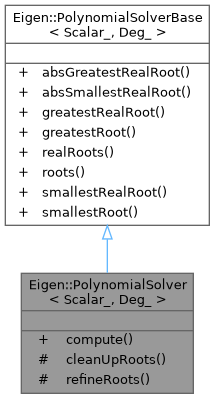
 Inheritance diagram for Eigen::PolynomialSolver< Scalar_, Deg_ >:
Public Member Functions | |
| template<typename OtherPolynomial> | |
| void | compute (const OtherPolynomial &poly) |
| Public Member Functions inherited from Eigen::PolynomialSolverBase< Scalar_, Deg_ > | |
| const RealScalar & | absGreatestRealRoot (bool &hasArealRoot, const RealScalar &absImaginaryThreshold=NumTraits< Scalar >::dummy_precision()) const |
| const RealScalar & | absSmallestRealRoot (bool &hasArealRoot, const RealScalar &absImaginaryThreshold=NumTraits< Scalar >::dummy_precision()) const |
| const RealScalar & | greatestRealRoot (bool &hasArealRoot, const RealScalar &absImaginaryThreshold=NumTraits< Scalar >::dummy_precision()) const |
| const RootType & | greatestRoot () const |
| template<typename Stl_back_insertion_sequence> | |
| void | realRoots (Stl_back_insertion_sequence &bi_seq, const RealScalar &absImaginaryThreshold=NumTraits< Scalar >::dummy_precision()) const |
| const RootsType & | roots () const |
| const RealScalar & | smallestRealRoot (bool &hasArealRoot, const RealScalar &absImaginaryThreshold=NumTraits< Scalar >::dummy_precision()) const |
| const RootType & | smallestRoot () const |
Protected Member Functions | |
| template<typename OtherPolynomial> | |
| void | cleanUpRoots (const OtherPolynomial &poly) |
| template<typename OtherPolynomial> | |
| void | refineRoots (const OtherPolynomial &poly) |
|
inlineprotected |
Restores the structure the in-place iteration keeps only to within rounding. The roots of a real polynomial are real or conjugate pairs: two iterates closer to each other's conjugate than to the real axis become exactly conjugate, and an iterate left without a partner becomes real. Residual-based snapping of the remaining roots requires an imaginary part at most sqrt(eps) times the real part and a finite rounding bound.
|
inline |
Computes the complex roots of a new polynomial.
|
inlineprotected |
Refines the eigenvalue estimates in m_roots by Ehrlich-Aberth iterations (Ehrlich 1967; Aberth 1973), \( z_i \leftarrow z_i - w_i / (1 - w_i \sum_{j \ne i} (z_i - z_j)^{-1}) \) with \( w_i = p(z_i) / p'(z_i) \). The iteration is cubic for simple roots, and the sum keeps the iterates apart, so every root is refined at once without deflation. Updates use the latest estimates; real starting values receive an epsilon-sized imaginary perturbation so they can reach nonreal roots. At the sweep limit, unfinished estimates are compared with their initial polynomial residuals. A root is final once \( |p(z_i)| \) is within the rounding bound of its evaluation, so that \( z_i \) is an exact root of a polynomial that close to \( p \) (the stopping rule of Bini 1996), or once its Newton correction is below one ulp.
 1.13.2