|
Eigen-Contrib
5.0.1
|

|
|
Eigen-Contrib
5.0.1
|
|
#include <contrib/Eigen/src/StructuredMatrices/DiagonalPlusLowRank.h>
An n x n operator \( D + U V^H \): a diagonal matrix plus a rank-k correction, stored as its diagonal and the two n x k factors.
Products cost O(nk) instead of O(n^2). Linear systems are solved in O(nk^2) through the Woodbury identity [1] \( (D + UV^H)^{-1} = D^{-1} - D^{-1} U (I_k + V^H D^{-1} U)^{-1} V^H D^{-1} \), factoring only the k x k capacitance matrix (solve). The determinant follows from the matrix determinant lemma [2] \( \det(D)\,\det(I_k + V^H D^{-1} U) \) (determinant), and the class is closed under inverse, transpose, conjugate and adjoint.
The rank-k correction may have k = 0 (a plain diagonal operator). k is not required to be small, but every advantage over a dense matrix vanishes as k approaches n.
The operator stores its own copies of the diagonal and the factors and derives from EigenBase. Because operator* returns an Eigen product expression, a DiagonalPlusLowRank also drops into the matrix-free iterative solvers, and it can be assigned to a dense matrix when an explicit representation is needed. As with any matrix-free operator, the iterative solvers must be instantiated with IdentityPreconditioner (e.g. GMRES<DiagonalPlusLowRank<double>,IdentityPreconditioner>): the default preconditioners read individual coefficients through col() or InnerIterator, which the structured operators do not expose.
| Scalar_ | the scalar type, real or complex. |
| Size_ | the dimension at compile time, or Dynamic (the default). |
| Rank_ | the correction rank at compile time, or Dynamic (the default). |
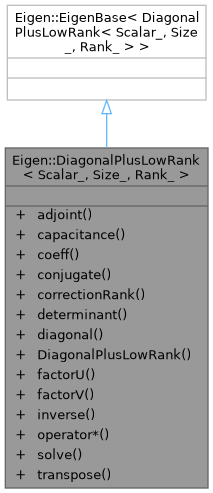
 Inheritance diagram for Eigen::DiagonalPlusLowRank< Scalar_, Size_, Rank_ >:
Public Member Functions | |
| DiagonalPlusLowRank | adjoint () const |
| CapacitanceType | capacitance () const |
| Scalar | coeff (Index row, Index col) const |
| DiagonalPlusLowRank | conjugate () const |
| Index | correctionRank () const |
| Scalar | determinant () const |
| const DiagonalVector & | diagonal () const |
| template<typename DDerived, typename UDerived, typename VDerived> | |
| DiagonalPlusLowRank (const MatrixBase< DDerived > &d, const MatrixBase< UDerived > &U, const MatrixBase< VDerived > &V) | |
| const FactorType & | factorU () const |
| const FactorType & | factorV () const |
| DiagonalPlusLowRank | inverse () const |
| template<typename Rhs> | |
| Product< DiagonalPlusLowRank, Rhs > | operator* (const MatrixBase< Rhs > &v) const |
| template<typename Rhs> | |
| Matrix< Scalar, Size_, Rhs::ColsAtCompileTime > | solve (const MatrixBase< Rhs > &b) const |
| DiagonalPlusLowRank | transpose () const |
|
inline |
Builds the operator diag(d) + U*V.adjoint(). The factors must have the same number of columns (the correction rank k, possibly zero) and as many rows as d has entries.
|
inline |
*this, itself a DiagonalPlusLowRank operator: \( (D + UV^H)^H = \bar D + V U^H \).
|
inline |
|
inline |
|
inline |
*this, itself a DiagonalPlusLowRank operator.
|
inline |
k.
|
inline |
m * 2^e (the split fraction/exponent determinant convention of LINPACK's xGEDI [3]) – the diagonal entries and the LU pivots of the capacitance matrix are renormalized to unit magnitude one at a time [4], with the powers of two tracked in a shared exponent – so neither ordinary determinant on its own can overflow or underflow when the combined determinant is representable, whatever the ordering and magnitudes of the entries. Genuinely out-of-range determinants still saturate to (signed) zero or infinity. The capacitance entries themselves are formed in plain arithmetic (see capacitance): at extreme factor magnitudes such as d = 1e-200, U = 1e-200, V = 1e200 they, and with them the determinant, overflow although the determinant (~1) is representable.
|
inline |
d.
|
inline |
U.
|
inline |
V.
|
inline |
*this, itself a DiagonalPlusLowRank operator: by the Woodbury identity [1], \( (D + UV^H)^{-1} = D^{-1} + U' V'^H \) with \( U' = -D^{-1} U (I_k + V^H D^{-1} U)^{-1} \) and \( V' = D^{-H} V \).
|
inline |
|
inline |
k x k capacitance matrix: O(nk^2 + k^3) setup and O(nk) per right-hand side. Supports multiple right-hand sides. max|1/d| greatly exceeds the norm of the operator's inverse, the correction cancels most of those amplified digits and the achievable accuracy degrades accordingly, even for a well-conditioned operator [5].
|
inline |
*this, itself a DiagonalPlusLowRank operator: \( (D + UV^H)^T = D + \bar V \bar U^H \).  1.13.2