Eigen-Contrib  5.0.1
 
Loading...
Searching...
No Matches
Eigen::CauchyLU< Scalar_ > Class Template Reference

#include <contrib/Eigen/src/StructuredMatrices/Cauchy.h>

Detailed Description

template<typename Scalar_>
class Eigen::CauchyLU< Scalar_ >

Partially pivoted O(n^2) LU solver for square Cauchy systems (Gohberg-Kailath-Olshevsky).

A Cauchy matrix satisfies the displacement equation \( D_x C - C D_y = \mathbf{1}\mathbf{1}^T \), and – crucially – this structure survives row permutations. The GKO algorithm exploits it to compute the row-pivoted factorization P*C = L*U in O(n^2) operations: at each step the current column of the Schur complement is generated from O(n) data, the largest entry is chosen as pivot, and the Schur complement stays Cauchy-like with updated generators. This gives Cauchy systems what the Levinson world lacks: genuine partial pivoting at fast-algorithm cost.

Usage follows the usual decomposition style, including the transposed and adjoint solves of SolverBase (from the same factorization):

CauchyLU<double> lu(C); // or lu.compute(C);
VectorXd u = lu.solve(b); // solve C * u = b
VectorXd v = lu.transpose().solve(b); // solve C^T * v = b
VectorXd w = lu.adjoint().solve(b); // solve C^H * w = b
CauchyLU()
Definition Cauchy.h:337
Matrix< double, Dynamic, 1 > VectorXd

The factors are stored densely (O(n^2) memory, like the dense LU decompositions).

References: I. Gohberg, T. Kailath, V. Olshevsky, "Fast Gaussian elimination with partial pivoting for matrices with displacement structure," Math. Comp. 64 (1995).

Template Parameters
Scalar_the scalar type, real or complex.
See also
class Cauchy
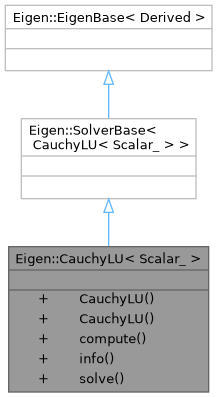
+ Inheritance diagram for Eigen::CauchyLU< Scalar_ >:

Public Member Functions

 CauchyLU ()
 
template<int Rows_, int Cols_>
 CauchyLU (const Cauchy< Scalar, Rows_, Cols_ > &C)
 
template<int Rows_, int Cols_>
CauchyLU & compute (const Cauchy< Scalar, Rows_, Cols_ > &C)
 
ComputationInfo info () const
 
template<typename Rhs>
const Solve< CauchyLU, Rhs > solve (const MatrixBase< Rhs > &b) const
 

Constructor & Destructor Documentation

◆ CauchyLU() [1/2]

template<typename Scalar_>
Eigen::CauchyLU< Scalar_ >::CauchyLU ( )
inline

Default constructor; call compute before solve.

◆ CauchyLU() [2/2]

template<typename Scalar_>
template<int Rows_, int Cols_>
Eigen::CauchyLU< Scalar_ >::CauchyLU ( const Cauchy< Scalar, Rows_, Cols_ > & C)
inlineexplicit

Constructs and factorizes from the square Cauchy matrix C.

Member Function Documentation

◆ compute()

template<typename Scalar_>
template<int Rows_, int Cols_>
CauchyLU & Eigen::CauchyLU< Scalar_ >::compute ( const Cauchy< Scalar, Rows_, Cols_ > & C)
inline

Factorizes the square Cauchy matrix C as P*C = L*U by the GKO recursion with partial pivoting. The Schur complement retains the form

\[ S_{ij}=\frac{a_i b_j}{x_i-y_j}, \qquad a_i\leftarrow a_i\frac{x_i-x_k}{x_i-y_k},\quad b_j\leftarrow b_j\frac{y_j-y_k}{y_j-x_k}. \]

This follows from the rank-one displacement \(D_x C-C D_y=\mathbf{1}\mathbf{1}^T\).

See also
solve

◆ info()

template<typename Scalar_>
ComputationInfo Eigen::CauchyLU< Scalar_ >::info ( ) const
inline
Returns
Success, or NumericalIssue when the factorization encounters a zero or non-finite entry that prevents a usable factorization.

◆ solve()

template<typename Scalar_>
template<typename Rhs>
const Solve< CauchyLU, Rhs > Eigen::CauchyLU< Scalar_ >::solve ( const MatrixBase< Rhs > & b) const
inline
Returns
the solution u of C*u = b, as a lazily evaluated expression. Supports multiple right-hand sides. The transposed and adjoint systems reuse the same factorization through transpose().solve(b) and adjoint().solve(b).
Precondition
compute has been called.

The documentation for this class was generated from the following file: