template<typename MatrixType_, typename PermutationIndex_>
class Eigen::FullPivHouseholderQR< MatrixType_, PermutationIndex_ >
Householder rank-revealing QR decomposition of a matrix with full pivoting.
- Template Parameters
-
| MatrixType_ | the type of the matrix of which we are computing the QR decomposition |
This class performs a rank-revealing QR decomposition of a matrix A into matrices Q, R and a column permutation P such that
\[ \mathbf{A} \, \mathbf{P} = \mathbf{Q} \, \mathbf{R}
\]
by using Householder transformations. Equivalently, \( \mathbf{A} = \mathbf{Q} \, \mathbf{R} \, \mathbf{P}^{-1} \). Here P is the column permutation returned by colsPermutation(), Q is the unitary matrix returned by matrixQ(), and R is an upper triangular matrix. Row transpositions used during pivoting are folded into Q.
This decomposition performs a very prudent full pivoting in order to be rank-revealing and achieve optimal numerical stability. The trade-off is that it is slower than HouseholderQR and ColPivHouseholderQR.
This class supports the inplace decomposition mechanism.
- See also
- MatrixBase::fullPivHouseholderQr()
|
| MatrixType::RealScalar | absDeterminant () const |
| |
| const PermutationType & | colsPermutation () const |
| |
| template<typename InputType> |
| FullPivHouseholderQR< MatrixType, PermutationIndex > & | compute (const EigenBase< InputType > &matrix) |
| |
| MatrixType::Scalar | determinant () const |
| |
| Index | dimensionOfKernel () const |
| |
| | FullPivHouseholderQR () |
| | Default Constructor.
|
| |
| template<typename InputType> |
| | FullPivHouseholderQR (const EigenBase< InputType > &matrix) |
| | Constructs a QR factorization from a given matrix.
|
| |
| template<typename InputType> |
| | FullPivHouseholderQR (EigenBase< InputType > &matrix) |
| | Constructs a QR factorization from a given matrix.
|
| |
| | FullPivHouseholderQR (Index rows, Index cols) |
| | Default Constructor with memory preallocation.
|
| |
| const HCoeffsType & | hCoeffs () const |
| |
| ComputationInfo | info () const |
| | Reports whether the QR factorization was successful.
|
| |
| Inverse< FullPivHouseholderQR > | inverse () const |
| |
| bool | isInjective () const |
| |
| bool | isInvertible () const |
| |
| bool | isSurjective () const |
| |
| MatrixType::RealScalar | logAbsDeterminant () const |
| |
| MatrixQReturnType | matrixQ (void) const |
| |
| const MatrixType & | matrixQR () const |
| |
| RealScalar | maxPivot () const |
| |
| Index | nonzeroPivots () const |
| |
| RealScalar | pivotCoeff (Index i) const |
| |
| Index | rank () const |
| |
| const IntDiagSizeVectorType & | rowsTranspositions () const |
| |
| FullPivHouseholderQR & | setThreshold (const RealScalar &threshold) |
| |
| FullPivHouseholderQR & | setThreshold (Default_t) |
| |
| MatrixType::Scalar | signDeterminant () const |
| |
| template<typename Rhs> |
| Solve< FullPivHouseholderQR, Rhs > | solve (const MatrixBase< Rhs > &b) const |
| |
| RealScalar | threshold () const |
| |
| const AdjointReturnType | adjoint () const |
| |
| constexpr FullPivHouseholderQR< MatrixType_, PermutationIndex_ > & | derived () |
| |
| constexpr const FullPivHouseholderQR< MatrixType_, PermutationIndex_ > & | derived () const |
| |
| Solve< FullPivHouseholderQR< MatrixType_, PermutationIndex_ >, Rhs > | solve (const MatrixBase< Rhs > &b) const |
| |
| | SolverBase ()=default |
| |
| const ConstTransposeReturnType | transpose () const |
| |
| constexpr Index | cols () const noexcept |
| |
| constexpr FullPivHouseholderQR< MatrixType_, PermutationIndex_ > & | derived () |
| |
| constexpr const FullPivHouseholderQR< MatrixType_, PermutationIndex_ > & | derived () const |
| |
| constexpr Index | rows () const noexcept |
| |
| constexpr Index | size () const noexcept |
| |
| Index | dimensionOfKernel () const |
| |
| bool | isInjective () const |
| |
| bool | isInvertible () const |
| |
| bool | isSurjective () const |
| |
| RealScalar | maxPivot () const |
| |
| Index | nonzeroPivots () const |
| |
| Index | rank () const |
| |
| FullPivHouseholderQR< MatrixType_, PermutationIndex_ > & | setThreshold (const RealScalar &threshold) |
| |
| FullPivHouseholderQR< MatrixType_, PermutationIndex_ > & | setThreshold (Default_t) |
| |
| RealScalar | threshold () const |
| |
template<typename MatrixType_, typename PermutationIndex_>
Allows to prescribe a threshold to be used by certain methods, such as rank(), which need to determine when pivots are to be considered nonzero. This is not used for the decomposition itself.
When it needs to get the threshold value, Eigen calls threshold(). By default, this uses a formula to automatically determine a reasonable threshold. Once you have called the present method setThreshold(const RealScalar&), your value is used instead.
- Parameters
-
| threshold | The new value to use as the threshold. |
A pivot will be considered nonzero if its absolute value is strictly greater than \( \vert pivot \vert \leqslant threshold \times \vert maxpivot \vert \) where maxpivot is the biggest pivot.
If you want to come back to the default behavior, call setThreshold(Default_t)
template<typename MatrixType_, typename PermutationIndex_>
template<typename Rhs>
This method finds a solution x to the equation Ax=b, where A is the matrix of which *this is the QR decomposition.
- Parameters
-
| b | the right-hand-side of the equation to solve. |
- Returns
- the exact or least-square solution if the rank is greater or equal to the number of columns of A, and an arbitrary solution otherwise. For overdetermined systems, the least-square solution minimizes the Euclidean norm \( \Vert A x - b \Vert \). For rank-deficient matrices, this method generally does not compute the minimum-norm solution; use CompleteOrthogonalDecomposition or an SVD if that is required.
This method just tries to find as good a solution as possible. If you want to check whether a solution exists or if it is accurate, just call this function to get a result and then compute the error of this result, or use MatrixBase::isApprox() directly, for instance like this:
bool a_solution_exists = (A*result).isApprox(b, precision);
This method avoids dividing by zero, so that the non-existence of a solution doesn't by itself mean that you'll get inf or nan values.
If there exists more than one solution, this method will arbitrarily choose one.
Example:
cout << "Here is the matrix m:" << endl << m << endl;
cout << "Here is the matrix y:" << endl << y << endl;
x = m.fullPivHouseholderQr().solve(y);
assert(y.isApprox(m* x));
cout << "Here is a solution x to the equation mx=y:" << endl << x << endl;
Matrix< float, 3, 3 > Matrix3f
3×3 matrix of type float.
Definition Matrix.h:488
Output:
Here is the matrix m:
  0.68  0.597  -0.33
-0.211  0.823  0.536
 0.566 -0.605 -0.444
Here is the matrix y:
  0.108   -0.27   0.832
-0.0452  0.0268   0.271
  0.258   0.904   0.435
Here is a solution x to the equation mx=y:
 0.609   2.68   1.67
-0.231  -1.57 0.0713
  0.51   3.51   1.05


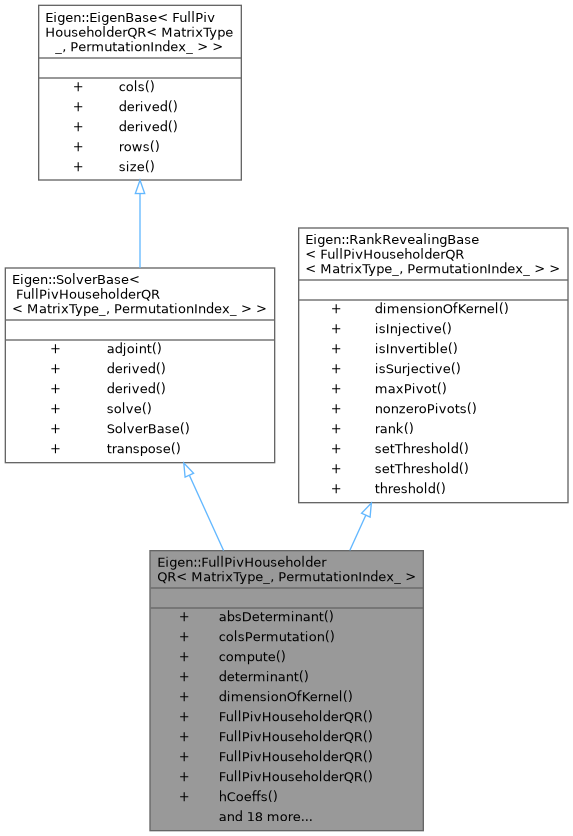
 Inheritance diagram for Eigen::FullPivHouseholderQR< MatrixType_, PermutationIndex_ >:
 1.13.2