|
Eigen
3.3.9
|

|
|
Eigen
3.3.9
|
|
#include <Eigen/src/SparseCore/SparseMatrixBase.h>
Base class of any sparse matrices or sparse expressions.
| Derived | is the derived type, e.g. a sparse matrix type, or an expression, etc. |
This class can be extended with the help of the plugin mechanism described on the page Extending MatrixBase (and other classes) by defining the preprocessor symbol EIGEN_SPARSEMATRIXBASE_PLUGIN.
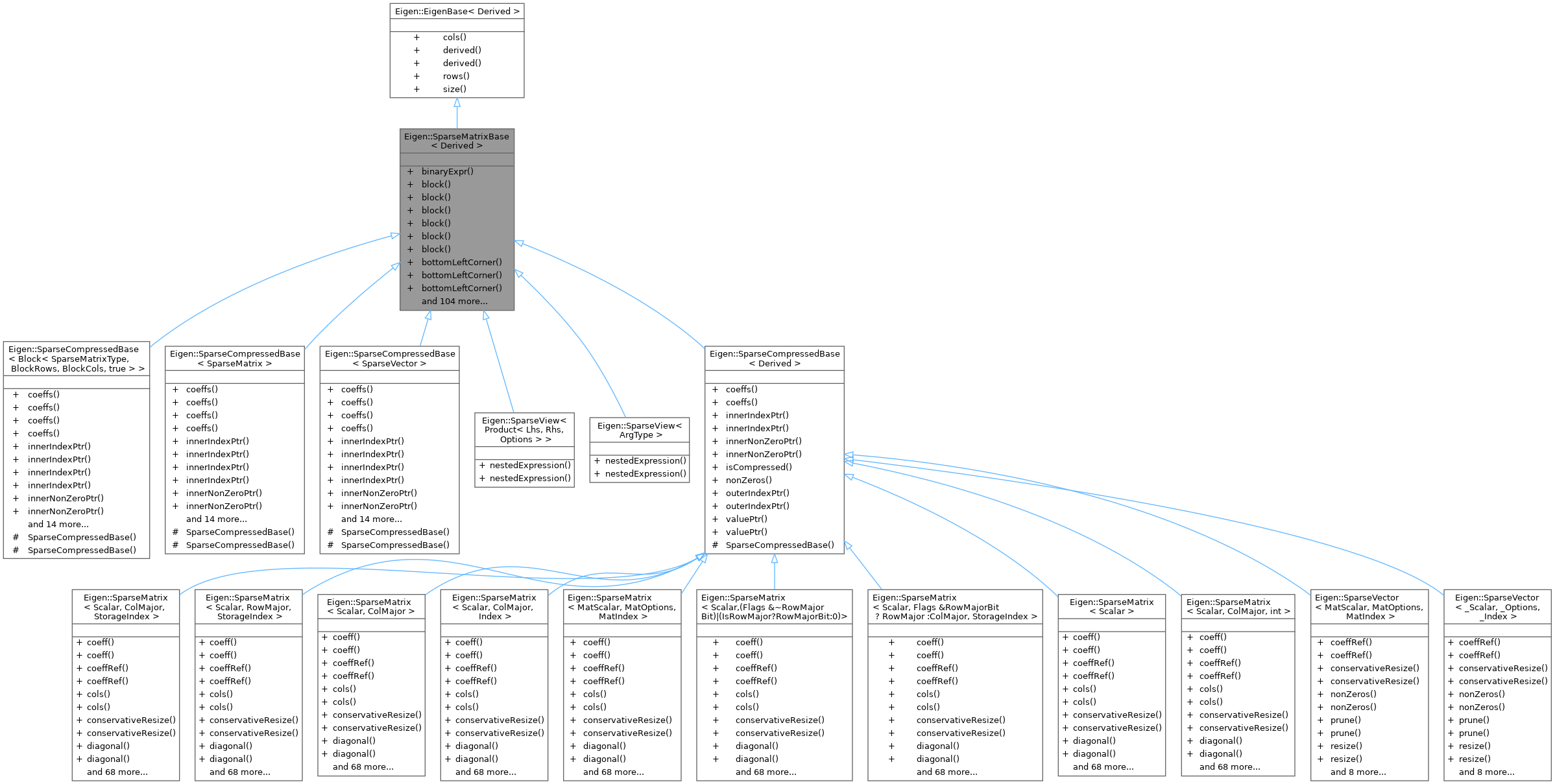
 Inheritance diagram for Eigen::SparseMatrixBase< Derived >:
Public Types | |
| enum | { RowsAtCompileTime , ColsAtCompileTime , SizeAtCompileTime , MaxRowsAtCompileTime , MaxColsAtCompileTime , MaxSizeAtCompileTime , IsVectorAtCompileTime , Flags , IsRowMajor , InnerSizeAtCompileTime } |
| typedef internal::traits< Derived >::StorageIndex | StorageIndex |
| typedef Scalar | value_type |
| Public Types inherited from Eigen::EigenBase< Derived > | |
| typedef Eigen::Index | Index |
| The interface type of indices. | |
Public Member Functions | |
| template<typename CustomBinaryOp, typename OtherDerived> | |
| const CwiseBinaryOp< CustomBinaryOp, const Derived, const OtherDerived > | binaryExpr (const Eigen::SparseMatrixBase< OtherDerived > &other, const CustomBinaryOp &func=CustomBinaryOp()) const |
| template<int NRows, int NCols> | |
| FixedBlockXpr< NRows, NCols >::Type | block (Index startRow, Index startCol) |
| template<int NRows, int NCols> | |
| const ConstFixedBlockXpr< NRows, NCols >::Type | block (Index startRow, Index startCol) const |
| This is the const version of block<>(Index, Index). */. | |
| BlockXpr | block (Index startRow, Index startCol, Index blockRows, Index blockCols) |
| template<int NRows, int NCols> | |
| FixedBlockXpr< NRows, NCols >::Type | block (Index startRow, Index startCol, Index blockRows, Index blockCols) |
| const ConstBlockXpr | block (Index startRow, Index startCol, Index blockRows, Index blockCols) const |
| This is the const version of block(Index,Index,Index,Index). */. | |
| template<int NRows, int NCols> | |
| const ConstFixedBlockXpr< NRows, NCols >::Type | block (Index startRow, Index startCol, Index blockRows, Index blockCols) const |
| This is the const version of block<>(Index, Index, Index, Index). | |
| template<int CRows, int CCols> | |
| FixedBlockXpr< CRows, CCols >::Type | bottomLeftCorner () |
| template<int CRows, int CCols> | |
| const ConstFixedBlockXpr< CRows, CCols >::Type | bottomLeftCorner () const |
| This is the const version of bottomLeftCorner<int, int>(). | |
| BlockXpr | bottomLeftCorner (Index cRows, Index cCols) |
| template<int CRows, int CCols> | |
| FixedBlockXpr< CRows, CCols >::Type | bottomLeftCorner (Index cRows, Index cCols) |
| const ConstBlockXpr | bottomLeftCorner (Index cRows, Index cCols) const |
| This is the const version of bottomLeftCorner(Index, Index). | |
| template<int CRows, int CCols> | |
| const ConstFixedBlockXpr< CRows, CCols >::Type | bottomLeftCorner (Index cRows, Index cCols) const |
| This is the const version of bottomLeftCorner<int, int>(Index, Index). | |
| template<int CRows, int CCols> | |
| FixedBlockXpr< CRows, CCols >::Type | bottomRightCorner () |
| template<int CRows, int CCols> | |
| const ConstFixedBlockXpr< CRows, CCols >::Type | bottomRightCorner () const |
| This is the const version of bottomRightCorner<int, int>(). | |
| BlockXpr | bottomRightCorner (Index cRows, Index cCols) |
| template<int CRows, int CCols> | |
| FixedBlockXpr< CRows, CCols >::Type | bottomRightCorner (Index cRows, Index cCols) |
| const ConstBlockXpr | bottomRightCorner (Index cRows, Index cCols) const |
| This is the const version of bottomRightCorner(Index, Index). | |
| template<int CRows, int CCols> | |
| const ConstFixedBlockXpr< CRows, CCols >::Type | bottomRightCorner (Index cRows, Index cCols) const |
| This is the const version of bottomRightCorner<int, int>(Index, Index). | |
| RowsBlockXpr | bottomRows (Index n) |
| ConstRowsBlockXpr | bottomRows (Index n) const |
| This is the const version of bottomRows(Index). | |
| template<int N> | |
| NRowsBlockXpr< N >::Type | bottomRows (Index n=N) |
| template<int N> | |
| ConstNRowsBlockXpr< N >::Type | bottomRows (Index n=N) const |
| This is the const version of bottomRows<int>(). | |
| template<typename NewType> | |
| CastXpr< NewType >::Type | cast () const |
| ColXpr | col (Index i) |
| ConstColXpr | col (Index i) const |
| This is the const version of col(). | |
| Index | cols () const |
| ConjugateReturnType | conjugate () const |
| const CwiseAbsReturnType | cwiseAbs () const |
| const CwiseAbs2ReturnType | cwiseAbs2 () const |
| template<typename OtherDerived> | |
| const CwiseBinaryOp< std::equal_to< Scalar >, const Derived, const OtherDerived > | cwiseEqual (const Eigen::SparseMatrixBase< OtherDerived > &other) const |
| const CwiseScalarEqualReturnType | cwiseEqual (const Scalar &s) const |
| const CwiseInverseReturnType | cwiseInverse () const |
| template<typename OtherDerived> | |
| const CwiseBinaryOp< internal::scalar_max_op< Scalar, Scalar >, const Derived, const OtherDerived > | cwiseMax (const Eigen::SparseMatrixBase< OtherDerived > &other) const |
| const CwiseBinaryOp< internal::scalar_max_op< Scalar, Scalar >, const Derived, const ConstantReturnType > | cwiseMax (const Scalar &other) const |
| template<typename OtherDerived> | |
| const CwiseBinaryOp< internal::scalar_min_op< Scalar, Scalar >, const Derived, const OtherDerived > | cwiseMin (const Eigen::SparseMatrixBase< OtherDerived > &other) const |
| const CwiseBinaryOp< internal::scalar_min_op< Scalar, Scalar >, const Derived, const ConstantReturnType > | cwiseMin (const Scalar &other) const |
| template<typename OtherDerived> | |
| const CwiseBinaryOp< std::not_equal_to< Scalar >, const Derived, const OtherDerived > | cwiseNotEqual (const Eigen::SparseMatrixBase< OtherDerived > &other) const |
| template<typename OtherDerived> | |
| const CwiseBinaryOp< internal::scalar_product_op< Derived ::Scalar, OtherDerived ::Scalar >, const Derived, const OtherDerived > | cwiseProduct (const Eigen::SparseMatrixBase< OtherDerived > &other) const |
| template<typename OtherDerived> | |
| const CwiseBinaryOp< internal::scalar_quotient_op< Scalar >, const Derived, const OtherDerived > | cwiseQuotient (const Eigen::SparseMatrixBase< OtherDerived > &other) const |
| const CwiseSignReturnType | cwiseSign () const |
| const CwiseSqrtReturnType | cwiseSqrt () const |
| const internal::eval< Derived >::type | eval () const |
| SegmentReturnType | head (Index n) |
| ConstSegmentReturnType | head (Index n) const |
| This is the const version of head(Index). | |
| template<int N> | |
| FixedSegmentReturnType< N >::Type | head (Index n=N) |
| template<int N> | |
| ConstFixedSegmentReturnType< N >::Type | head (Index n=N) const |
| This is the const version of head<int>(). | |
| NonConstImagReturnType | imag () |
| const ImagReturnType | imag () const |
| Index | innerSize () const |
| InnerVectorReturnType | innerVector (Index outer) |
| const ConstInnerVectorReturnType | innerVector (Index outer) const |
| InnerVectorsReturnType | innerVectors (Index outerStart, Index outerSize) |
| const ConstInnerVectorsReturnType | innerVectors (Index outerStart, Index outerSize) const |
| bool | isVector () const |
| ColsBlockXpr | leftCols (Index n) |
| ConstColsBlockXpr | leftCols (Index n) const |
| This is the const version of leftCols(Index). | |
| template<int N> | |
| NColsBlockXpr< N >::Type | leftCols (Index n=N) |
| template<int N> | |
| ConstNColsBlockXpr< N >::Type | leftCols (Index n=N) const |
| This is the const version of leftCols<int>(). | |
| template<int N> | |
| NColsBlockXpr< N >::Type | middleCols (Index startCol, Index n=N) |
| template<int N> | |
| ConstNColsBlockXpr< N >::Type | middleCols (Index startCol, Index n=N) const |
| This is the const version of middleCols<int>(). | |
| ColsBlockXpr | middleCols (Index startCol, Index numCols) |
| ConstColsBlockXpr | middleCols (Index startCol, Index numCols) const |
| This is the const version of middleCols(Index,Index). | |
| RowsBlockXpr | middleRows (Index startRow, Index n) |
| ConstRowsBlockXpr | middleRows (Index startRow, Index n) const |
| This is the const version of middleRows(Index,Index). | |
| template<int N> | |
| NRowsBlockXpr< N >::Type | middleRows (Index startRow, Index n=N) |
| template<int N> | |
| ConstNRowsBlockXpr< N >::Type | middleRows (Index startRow, Index n=N) const |
| This is the const version of middleRows<int>(). | |
| template<typename OtherDerived> | |
| const CwiseBinaryOp< internal::scalar_boolean_and_op, const Derived, const OtherDerived > | operator&& (const Eigen::SparseMatrixBase< OtherDerived > &other) const |
| template<typename OtherDerived> | |
| const Product< Derived, OtherDerived, AliasFreeProduct > | operator* (const SparseMatrixBase< OtherDerived > &other) const |
| template<typename T> | |
| const CwiseBinaryOp< internal::scalar_product_op< Scalar, T >, Derived, Constant< T > > | operator* (const T &scalar) const |
| template<typename OtherDerived> | |
| const CwiseBinaryOp< sum< Scalar >, const Derived, const OtherDerived > | operator+ (const Eigen::SparseMatrixBase< OtherDerived > &other) const |
| const NegativeReturnType | operator- () const |
| template<typename OtherDerived> | |
| const CwiseBinaryOp< difference< Scalar >, const Derived, const OtherDerived > | operator- (const Eigen::SparseMatrixBase< OtherDerived > &other) const |
| template<typename T> | |
| const CwiseBinaryOp< internal::scalar_quotient_op< Scalar, T >, Derived, Constant< T > > | operator/ (const T &scalar) const |
| template<typename OtherDerived> | |
| const CwiseBinaryOp< internal::scalar_boolean_or_op, const Derived, const OtherDerived > | operator|| (const Eigen::SparseMatrixBase< OtherDerived > &other) const |
| Index | outerSize () const |
| const SparseView< Derived > | pruned (const Scalar &reference=Scalar(0), const RealScalar &epsilon=NumTraits< Scalar >::dummy_precision()) const |
| NonConstRealReturnType | real () |
| RealReturnType | real () const |
| ColsBlockXpr | rightCols (Index n) |
| ConstColsBlockXpr | rightCols (Index n) const |
| This is the const version of rightCols(Index). | |
| template<int N> | |
| NColsBlockXpr< N >::Type | rightCols (Index n=N) |
| template<int N> | |
| ConstNColsBlockXpr< N >::Type | rightCols (Index n=N) const |
| This is the const version of rightCols<int>(). | |
| RowXpr | row (Index i) |
| ConstRowXpr | row (Index i) const |
| This is the const version of row(). */. | |
| Index | rows () const |
| SegmentReturnType | segment (Index start, Index n) |
| ConstSegmentReturnType | segment (Index start, Index n) const |
| This is the const version of segment(Index,Index). | |
| template<int N> | |
| FixedSegmentReturnType< N >::Type | segment (Index start, Index n=N) |
| template<int N> | |
| ConstFixedSegmentReturnType< N >::Type | segment (Index start, Index n=N) const |
| This is the const version of segment<int>(Index). | |
| Index | size () const |
| SegmentReturnType | tail (Index n) |
| ConstSegmentReturnType | tail (Index n) const |
| This is the const version of tail(Index). | |
| template<int N> | |
| FixedSegmentReturnType< N >::Type | tail (Index n=N) |
| template<int N> | |
| ConstFixedSegmentReturnType< N >::Type | tail (Index n=N) const |
| This is the const version of tail<int>. | |
| template<int CRows, int CCols> | |
| FixedBlockXpr< CRows, CCols >::Type | topLeftCorner () |
| template<int CRows, int CCols> | |
| const ConstFixedBlockXpr< CRows, CCols >::Type | topLeftCorner () const |
| This is the const version of topLeftCorner<int, int>(). | |
| BlockXpr | topLeftCorner (Index cRows, Index cCols) |
| template<int CRows, int CCols> | |
| FixedBlockXpr< CRows, CCols >::Type | topLeftCorner (Index cRows, Index cCols) |
| const ConstBlockXpr | topLeftCorner (Index cRows, Index cCols) const |
| This is the const version of topLeftCorner(Index, Index). | |
| template<int CRows, int CCols> | |
| const ConstFixedBlockXpr< CRows, CCols >::Type | topLeftCorner (Index cRows, Index cCols) const |
| This is the const version of topLeftCorner<int, int>(Index, Index). | |
| template<int CRows, int CCols> | |
| FixedBlockXpr< CRows, CCols >::Type | topRightCorner () |
| template<int CRows, int CCols> | |
| const ConstFixedBlockXpr< CRows, CCols >::Type | topRightCorner () const |
| This is the const version of topRightCorner<int, int>(). | |
| BlockXpr | topRightCorner (Index cRows, Index cCols) |
| template<int CRows, int CCols> | |
| FixedBlockXpr< CRows, CCols >::Type | topRightCorner (Index cRows, Index cCols) |
| const ConstBlockXpr | topRightCorner (Index cRows, Index cCols) const |
| This is the const version of topRightCorner(Index, Index). | |
| template<int CRows, int CCols> | |
| const ConstFixedBlockXpr< CRows, CCols >::Type | topRightCorner (Index cRows, Index cCols) const |
| This is the const version of topRightCorner<int, int>(Index, Index). | |
| RowsBlockXpr | topRows (Index n) |
| ConstRowsBlockXpr | topRows (Index n) const |
| This is the const version of topRows(Index). | |
| template<int N> | |
| NRowsBlockXpr< N >::Type | topRows (Index n=N) |
| template<int N> | |
| ConstNRowsBlockXpr< N >::Type | topRows (Index n=N) const |
| This is the const version of topRows<int>(). | |
| SparseSymmetricPermutationProduct< Derived, Upper|Lower > | twistedBy (const PermutationMatrix< Dynamic, Dynamic, StorageIndex > &perm) const |
| template<typename CustomUnaryOp> | |
| const CwiseUnaryOp< CustomUnaryOp, const Derived > | unaryExpr (const CustomUnaryOp &func=CustomUnaryOp()) const |
| Apply a unary operator coefficient-wise. | |
| template<typename CustomViewOp> | |
| const CwiseUnaryView< CustomViewOp, const Derived > | unaryViewExpr (const CustomViewOp &func=CustomViewOp()) const |
| Public Member Functions inherited from Eigen::EigenBase< Derived > | |
| Index | cols () const |
| Derived & | derived () |
| const Derived & | derived () const |
| Index | rows () const |
| Index | size () const |
| typedef internal::traits<Derived>::StorageIndex Eigen::SparseMatrixBase< Derived >::StorageIndex |
The integer type used to store indices within a SparseMatrix. For a SparseMatrix<Scalar,Options,IndexType> it an alias of the third template parameter IndexType.
| typedef Scalar Eigen::SparseMatrixBase< Derived >::value_type |
The numeric type of the expression' coefficients, e.g. float, double, int or std::complex<float>, etc.
It is an alias for the Scalar type
| anonymous enum |
| Enumerator | |
|---|---|
| RowsAtCompileTime | The number of rows at compile-time. This is just a copy of the value provided by the Derived type. If a value is not known at compile-time, it is set to the Dynamic constant.
|
| ColsAtCompileTime | The number of columns at compile-time. This is just a copy of the value provided by the Derived type. If a value is not known at compile-time, it is set to the Dynamic constant.
|
| SizeAtCompileTime | This is equal to the number of coefficients, i.e. the number of rows times the number of columns, or to Dynamic if this is not known at compile-time.
|
| IsVectorAtCompileTime | This is set to true if either the number of rows or the number of columns is known at compile-time to be equal to 1. Indeed, in that case, we are dealing with a column-vector (if there is only one column) or with a row-vector (if there is only one row). |
| Flags | This stores expression Flags flags which may or may not be inherited by new expressions constructed from this one. See the list of flags. |
|
inline |
The template parameter CustomBinaryOp is the type of the functor of the custom operator (see class CwiseBinaryOp for an example)
Here is an example illustrating the use of custom functors:
Output:
   (0.68,0.271)  (0.823,-0.967) (-0.444,-0.687)   (-0.27,0.998)
 (-0.211,0.435) (-0.605,-0.514)  (0.108,-0.198) (0.0268,-0.563)
 (0.566,-0.717)  (-0.33,-0.726) (-0.0452,-0.74)  (0.904,0.0259)
  (0.597,0.214)   (0.536,0.608)  (0.258,-0.782)   (0.832,0.678)
|
inline |
The template parameters NRows and NCols are the number of rows and columns in the block.
| startRow | the first row in the block |
| startCol | the first column in the block |
Example:
Output:
Here is the matrix m:
 7  9 -5 -3
-2 -6  1  0
 6 -3  0  9
 6  6  3  9
Here is m.block<2,2>(1,1):
-6  1
-3  0
Now the matrix m is:
 7  9 -5 -3
-2  0  0  0
 6  0  0  9
 6  6  3  9
|
inline |
| startRow | the first row in the block |
| startCol | the first column in the block |
| blockRows | the number of rows in the block |
| blockCols | the number of columns in the block |
Example:
Output:
Here is the matrix m:
 7  9 -5 -3
-2 -6  1  0
 6 -3  0  9
 6  6  3  9
Here is m.block(1, 1, 2, 2):
-6  1
-3  0
Now the matrix m is:
 7  9 -5 -3
-2  0  0  0
 6  0  0  9
 6  6  3  9
|
inline |
| NRows | number of rows in block as specified at compile-time |
| NCols | number of columns in block as specified at compile-time |
| startRow | the first row in the block |
| startCol | the first column in the block |
| blockRows | number of rows in block as specified at run-time |
| blockCols | number of columns in block as specified at run-time |
This function is mainly useful for blocks where the number of rows is specified at compile-time and the number of columns is specified at run-time, or vice versa. The compile-time and run-time information should not contradict. In other words, blockRows should equal NRows unless NRows is Dynamic, and the same for the number of columns.
Example:
Output:
Matrix4i m = Matrix4i::Random();
cout << "Here is the matrix m:" << endl << m << endl;
cout << "Here is the block:" << endl << m.block<2, Dynamic>(1, 1, 2, 3) << endl;
m.block<2, Dynamic>(1, 1, 2, 3).setZero();
cout << "Now the matrix m is:" << endl << m << endl;
|
inline |
The template parameters CRows and CCols are the number of rows and columns in the corner.
Example:
Output:
Here is the matrix m:
 7  9 -5 -3
-2 -6  1  0
 6 -3  0  9
 6  6  3  9
Here is m.bottomLeftCorner<2,2>():
 6 -3
 6  6
Now the matrix m is:
 7  9 -5 -3
-2 -6  1  0
 0  0  0  9
 0  0  3  9
|
inline |
| cRows | the number of rows in the corner |
| cCols | the number of columns in the corner |
Example:
Output:
Here is the matrix m:
 7  9 -5 -3
-2 -6  1  0
 6 -3  0  9
 6  6  3  9
Here is m.bottomLeftCorner(2, 2):
 6 -3
 6  6
Now the matrix m is:
 7  9 -5 -3
-2 -6  1  0
 0  0  0  9
 0  0  3  9
|
inline |
| CRows | number of rows in corner as specified at compile-time |
| CCols | number of columns in corner as specified at compile-time |
| cRows | number of rows in corner as specified at run-time |
| cCols | number of columns in corner as specified at run-time |
This function is mainly useful for corners where the number of rows is specified at compile-time and the number of columns is specified at run-time, or vice versa. The compile-time and run-time information should not contradict. In other words, cRows should equal CRows unless CRows is Dynamic, and the same for the number of columns.
Example:
Output:
Here is the matrix m:
 7  9 -5 -3
-2 -6  1  0
 6 -3  0  9
 6  6  3  9
Here is m.bottomLeftCorner<2,Dynamic>(2,2):
 6 -3
 6  6
Now the matrix m is:
 7  9 -5 -3
-2 -6  1  0
 0  0  0  9
 0  0  3  9
|
inline |
The template parameters CRows and CCols are the number of rows and columns in the corner.
Example:
Output:
Here is the matrix m:
 7  9 -5 -3
-2 -6  1  0
 6 -3  0  9
 6  6  3  9
Here is m.bottomRightCorner<2,2>():
0 9
3 9
Now the matrix m is:
 7  9 -5 -3
-2 -6  1  0
 6 -3  0  0
 6  6  0  0
|
inline |
| cRows | the number of rows in the corner |
| cCols | the number of columns in the corner |
Example:
Output:
Here is the matrix m:
 7  9 -5 -3
-2 -6  1  0
 6 -3  0  9
 6  6  3  9
Here is m.bottomRightCorner(2, 2):
0 9
3 9
Now the matrix m is:
 7  9 -5 -3
-2 -6  1  0
 6 -3  0  0
 6  6  0  0
|
inline |
| CRows | number of rows in corner as specified at compile-time |
| CCols | number of columns in corner as specified at compile-time |
| cRows | number of rows in corner as specified at run-time |
| cCols | number of columns in corner as specified at run-time |
This function is mainly useful for corners where the number of rows is specified at compile-time and the number of columns is specified at run-time, or vice versa. The compile-time and run-time information should not contradict. In other words, cRows should equal CRows unless CRows is Dynamic, and the same for the number of columns.
Example:
Output:
Here is the matrix m:
 7  9 -5 -3
-2 -6  1  0
 6 -3  0  9
 6  6  3  9
Here is m.bottomRightCorner<2,Dynamic>(2,2):
0 9
3 9
Now the matrix m is:
 7  9 -5 -3
-2 -6  1  0
 6 -3  0  0
 6  6  0  0
|
inline |
| n | the number of rows in the block |
Example:
Output:
Here is the array a:
 7  9 -5 -3
-2 -6  1  0
 6 -3  0  9
 6  6  3  9
Here is a.bottomRows(2):
 6 -3  0  9
 6  6  3  9
Now the array a is:
 7  9 -5 -3
-2 -6  1  0
 0  0  0  0
 0  0  0  0
|
inline |
| N | the number of rows in the block as specified at compile-time |
| n | the number of rows in the block as specified at run-time |
The compile-time and run-time information should not contradict. In other words, n should equal N unless N is Dynamic.
Example:
Output:
Here is the array a:
 7  9 -5 -3
-2 -6  1  0
 6 -3  0  9
 6  6  3  9
Here is a.bottomRows<2>():
 6 -3  0  9
 6  6  3  9
Now the array a is:
 7  9 -5 -3
-2 -6  1  0
 0  0  0  0
 0  0  0  0
|
inline |
*this with the Scalar type casted to NewScalar.The template parameter NewScalar is the type we are casting the scalars to.
This method does not change the sparsity of *this: the conversion function is applied to explicitly stored coefficients only.
|
inline |
Example:
Output:
1 4 0
0 5 0
0 6 1
|
inline |
|
inline |
*this. This method does not change the sparsity of *this: the complex conjugate is applied to explicitly stored coefficients only.
|
inline |
*this Example:
Output:
2 4 6
5 1 0
This method does not change the sparsity of *this: the absolute value is applied to explicitly stored coefficients only.
|
inline |
*this Example:
Output:
 4 16 36
25  1  0
This method does not change the sparsity of *this: the squared absolute value is applied to explicitly stored coefficients only.
|
inline |
Example:
Output:
Comparing m with identity matrix:
1 1
0 1
Number of coefficients that are equal: 3
|
inline |
*this and a scalar s
|
inline |
Example:
Output:
  0.5     2     1
0.333     4     1
This method does not change the sparsity of *this: the inverse is applied to explicitly stored coefficients only.
|
inline |
Example:
Output:
4
3
4
|
inline |
|
inline |
Example:
Output:
2
2
3
|
inline |
|
inline |
Example:
Output:
Comparing m with identity matrix:
0 0
1 0
Number of coefficients that are not equal: 1
|
inline |
Example:
Output:
a:
 7  6 -3
-2  9  6
 6 -6 -5
b:
 1 -3  9
 0  0  3
 3  9  5
c:
  7 -18 -27
  0   0  18
 18 -54 -25
|
inline |
Example:
Output:
 0.5
 1.5
1.33
|
inline |
Example:
Output:
 1 -1  1
-1  1  0
This method does not change the sparsity of *this: the sign function is applied to explicitly stored coefficients only.
|
inline |
Example:
Output:
   1
1.41
   2
This method does not change the sparsity of *this: the square-root is applied to explicitly stored coefficients only.
|
inline |
Notice that in the case of a plain matrix or vector (not an expression) this function just returns a const reference, in order to avoid a useless copy.
|
inline |
This is only for vectors (either row-vectors or column-vectors), i.e. matrices which are known at compile-time to have either one row or one column.
| n | the number of coefficients in the segment |
Example:
Output:
Here is the vector v:
 7 -2  6  6
Here is v.head(2):
 7 -2
Now the vector v is:
0 0 6 6
|
inline |
This is only for vectors (either row-vectors or column-vectors), i.e. matrices which are known at compile-time to have either one row or one column.
| N | the number of coefficients in the segment as specified at compile-time |
| n | the number of coefficients in the segment as specified at run-time |
The compile-time and run-time information should not contradict. In other words, n should equal N unless N is Dynamic.
Example:
Output:
Here is the vector v:
 7 -2  6  6
Here is v.head(2):
 7 -2
Now the vector v is:
0 0 6 6
|
inline |
*this. This method does not change the sparsity of *this: the imaginary part function is applied to explicitly stored coefficients only.
|
inline |
*this. This method does not change the sparsity of *this: the imaginary part function is applied to explicitly stored coefficients only.
|
inline |
| SparseMatrixBase< Derived >::InnerVectorReturnType Eigen::SparseMatrixBase< Derived >::innerVector | ( | Index | outer | ) |
*this if *this is col-major (resp. row-major). | const SparseMatrixBase< Derived >::ConstInnerVectorReturnType Eigen::SparseMatrixBase< Derived >::innerVector | ( | Index | outer | ) | const |
*this if *this is col-major (resp. row-major). Read-only. | SparseMatrixBase< Derived >::InnerVectorsReturnType Eigen::SparseMatrixBase< Derived >::innerVectors | ( | Index | outerStart, |
| Index | outerSize ) |
*this if *this is col-major (resp. row-major). | const SparseMatrixBase< Derived >::ConstInnerVectorsReturnType Eigen::SparseMatrixBase< Derived >::innerVectors | ( | Index | outerStart, |
| Index | outerSize ) const |
*this if *this is col-major (resp. row-major). Read-only.
|
inline |
|
inline |
| n | the number of columns in the block |
Example:
Output:
Here is the array a:
 7  9 -5 -3
-2 -6  1  0
 6 -3  0  9
 6  6  3  9
Here is a.leftCols(2):
 7  9
-2 -6
 6 -3
 6  6
Now the array a is:
 0  0 -5 -3
 0  0  1  0
 0  0  0  9
 0  0  3  9
|
inline |
| N | the number of columns in the block as specified at compile-time |
| n | the number of columns in the block as specified at run-time |
The compile-time and run-time information should not contradict. In other words, n should equal N unless N is Dynamic.
Example:
Output:
Here is the array a:
 7  9 -5 -3
-2 -6  1  0
 6 -3  0  9
 6  6  3  9
Here is a.leftCols<2>():
 7  9
-2 -6
 6 -3
 6  6
Now the array a is:
 0  0 -5 -3
 0  0  1  0
 0  0  0  9
 0  0  3  9
|
inline |
| N | the number of columns in the block as specified at compile-time |
| startCol | the index of the first column in the block |
| n | the number of columns in the block as specified at run-time |
The compile-time and run-time information should not contradict. In other words, n should equal N unless N is Dynamic.
Example:
Output:
A =
  7  -6   0   9 -10
 -2  -3   3   3  -5
  6   6  -3   5  -8
  6  -5   0  -8   6
  9   1   9   2  -7

A(:,1..3) =
-6  0  9
-3  3  3
 6 -3  5
-5  0 -8
 1  9  2
|
inline |
| startCol | the index of the first column in the block |
| numCols | the number of columns in the block |
Example:
Output:
A =
  7  -6   0   9 -10
 -2  -3   3   3  -5
  6   6  -3   5  -8
  6  -5   0  -8   6
  9   1   9   2  -7

A(1..3,:) =
-6  0  9
-3  3  3
 6 -3  5
-5  0 -8
 1  9  2
|
inline |
| startRow | the index of the first row in the block |
| n | the number of rows in the block |
Example:
Output:
A =
  7  -6   0   9 -10
 -2  -3   3   3  -5
  6   6  -3   5  -8
  6  -5   0  -8   6
  9   1   9   2  -7

A(2..3,:) =
 6  6 -3  5 -8
 6 -5  0 -8  6
|
inline |
| N | the number of rows in the block as specified at compile-time |
| startRow | the index of the first row in the block |
| n | the number of rows in the block as specified at run-time |
The compile-time and run-time information should not contradict. In other words, n should equal N unless N is Dynamic.
Example:
Output:
A =
  7  -6   0   9 -10
 -2  -3   3   3  -5
  6   6  -3   5  -8
  6  -5   0  -8   6
  9   1   9   2  -7

A(1..3,:) =
-2 -3  3  3 -5
 6  6 -3  5 -8
 6 -5  0 -8  6
|
inline |
*this and other Example:
Output:
0
0
0
|
inline |
ref is a meaningful non zero reference value. | const CwiseBinaryOp< internal::scalar_product_op< Scalar, T >, Derived, Constant< T > > Eigen::SparseMatrixBase< Derived >::operator* | ( | const T & | scalar | ) | const |
*this scaled by the scalar factor scalar | T | is the scalar type of scalar. It must be compatible with the scalar type of the given expression. |
| const CwiseBinaryOp< sum< Scalar >, const Derived, const OtherDerived > Eigen::SparseMatrixBase< Derived >::operator+ | ( | const Eigen::SparseMatrixBase< OtherDerived > & | other | ) | const |
*this and other
|
inline |
*this This method does not change the sparsity of *this: the opposite is applied to explicitly stored coefficients only.
| const CwiseBinaryOp< difference< Scalar >, const Derived, const OtherDerived > Eigen::SparseMatrixBase< Derived >::operator- | ( | const Eigen::SparseMatrixBase< OtherDerived > & | other | ) | const |
*this and other | const CwiseBinaryOp< internal::scalar_quotient_op< Scalar, T >, Derived, Constant< T > > Eigen::SparseMatrixBase< Derived >::operator/ | ( | const T & | scalar | ) | const |
*this divided by the scalar value scalar | T | is the scalar type of scalar. It must be compatible with the scalar type of the given expression. |
|
inline |
*this and other Example:
Output:
1
0
1
|
inline |
|
inline |
*this with values smaller than reference * epsilon removed.This method is typically used in conjunction with the product of two sparse matrices to automatically prune the smallest values as follows:
where ref is a meaningful non zero reference value.
|
inline |
*this. This method does not change the sparsity of *this: the real part function is applied to explicitly stored coefficients only.
|
inline |
*this. This method does not change the sparsity of *this: the real part function is applied to explicitly stored coefficients only.
|
inline |
| n | the number of columns in the block |
Example:
Output:
Here is the array a:
 7  9 -5 -3
-2 -6  1  0
 6 -3  0  9
 6  6  3  9
Here is a.rightCols(2):
-5 -3
 1  0
 0  9
 3  9
Now the array a is:
 7  9  0  0
-2 -6  0  0
 6 -3  0  0
 6  6  0  0
|
inline |
| N | the number of columns in the block as specified at compile-time |
| n | the number of columns in the block as specified at run-time |
The compile-time and run-time information should not contradict. In other words, n should equal N unless N is Dynamic.
Example:
Output:
Here is the array a:
 7  9 -5 -3
-2 -6  1  0
 6 -3  0  9
 6  6  3  9
Here is a.rightCols<2>():
-5 -3
 1  0
 0  9
 3  9
Now the array a is:
 7  9  0  0
-2 -6  0  0
 6 -3  0  0
 6  6  0  0
|
inline |
Example:
Output:
1 0 0
4 5 6
0 0 1
|
inline |
|
inline |
This is only for vectors (either row-vectors or column-vectors), i.e. matrices which are known at compile-time to have either one row or one column.
| start | the first coefficient in the segment |
| n | the number of coefficients in the segment |
Example:
Output:
Here is the vector v:
 7 -2  6  6
Here is v.segment(1, 2):
-2  6
Now the vector v is:
7 0 0 6
|
inline |
*this This is only for vectors (either row-vectors or column-vectors), i.e. matrices which are known at compile-time to have either one row or one column.
| N | the number of coefficients in the segment as specified at compile-time |
| start | the index of the first element in the segment |
| n | the number of coefficients in the segment as specified at compile-time |
The compile-time and run-time information should not contradict. In other words, n should equal N unless N is Dynamic.
Example:
Output:
Here is the vector v:
 7 -2  6  6
Here is v.segment<2>(1):
-2  6
Now the vector v is:
 7 -2  0  0
|
inline |
|
inline |
This is only for vectors (either row-vectors or column-vectors), i.e. matrices which are known at compile-time to have either one row or one column.
| n | the number of coefficients in the segment |
Example:
Output:
Here is the vector v:
 7 -2  6  6
Here is v.tail(2):
6 6
Now the vector v is:
 7 -2  0  0
|
inline |
This is only for vectors (either row-vectors or column-vectors), i.e. matrices which are known at compile-time to have either one row or one column.
| N | the number of coefficients in the segment as specified at compile-time |
| n | the number of coefficients in the segment as specified at run-time |
The compile-time and run-time information should not contradict. In other words, n should equal N unless N is Dynamic.
Example:
Output:
Here is the vector v:
 7 -2  6  6
Here is v.tail(2):
6 6
Now the vector v is:
 7 -2  0  0
|
inline |
The template parameters CRows and CCols are the number of rows and columns in the corner.
Example:
Output:
Here is the matrix m:
 7  9 -5 -3
-2 -6  1  0
 6 -3  0  9
 6  6  3  9
Here is m.topLeftCorner<2,2>():
 7  9
-2 -6
Now the matrix m is:
 0  0 -5 -3
 0  0  1  0
 6 -3  0  9
 6  6  3  9
|
inline |
| cRows | the number of rows in the corner |
| cCols | the number of columns in the corner |
Example:
Output:
Here is the matrix m:
 7  9 -5 -3
-2 -6  1  0
 6 -3  0  9
 6  6  3  9
Here is m.topLeftCorner(2, 2):
 7  9
-2 -6
Now the matrix m is:
 0  0 -5 -3
 0  0  1  0
 6 -3  0  9
 6  6  3  9
|
inline |
| CRows | number of rows in corner as specified at compile-time |
| CCols | number of columns in corner as specified at compile-time |
| cRows | number of rows in corner as specified at run-time |
| cCols | number of columns in corner as specified at run-time |
This function is mainly useful for corners where the number of rows is specified at compile-time and the number of columns is specified at run-time, or vice versa. The compile-time and run-time information should not contradict. In other words, cRows should equal CRows unless CRows is Dynamic, and the same for the number of columns.
Example:
Output:
Here is the matrix m:
 7  9 -5 -3
-2 -6  1  0
 6 -3  0  9
 6  6  3  9
Here is m.topLeftCorner<2,Dynamic>(2,2):
 7  9
-2 -6
Now the matrix m is:
 0  0 -5 -3
 0  0  1  0
 6 -3  0  9
 6  6  3  9
|
inline |
| CRows | the number of rows in the corner |
| CCols | the number of columns in the corner |
Example:
Output:
Here is the matrix m:
 7  9 -5 -3
-2 -6  1  0
 6 -3  0  9
 6  6  3  9
Here is m.topRightCorner<2,2>():
-5 -3
 1  0
Now the matrix m is:
 7  9  0  0
-2 -6  0  0
 6 -3  0  9
 6  6  3  9
|
inline |
| cRows | the number of rows in the corner |
| cCols | the number of columns in the corner |
Example:
Output:
Here is the matrix m:
 7  9 -5 -3
-2 -6  1  0
 6 -3  0  9
 6  6  3  9
Here is m.topRightCorner(2, 2):
-5 -3
 1  0
Now the matrix m is:
 7  9  0  0
-2 -6  0  0
 6 -3  0  9
 6  6  3  9
|
inline |
| CRows | number of rows in corner as specified at compile-time |
| CCols | number of columns in corner as specified at compile-time |
| cRows | number of rows in corner as specified at run-time |
| cCols | number of columns in corner as specified at run-time |
This function is mainly useful for corners where the number of rows is specified at compile-time and the number of columns is specified at run-time, or vice versa. The compile-time and run-time information should not contradict. In other words, cRows should equal CRows unless CRows is Dynamic, and the same for the number of columns.
Example:
Output:
Here is the matrix m:
 7  9 -5 -3
-2 -6  1  0
 6 -3  0  9
 6  6  3  9
Here is m.topRightCorner<2,Dynamic>(2,2):
-5 -3
 1  0
Now the matrix m is:
 7  9  0  0
-2 -6  0  0
 6 -3  0  9
 6  6  3  9
|
inline |
| n | the number of rows in the block |
Example:
Output:
Here is the array a:
 7  9 -5 -3
-2 -6  1  0
 6 -3  0  9
 6  6  3  9
Here is a.topRows(2):
 7  9 -5 -3
-2 -6  1  0
Now the array a is:
 0  0  0  0
 0  0  0  0
 6 -3  0  9
 6  6  3  9
|
inline |
| N | the number of rows in the block as specified at compile-time |
| n | the number of rows in the block as specified at run-time |
The compile-time and run-time information should not contradict. In other words, n should equal N unless N is Dynamic.
Example:
Output:
Here is the array a:
 7  9 -5 -3
-2 -6  1  0
 6 -3  0  9
 6  6  3  9
Here is a.topRows<2>():
 7  9 -5 -3
-2 -6  1  0
Now the array a is:
 0  0  0  0
 0  0  0  0
 6 -3  0  9
 6  6  3  9
|
inline |
*this
|
inline |
Apply a unary operator coefficient-wise.
| [in] | func | Functor implementing the unary operator |
| CustomUnaryOp | Type of func |
The function ptr_fun() from the C++ standard library can be used to make functors out of normal functions.
Example:
Output:
   0.68   0.823  -0.444   -0.27
 -0.211  -0.605   0.108  0.0268
  0.566   -0.33 -0.0452   0.904
  0.597   0.536   0.258   0.832
becomes:
  0.68  0.823      0      0
     0      0  0.108 0.0268
 0.566      0      0  0.904
 0.597  0.536  0.258  0.832
Genuine functors allow for more possibilities, for instance it may contain a state.
Example:
Output:
   0.68   0.823  -0.444   -0.27
 -0.211  -0.605   0.108  0.0268
  0.566   -0.33 -0.0452   0.904
  0.597   0.536   0.258   0.832
becomes:
    0.5     0.5  -0.444   -0.27
 -0.211    -0.5   0.108  0.0268
    0.5   -0.33 -0.0452     0.5
    0.5     0.5   0.258     0.5
This method does not change the sparsity of *this: the unary function is applied to explicitly stored coefficients only.
|
inline |
The template parameter CustomUnaryOp is the type of the functor of the custom unary operator.
Example:
Output:
   0.68   0.823  -0.444   -0.27
 -0.211  -0.605   0.108  0.0268
  0.566   -0.33 -0.0452   0.904
  0.597   0.536   0.258   0.832
becomes:
    0.5     0.5  -0.444   -0.27
 -0.211    -0.5   0.108  0.0268
    0.5   -0.33 -0.0452     0.5
    0.5     0.5   0.258     0.5
This method does not change the sparsity of *this: the unary function is applied to explicitly stored coefficients only.
 1.13.2